JW and JZ modifiers for infusion billing: a current guide
What the JW and JZ modifiers mean, when Medicare requires them on single-dose container drugs, how to bill each case, and how to check your own infusion claims.

Written by Linus Tse, founder of Greyfield Data
· 10 min read
On this page 9 sections

The JW modifier reports the amount of a single-dose container drug that was discarded. The JZ modifier attests that none was discarded. For Medicare Part B, CMS has required JW on discarded amounts since January 1, 2017, and JZ when there is no discarded amount since no later than July 1, 2023. Since October 1, 2023, claims that leave out the modifiers where they apply may be returned as unprocessable. That is all from CMS's own JW and JZ modifier FAQ, which I read in November 2026 and quote below.
This guide is educational, not billing or legal advice. Rules change, Medicare Administrative Contractors (MACs) can add local instructions, and commercial payers set their own policies. Check current CMS guidance, your MAC, and your payer contracts before you change how you bill. I build reporting for ambulatory infusion centers that checks claims data for patterns like the ones below. If missing waste lines are part of a bigger revenue question, read where infusion centers lose revenue between order and deposit.
Key takeaways
- JW means "Drug amount discarded/not administered to any patient". JZ means "Zero drug amount discarded/not administered to any patient". Both are HCPCS Level II modifiers, per the CMS FAQ.
- They apply to separately payable Medicare Part B drugs supplied in single-dose containers or single-use packages, based on FDA-approved labeling. They don't apply to multiple-dose containers.
- With waste, bill two lines: the administered units with no modifier, and the discarded units with JW. With no waste, bill one line with JZ.
- Don't use JW for overfill, and don't use JW when the dose is smaller than one billing unit. In that case CMS says to bill the full unit with JZ.
- You can check compliance in your own claims data: single-dose drug lines with neither modifier, JW lines without a paired administered line, and billed JW units that don't match documented waste.
What do the JW and JZ modifiers mean?
JW reports discarded drug and JZ attests that none was discarded. The CMS FAQ defines both modifiers and their short descriptors.
| Modifier | Long descriptor (CMS) | Short descriptor | Used when |
|---|---|---|---|
| JW | Drug amount discarded/not administered to any patient | Discarded drug not administered | Part of a single-dose container was discarded |
| JZ | Zero drug amount discarded/not administered to any patient | Zero drug wasted | Nothing was discarded from a single-dose container |
CMS defines the discarded amount as "any amount that is not part of the prescribed dose and not intended to have a therapeutic effect in the patient." It adds that the discarded amount is generally "the labeled amount on the single-dose container (or containers if more than one is required) minus the dose."
Why did CMS add JZ?
The FAQ says CMS added JZ "because of observed low compliance with JW modifier use (leading to incomplete JW modifier data)". The data matters because of manufacturer refunds. The Infrastructure Investment and Jobs Act requires manufacturers to pay refunds to CMS for certain discarded amounts of refundable single-dose container drugs. CMS uses the JW and JZ modifiers to calculate those refunds starting January 1, 2023.
When are JW and JZ required?
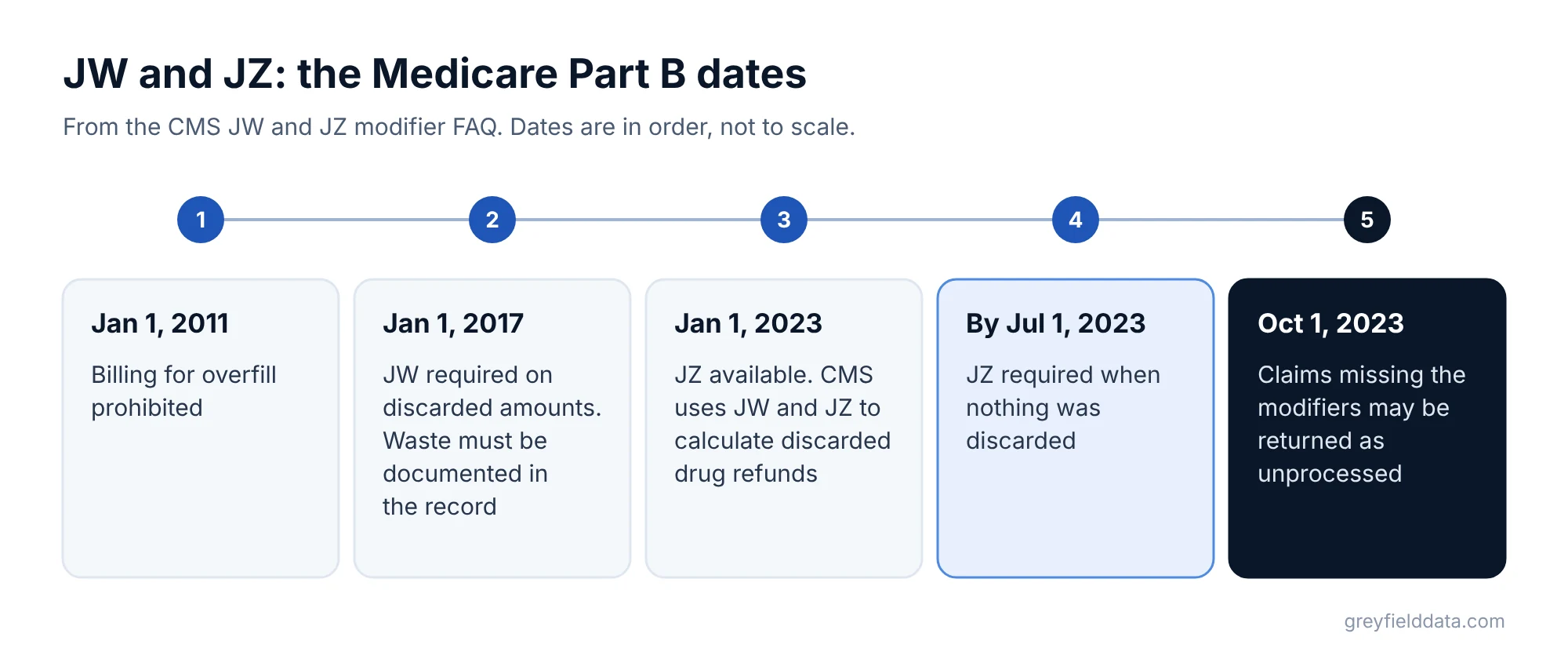
For Medicare Part B, they are required on claims for separately payable drugs from single-dose containers. Here are the key dates from the CMS FAQ.
- January 1, 2017: JW required on discarded amounts from single-dose containers, and the discarded amount must be documented in the medical record.
- January 1, 2023: JZ available to use, and CMS starts using both modifiers to calculate discarded drug refunds.
- No later than July 1, 2023: JZ required when there is no discarded amount.
- October 1, 2023: claims that don't report the modifiers as appropriate "may be returned as unprocessed until claims are properly resubmitted."
Which settings does it cover?
The FAQ says the policy applies to "all providers and suppliers who buy and bill separately payable drugs under Medicare Part B." It adds that the modifiers are mostly reported from the physician office and hospital outpatient settings. For an ambulatory infusion center or office infusion suite billing like a physician office, that means in general every single-dose container drug paid incident to a physician service.
The FAQ also lists where the modifiers don't apply or work differently:
- Hospital outpatient and ASC: only separately payable drugs (OPPS status indicators G and K, ASC payment indicator K2). Packaged drugs (status indicator N, payment indicator N1) are excluded.
- RHCs and FQHCs: not applicable, because drugs there are generally not separately payable.
- Inpatient (IPPS) claims: not intended for use.
- Certain vaccines: not required for the vaccines in section 1861(s)(10) of the Social Security Act, such as influenza, pneumococcal, and COVID-19.
- Multiple-dose containers: "not appropriate."
Which drugs need them?
CMS publishes a list of HCPCS codes to which only single-dose containers are assigned, on its ASP billing resources page. The FAQ is clear that the list is not all-inclusive, and that drugs from single-dose containers still need the modifiers even if they are excluded from the refund (for example, multiple source drugs). The FAQ also says the modifiers are required for single-dose container drugs billed with a not otherwise classified (NOC) code in the physician office.
How do you bill each case?
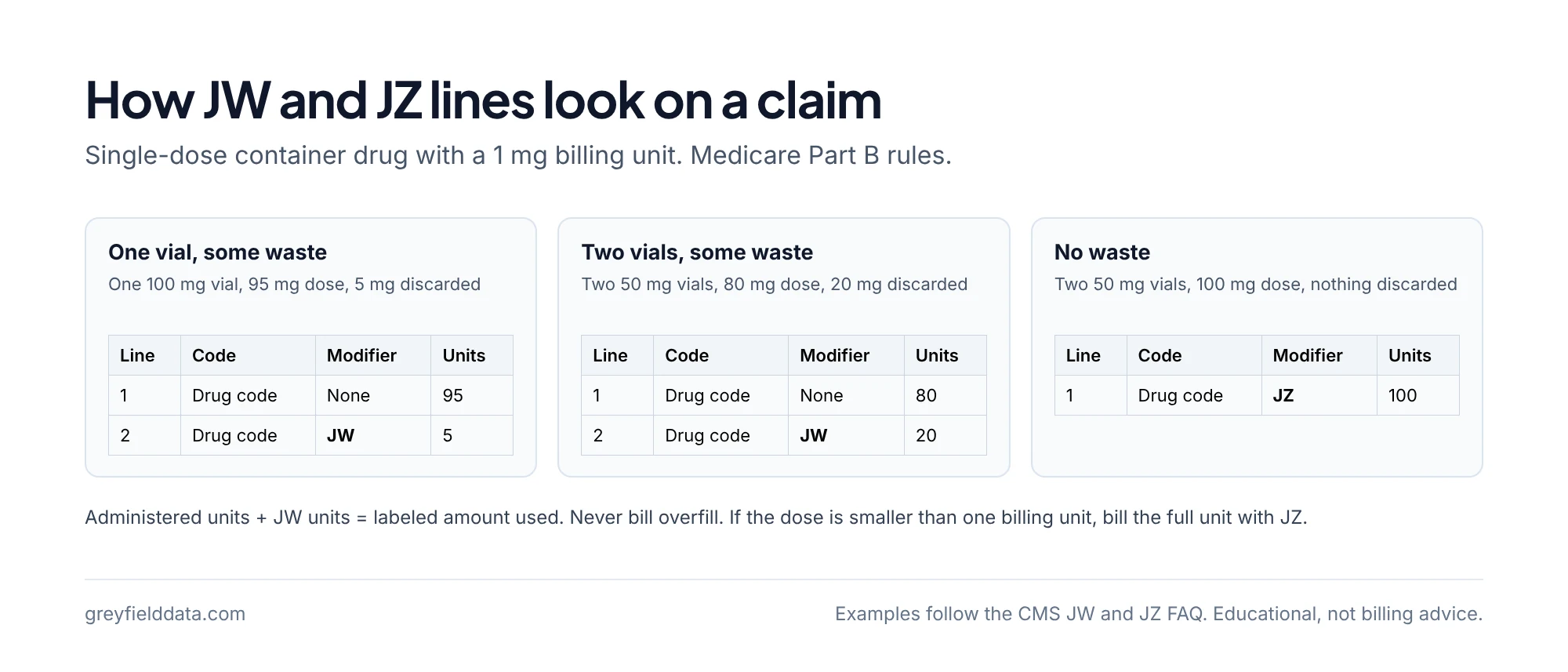
The FAQ gives worked examples. These follow the same patterns with 1 mg billing units:
Some drug was discarded
Bill two lines with the same HCPCS code. The first line has the administered units and no modifier. The second line has the discarded units and JW. This applies even if you used more than one vial.
CMS's example: two 50 mg vials used to prepare an 80 mg dose, with a 1 mg billing unit. Bill 80 units on the first line with no modifier, and 20 units on the second line with JW. Check: 2 × 50 = 100 mg labeled, minus 80 mg dose, equals 20 mg discarded.
Nothing was discarded
Bill one line with the HCPCS code, the administered units, and JZ. CMS's example: two 50 mg vials used for a 100 mg dose are billed as 100 units with JZ.
The dose is smaller than one billing unit
CMS doesn't use fractional billing units. The FAQ says JW "should not be used when the dose of the drug administered is less than the billing unit." Bill the full billing unit with JZ.
Very large doses
A claim line holds at most 9,999 units. The FAQ explains how to split larger doses across lines:
- Full 9,999-unit lines carry JZ.
- The remainder of the administered amount goes on a line with no modifier.
- The waste goes on a JW line. If there is no waste, every line carries JZ.
Overfill
Overfill is drug in the container beyond the labeled amount. CMS has prohibited billing for overfill since January 1, 2011. The FAQ also says JW "must not be used to report discarded amounts of overfill."
What documentation does CMS expect?
CMS expects the discarded amount to be documented in the medical record, along with accurate purchasing and inventory records.
The FAQ says CMS has no specific requirement about the method, format, who records it, or where in the record it goes. It adds that a software calculation is acceptable "as long as the discarded amount is accurately documented." Your MAC may have more detail, so check its guidance too.
In practice, the record for each administration should let someone recompute the waste: drug, NDC, number and size of containers used, the dose given, and the amount discarded. A weekly list of administrations with no waste record is one of the eight lists in the red flag reports guide.
How do you check your claims data?
You can audit JW and JZ use with claim-line data, and you don't need a new tool to start. Run these checks on the last 90 days of Medicare Part B claims for single-dose container drugs.
| Check | What it finds | Grain |
|---|---|---|
| Single-dose drug lines with neither JW nor JZ | Lines at risk of being returned as unprocessable | Claim line |
| JW line with no matching administered line for the same code and date | Claims likely to fail CMS's pairing edit | Claim × HCPCS code |
| Same code billed with JZ and JW on one claim, under 9,999 units | Conflicting attestations | Claim × HCPCS code |
| JW or JZ on a drug from a multiple-dose container | Modifier used where it doesn't apply | Claim line |
| Administered units + JW units ≠ labeled container units used | Waste under-billed or over-billed, or overfill billed | Administration |
| Billed JW units vs waste documented in the EHR | Waste that was recorded but never billed | Drug × week |
| JW units per administration by drug and site | Outliers worth a closer look | Drug × site × month |
The fifth check needs the container size and the number of containers used, which usually live in documentation or inventory data rather than the claim. That is the join that finds unbilled waste: compare what came out of inventory with what was billed, including JW units. If you use WeInfuse, the WeInfuse inventory report guide shows where vial counts sit, and used inventory vs approved supply explains why the two counts differ.
A worked check
Synthetic example. A center's claims for one drug with 1 mg billing units show 40 administrations in a month. Each used two 50 mg vials for an 80 mg dose. Expected billing per administration: 80 administered units plus 20 JW units. Across 40 administrations, that is 40 × 80 = 3,200 administered units and 40 × 20 = 800 JW units.
Claims show 3,200 administered units but only 640 JW units. The gap is 800 − 640 = 160 units, or 160 ÷ 20 = 8 administrations where the waste line is missing. The next step is to pull those 8 records and see whether waste was documented and not billed, or not documented at all. To put a monthly dollar figure on gaps like this, try the infusion revenue leakage calculator.
Do commercial payers require JW and JZ?
It depends on the payer. The CMS rules above are Medicare Part B rules.
Commercial plans, Medicare Advantage plans, and Medicaid programs publish their own policies, and some follow CMS while others don't. Read each payer's current reimbursement policy and contract, and track modifier-related denials by payer in your denial analysis.
What to do next
Run the first two checks in the table on your last 90 days of claims. If you find lines with neither modifier, or JW lines without a paired line, fix the charge capture rule before the next billing cycle.
Then add waste units to your weekly reporting. The 12 weekly reports guide shows how, and the infusion center KPI glossary defines waste units billed. The revenue cycle dashboards guide shows where waste sits on a billing dashboard, and the buy-and-bill margin calculator shows what unbilled waste does to drug margin. For the full reporting picture, start with the WeInfuse reporting guide or the infusion center metrics white paper.
Joining documentation, inventory, and claims data so missing waste lines show up automatically is part of my WeInfuse reporting service. If you want help with it, book a call with me.
WeInfuse is a trademark of its owner. Greyfield Data is independent and not affiliated with WeInfuse.
Frequently asked questions
What is the difference between the JW and JZ modifiers?
JW reports the units of a single-dose container drug that were discarded. JZ attests that no amount was discarded. You use one or the other for each single-dose container drug on a Medicare Part B claim.
When did the JZ modifier become required?
CMS made JZ available on January 1, 2023 and required it no later than July 1, 2023. Since October 1, 2023, claims missing the modifiers where they apply may be returned as unprocessable.
Do JW and JZ apply to multiple-dose vials?
No. The CMS FAQ says the modifiers are not appropriate for drugs from multiple-dose containers.
Can I bill overfill with the JW modifier?
No. CMS prohibits billing for overfill, and the FAQ says JW must not be used to report discarded overfill.
Where can I find the official JW and JZ rules?
Start with the CMS JW and JZ modifier FAQ, the code list on the ASP billing resources page, and chapter 17 of the Medicare Claims Processing Manual. Then check your MAC's guidance.
Part of the Infusion analytics guides, a reading path through related articles.
Linus Tse
Founder of Greyfield Data. Built 400+ dashboards. Certified in Sigma, Snowflake, Tableau, and Power BI.
About Linus