Is drug used at visits the same as approved supply or treatments left?
Drug used at visits, approved supply and treatments remaining are three different infusion numbers. Where each comes from, and why one can't replace another.

Written by Linus Tse, founder of Greyfield Data
· 7 min read
On this page 9 sections
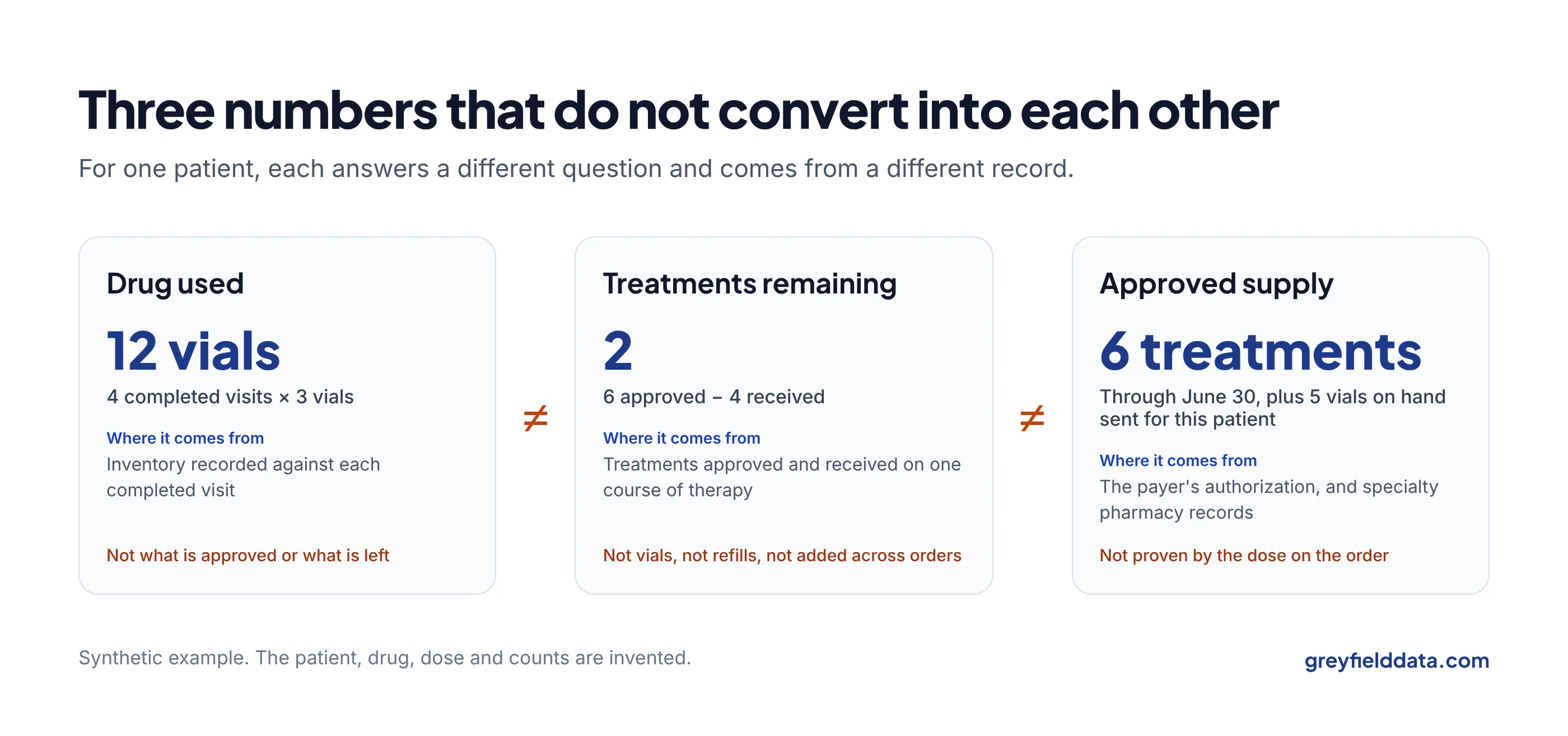
No. Drug used at visits is what went into patients: the vials or units recorded against completed appointments. Approved supply is what the payer or program has approved, or what a specialty pharmacy has sent for a patient. Treatments remaining is approved treatments minus treatments received on one course of therapy. They come from different records, count different things, and cannot be converted into each other without drug-specific rules.
I have built program and inventory reports for ambulatory infusion centers and manufacturer programs where these three numbers had to be kept apart. If a report or a program is asking you for one of them, see WeInfuse reporting help, or book a 30-minute call.
Key takeaways
- Drug used counts vials or units given at completed visits. It tells you what happened, not what is approved.
- Treatments remaining is treatments approved minus treatments received for one course of therapy. It counts visits, not vials, and it is not prescription refills.
- Approved supply is what a payer approved or a pharmacy shipped. A dose on an order does not prove it.
- Converting visits into vials needs the drug's own rules and the patient's dose. Do not guess it in a spreadsheet.
- When a report asks for a number your system does not hold, leave it blank and say so, rather than filling it with a close substitute.
What are the three numbers?
They are drug used, treatments remaining and approved supply. Each comes from a different record.
| Number | What it counts | Where it comes from | What it is not |
|---|---|---|---|
| Drug used | Vials or units given at completed visits | Inventory recorded at each visit | Approved supply, or what is left |
| Treatments remaining | Visits still approved on one course of therapy | Treatments approved minus received, on the order or authorization | Vials, refills, or a patient-wide count |
| Approved supply | What a payer approved, or a pharmacy shipped for the patient | The authorization, and specialty pharmacy records | Proven by the dose on the order alone |
Each answers a different question.
- Drug used answers "what did we give?".
- Treatments remaining answers "how many more visits are covered?".
- Approved supply answers "what are we allowed, or do we have, for this patient?".
Where does each number live in WeInfuse?
If your center uses WeInfuse, these are the places I look. The field names come from WeInfuse's own data dictionary. For the wider map of WeInfuse reports, start with the WeInfuse reporting guide.
Drug used
Inventory items carry the appointment they were used on (the field is Inventory Items Actual Appointment ID), along with the NDC, lot and units for billing. There is also a field for the number of vials, Inventory Items Nbr of Vials. When I checked it, it was tied to the inventory packages used at completed visits. That makes it a count of what was used, not of what is approved or left.
Treatments remaining
Order series, one course of treatment on an order, carry Treatments Approved and Treatments Received. On one program, we defined treatments remaining as approved minus received, for each order series. The authorization records have their own treatments approved and received too, so say which one your report uses. The expiring authorizations report uses the same fields to flag visits that are running out of cover.
Approved supply
The authorization carries the payer's decision: status, treatments approved and an expiry date. For specialty pharmacy drug sent for one patient, WeInfuse keeps specialty inventory separate from buy-and-bill stock. Neither is the same as the dose written on the order. The inventory on hand report shows how to count stock without mixing the two.
How do the three numbers differ for one patient?
For one patient they give three different answers, and none of them is "vials still needed".
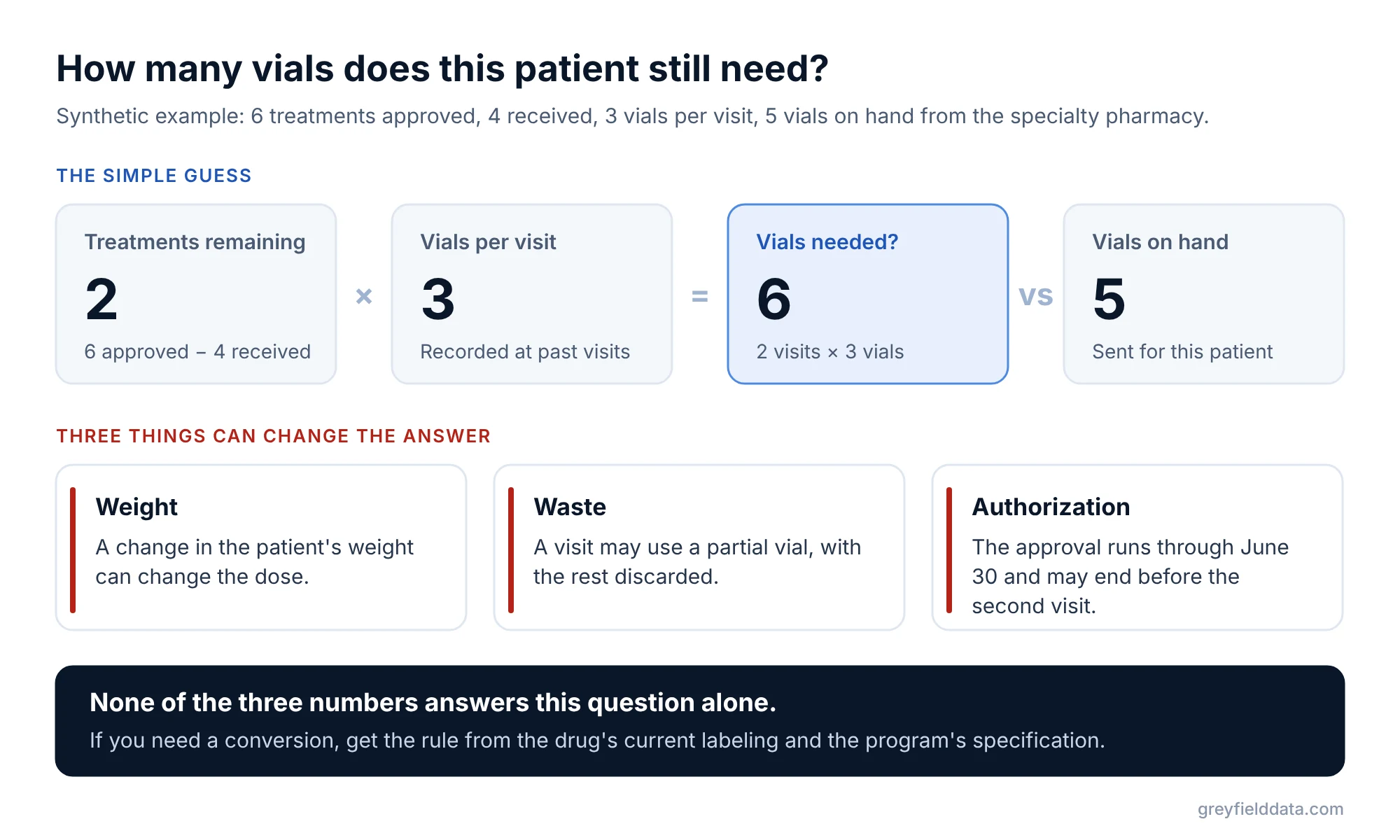
Synthetic example. One patient on a weight-based drug, three vials per visit.
| Number | Value | How it was worked out |
|---|---|---|
| Treatments approved | 6 | From the authorization, valid through June 30 |
| Treatments received | 4 | Completed visits on this course |
| Treatments remaining | 2 | 6 − 4 |
| Drug used | 12 vials | 4 visits × 3 vials recorded at each visit |
| Specialty drug on hand for this patient | 5 vials | Sent by the specialty pharmacy, not yet used |
Now try to answer "how many vials does this patient still need?". Two visits at three vials is six. But three things can change that:
- the patient's weight may change the dose
- a visit may use a partial vial with the rest discarded
- the authorization may end before the second visit
The 5 vials on hand do not cover 6, but whether that matters depends on the date of the next visit and the next approval. None of the three numbers answers the question alone.
Why do reports mix them up?
Because they sit near each other and look like they should add up. Three mistakes I see:
- Using vials used as "remaining vials". A program asks for remaining supply, and the nearest field in the system counts vials used at visits. That field is about the past.
- Calling treatments remaining "refills". A refill is a pharmacy idea. Treatments remaining counts approved visits on one course.
- Adding treatments remaining across orders. A patient with two orders has two courses. Adding them gives a number no payer approved.
On one program, the export had drug-specific rules for converting visits into containers and refills. Those were rules agreed for that one program, not general dosing guidance. If you need a conversion like that, get the rule from the drug's current labeling and the program's specification, and write it down.
What about billed units?
Billed units are a fourth number, and they can include waste on top of what was given. For single-dose vials, Medicare's JW modifier reports the amount discarded and JZ attests that nothing was discarded.
The JW and JZ modifier guide explains when each applies. Rebate and program reports sometimes ask for billed units, given plus discarded, and that is different again from vials used.
What should a report do when a number is missing?
Leave it blank and say why. A visible gap gets fixed, but a close substitute that looks right does not.
If a program asks for remaining vials and your system only holds treatments remaining and vials used, tell the program what you have and what each means. The free guide Manufacturer Programs Without the Manual Reporting covers how to handle required columns that your system cannot fill. The status vs dispense guide shows a similar mix-up between two program files.
For the definitions behind the related measures, see the infusion center KPI glossary. To see how drug cost and payment drive margin per visit, try the buy-and-bill margin calculator. If specialty pharmacy drug goes unused, the white bagging waste calculator estimates what it costs.
WeInfuse is a trademark of its owner. Greyfield Data is independent and not affiliated with WeInfuse.
Frequently asked questions
How do I calculate treatments remaining for an infusion patient?
Subtract treatments received from treatments approved for one course of therapy, such as one order series. Report it per course, not added up across a patient's orders.
Are treatments remaining the same as refills?
No. Treatments remaining counts approved visits on a course of therapy. Refills are a pharmacy measure and follow different rules.
Can I work out approved vials from the dose on the order?
Not reliably. The approved amount comes from the payer's authorization, and vials per visit can change with weight, dose and waste. Use drug-specific rules from current labeling.
Why doesn't drug used match what the payer approved?
They measure different things. Drug used is what was given at completed visits; approved supply is what the payer allowed. Gaps are normal until the course ends.
What to do next
Pick one report that mentions supply, vials or remaining treatments, and write next to each column which of the three numbers it really is. If any column is a stand-in for something else, fix the label or leave it blank. The WeInfuse data guide lists where each field sits for whoever builds the report.
If you want help sorting out a program report like this, book a call.
Part of the Infusion analytics guides, a reading path through related articles.
Linus Tse
Founder of Greyfield Data. Built 400+ dashboards. Certified in Sigma, Snowflake, Tableau, and Power BI.
About Linus