Choosing an infusion analytics partner: criteria and questions
How to choose an infusion analytics partner: the five kinds of help available, the criteria that matter, questions to ask, red flags, and when not to hire one.

Written by Linus Tse, founder of Greyfield Data
· 9 min read
On this page 9 sections
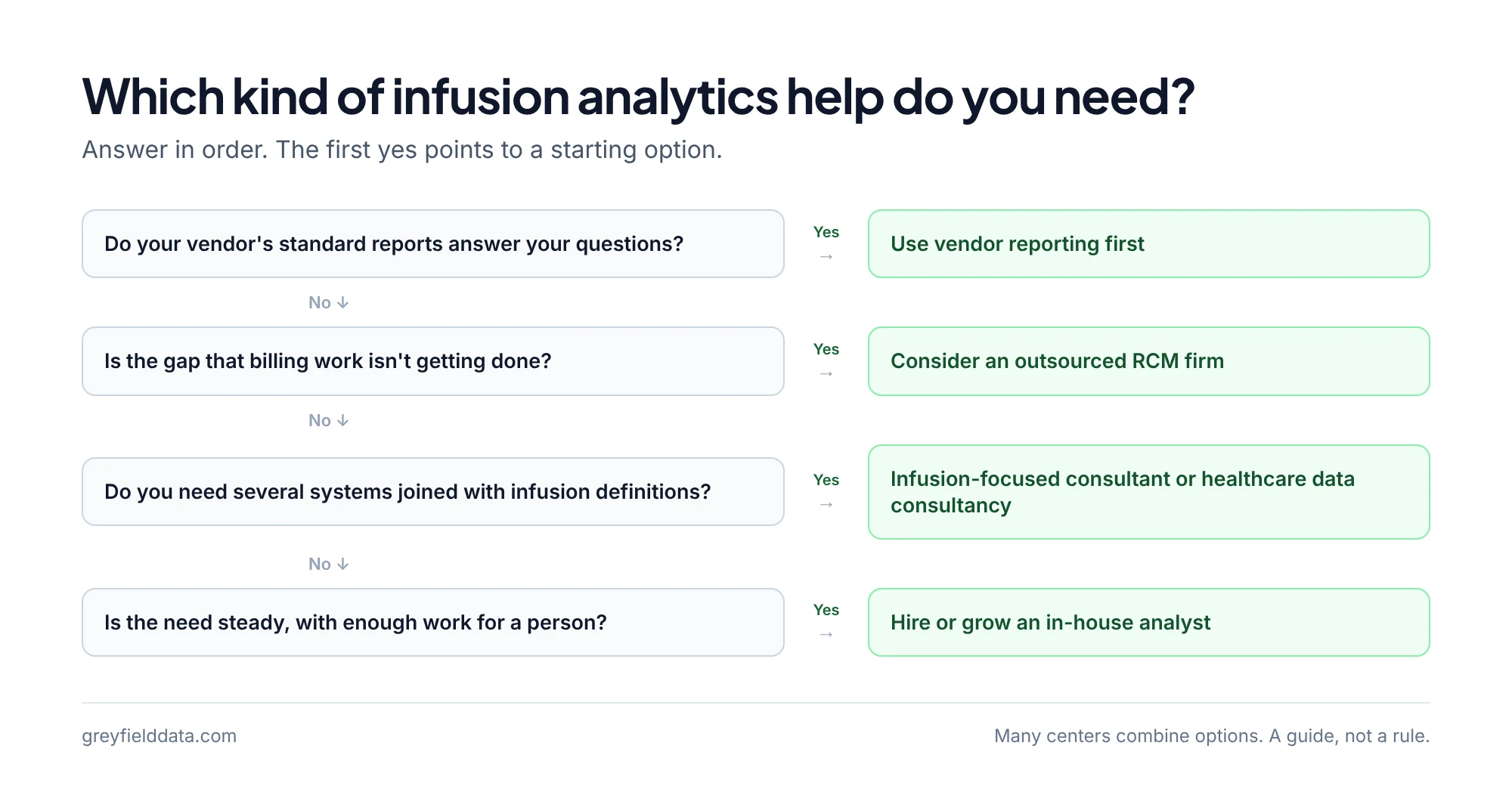
Choose an infusion analytics partner by first deciding what kind of help you need. The options are better reports inside the systems you already run, an outsourced revenue cycle team that also reports, a data warehouse that joins several systems, or an analyst on staff. Then test any partner on whether they understand infusion data (orders, authorizations, administrations, claim lines, waste) and whether they write definitions down before they build.
Greyfield Data is one option: an independent consultancy that builds infusion reporting, including WeInfuse reporting on its embedded Looker, and joins it with billing and remittance data. This guide is written to be useful whoever you hire. If you are not sure what you need yet, the 12 weekly reports guide is a good way to find out which questions you can't answer today.
Disclosure. Greyfield Data wrote this guide and sells infusion analytics services. It is a criteria guide rather than a list of firms, because I could not verify enough infusion-specific analytics firms from their own websites to make a fair list. If you know of one that should be considered, email me.
Key takeaways
- There are five kinds of help: your EHR or practice management vendor's reporting, an outsourced revenue cycle (RCM) firm, a general healthcare data consultancy, an infusion-focused analytics consultant, or an in-house analyst. Pick the kind before the firm.
- The best test of infusion experience is how they count. Ask how they would count referrals, visits, and billed units, and whether they know one order has many appointments.
- Ask who owns the definitions, the code, and the data account at the end, and who runs it after launch.
- A partner should be able to explain where your data can't answer a question, such as utilization without check-in times, rather than promising every metric.
- Sometimes the right answer is not to hire anyone yet. If you have one site and standard reports answer your questions, use them.
Quick answers
- Billing work isn't getting done: an outsourced RCM firm.
- One site, and standard reports answer your questions: your EHR vendor's built-in reports.
- Several systems need joining: an infusion-focused consultant, or a data consultancy for very large groups.
- Steady, ongoing reporting needs: an in-house analyst, with backup.
- Biggest red flag: a dashboard demo before anyone asks about your definitions.
What kinds of infusion analytics help are there?
Five kinds of help cover most of what infusion operators buy. They solve different problems, and many centers use more than one.
| Option | Best for | Strengths | Limits |
|---|---|---|---|
| EHR or practice management vendor reporting | Standard operational reports in one system | Already paid for; data is current; vendor knows its own model | Usually limited to that system's data; custom fields and joins may not be possible |
| Outsourced RCM firm with reporting | Centers that want billing worked as well as reported | Denials, AR, and posting handled by the same team that reports them | Reports usually cover their own work, not intake, scheduling, or inventory |
| General healthcare data consultancy | Larger organizations building a warehouse across many systems | Engineering depth; experience with large data platforms | May learn infusion billing, grain, and waste on your budget |
| Infusion-focused analytics consultant | Operators who need infusion EHR, billing, and remittance data joined with infusion-specific definitions | Knows the order-to-administration model, authorizations, units, and waste | Usually smaller teams; check capacity and who runs it after launch |
| In-house analyst | Centers with steady, ongoing reporting needs | Knows the business; always available | Needs data access, tools, and someone to learn from; one person is a single point of failure |
What criteria matter most?
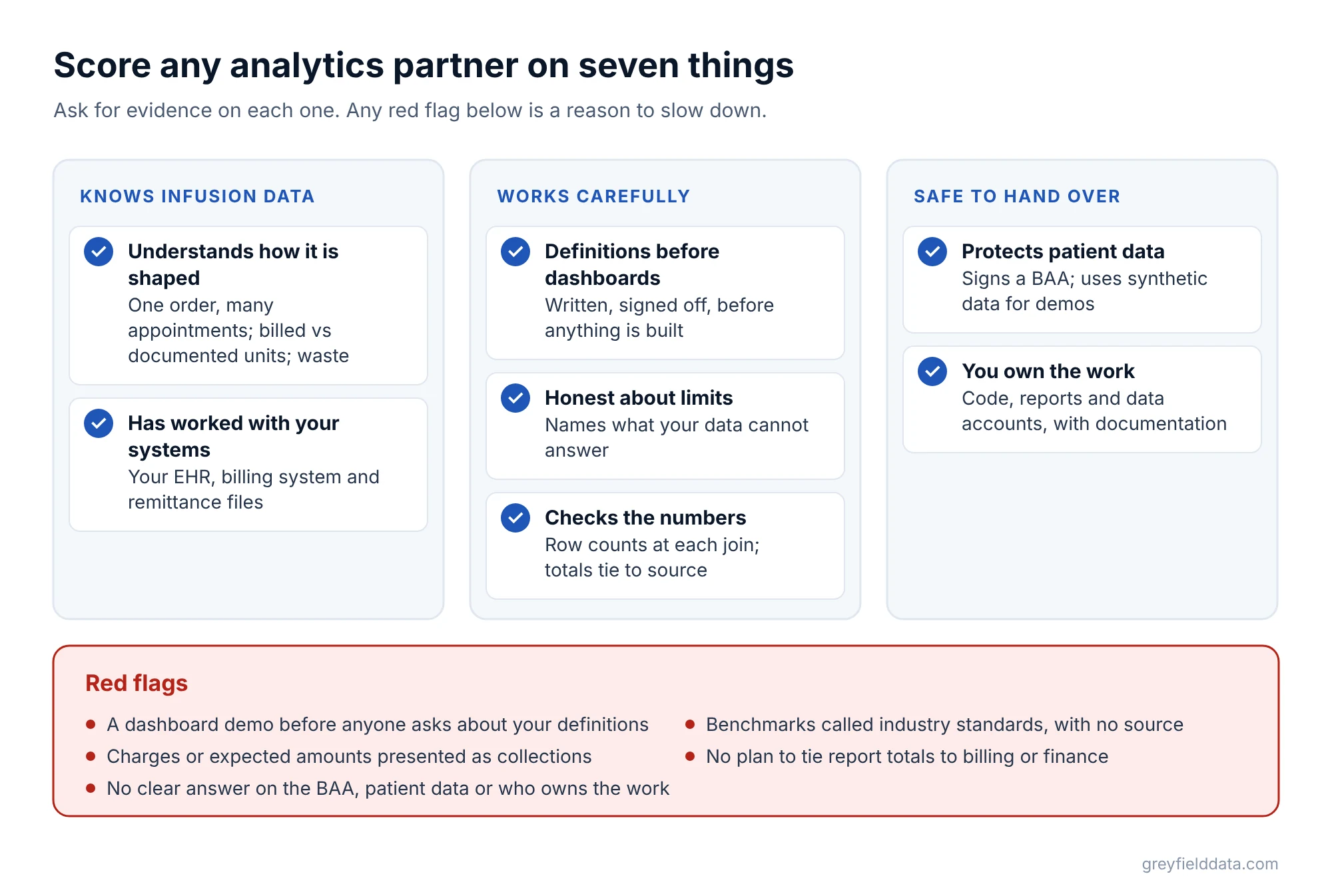
Score each candidate on the criteria below, and ask for evidence rather than claims.
Do they understand how infusion data works?
The partner should know how infusion data is shaped: one order has many appointments, an appointment can have several administrations, and a claim can cover several administrations. They should know the difference between billed units and documented units, how waste is billed with the JW and JZ modifiers, and why authorization dates matter for scheduling.
Have they worked with your systems?
Ask whether they have worked with your infusion EHR, your billing system, and your remittance files. If you run WeInfuse, ask whether they have built reports in its embedded Looker, how they avoid double-counted rows, and how they get data out. The WeInfuse reporting guide covers what to expect.
Do they write definitions before dashboards?
A good partner writes down each metric's numerator, denominator, what one row counts, and which date it runs from before building anything, and gets your sign-off. The infusion center KPI glossary shows the format.
Are they honest about what your data can't answer?
Ask what your data can't answer. A partner who says "everything" hasn't looked.
Common limits: utilization from scheduled times rather than actual chair times, turnaround times when stage history isn't stored, and revenue when only expected amounts are available rather than payments.
How do they check that the numbers are right?
Ask how they check that numbers are right: row counts at each join, reconciliation of report totals to source totals, and checks that scheduled exports didn't skip a window. A successful export run doesn't prove the data is complete. The infusion data feeds white paper lists the checks worth asking for.
How will they protect patient data?
Infusion data includes PHI. Ask whether they will sign a business associate agreement (BAA), how they access your systems, whether they use synthetic data for demos, and where any copied data will live.
Who owns the work at the end?
Ask who owns the code, the reports, and any data accounts at the end, and what documentation you'll get. Ask who will run it after launch: them, your team, or both. Multi-site groups choosing a partner for a data warehouse should also read the infusion data warehouse guide for CFOs and its companion CFO white paper.
What questions should you ask?
- How would you calculate referral-to-first-treatment time, and what timestamps do you need from us?
- How would you count completed visits so that a check-in with no drug given is excluded?
- How do you sum billed drug units, and do they include waste?
- Which of our metrics can't be built from the data we have today?
- Show me a definition document from a past project, with client details removed.
- Who will do the work, and who will I talk to each week?
- What happens if you are unavailable for a month?
What are the red flags?
- A dashboard demo before anyone has asked about your definitions or your data.
- Benchmarks presented as industry standards with no source.
- Revenue figures built from billed charges or expected amounts, presented as collections.
- No plan to reconcile report totals with your billing or finance numbers.
- No clear answer on BAA, PHI handling, or who owns the work.
When should you not hire Greyfield Data?
Here is where I'd point you elsewhere.
- You want your billing worked, not just reported. Greyfield doesn't post payments, work denials, or file appeals. An RCM firm is the better fit.
- Your vendor's standard reports answer your questions. If you run one site and the built-in reports cover what you need, use them and spend the money elsewhere.
- You need a large team on site. Greyfield is a small, senior-led consultancy. If you need many people embedded full time, a larger firm fits better.
- You need clinical or coding advice. Greyfield builds reporting on billing data; it doesn't give billing, coding, or legal advice.
Where Greyfield is a good fit
- You run an infusion EHR such as WeInfuse and need reports, data feeds, or exports its standard reports don't give you.
- You need infusion EHR, billing, and remittance data joined so revenue leakage, denials, and referral stalls show up in one place.
- You need data feeds to a manufacturer, hub, or CRM with agreed definitions and validation.
Examples of work I've done, anonymized:
- A consistent per-visit value for a multi-site infusion center's referral development team, built from billing units per administered visit.
- A repeatable connector that pulls an infusion EHR's reports for a hub-services company onboarding new centers.
- A referral-targeting view built on public Medicare provider data for a group expanding into new markets.
More about my background is on the about page.
WeInfuse is a trademark of its owner. Greyfield Data is independent and not affiliated with WeInfuse.
What to do next
Write down the three questions you most need answered, then use the criteria above to decide which kind of partner fits.
If the questions are about lost referrals, the referral leakage calculator gives you a number to start the conversation. The infusion data readiness check shows how much groundwork your data needs first. If you'd like to talk through whether Greyfield is a fit, or who else might be, book a call with me.
Frequently asked questions
What does an infusion analytics consultant do?
They join and model your infusion data (orders, authorizations, appointments, administrations, claims, remittances, and inventory) so you can measure intake, capacity, revenue, and drug use with agreed definitions. Some also build data feeds to manufacturers, hubs, or CRMs.
Do I need an analytics partner or an RCM company?
If the problem is that billing work isn't getting done, you need an RCM company. If the work is getting done but you can't see where revenue or referrals are lost, you need analytics. Some centers need both.
Can our EHR's built-in reports replace an analytics partner?
Often, for single-system operational reports. They usually can't join data from your billing system, remittances, bank, or CRM, which is where denials, underpayments, and deposits live.
How long does an infusion analytics project take?
It depends on scope and data access. A first set of operational reports from one system can take weeks; joining several systems into a warehouse takes longer. Ask any partner for a phased plan with the first useful report early.
Should an analytics partner sign a BAA?
Yes, if they will access PHI. Ask before you share any data, and ask whether they can work with synthetic or de-identified data where possible.
Part of the Infusion analytics guides, a reading path through related articles.
Linus Tse
Founder of Greyfield Data. Built 400+ dashboards. Certified in Sigma, Snowflake, Tableau, and Power BI.
About Linus