AI in infusion operations: where it helps and how to vet a vendor
Where AI helps infusion operations, from referral intake to eligibility and work queues, and how to vet a vendor on the task, its outputs, and the full cost.

Written by Linus Tse, founder of Greyfield Data
· 8 min read
On this page 7 sections
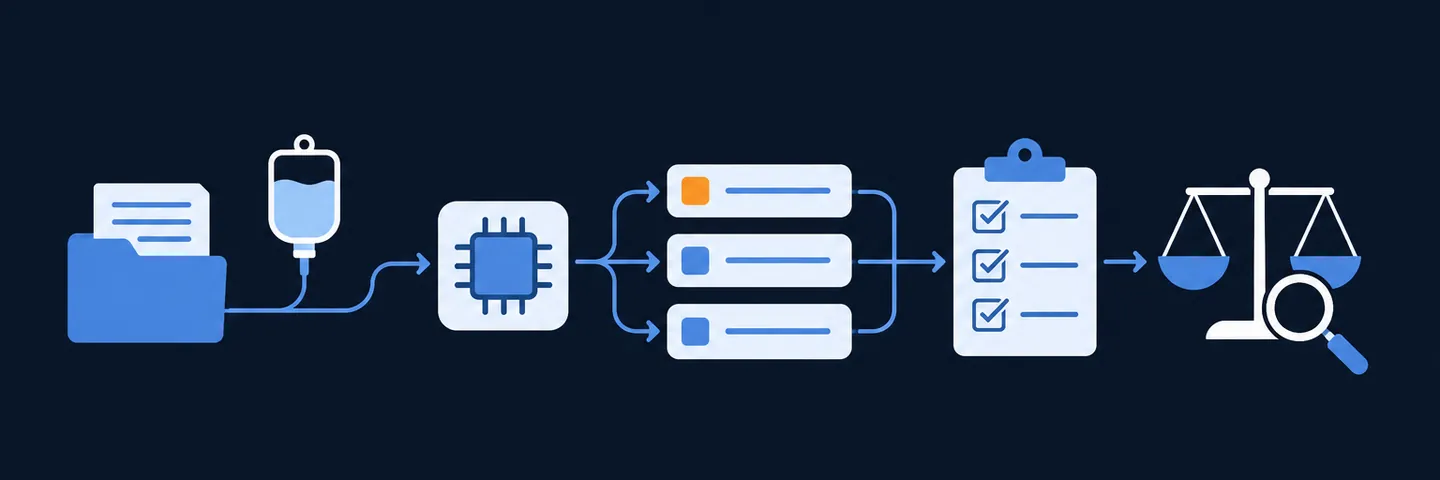
AI helps infusion operations most on narrow, repetitive tasks with a clear right answer that a person can check. Examples are reading referral faxes into structured fields, running eligibility checks, pulling data out of clinical documents, and ranking work queues. It helps least where the input is messy and nobody checks the output. Before buying, verify the exact task, audit a sample of its outputs, and add up the full cost, including staff time to review.
I build the data side of this work for infusion providers. That means getting order, authorization, and billing data out of the infusion EHR and into a shape that a person, a report, or a model can use. If you're weighing an AI tool and want a second opinion on whether your data can support it, that is part of the infusion analytics work I do. If your real question is how much your intake funnel is leaking, the referral leakage calculator sizes it first.
Key takeaways
- AI earns its keep in infusion on narrow, checkable tasks: document intake, eligibility, field extraction, and ranking queues.
- Ask any vendor to name the exact task, the input, the output, and who checks it. "AI-powered intake" is not a task.
- Audit outputs on your own documents. A sample of real referrals, scored field by field against what a person entered, tells you more than a demo.
- Count the fully loaded cost: license, setup, integration, and the staff time spent reviewing and correcting outputs.
- AI on top of messy data automates the mess. Agreed definitions and clean keys usually come first.
Where does AI genuinely help in infusion operations?
AI helps where the work is high volume, follows a pattern, and has an answer a person can verify. These are the infusion tasks where I see that fit best.
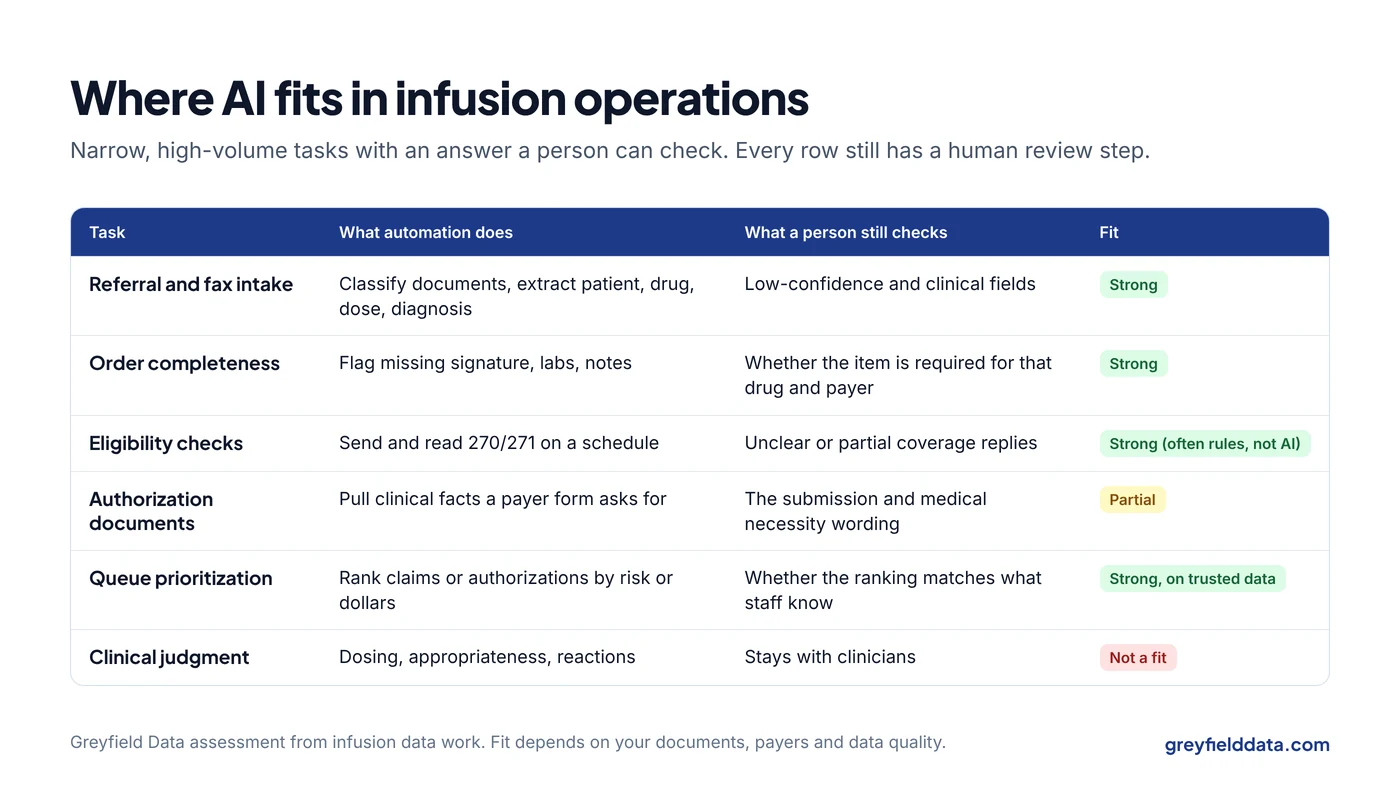
| Task | What AI or automation does | What a person still checks |
|---|---|---|
| Referral and fax intake | Reads faxed orders and records, classifies the document, extracts patient, drug, dose, diagnosis, and prescriber | Fields the tool marked low confidence; anything clinical |
| Order completeness | Flags missing items: signature, diagnosis, labs, notes | Whether the missing item is truly required for that drug and payer |
| Eligibility checks | Sends and reads electronic eligibility requests on a schedule | Plans that return unclear or partial coverage detail |
| Document extraction for authorizations | Pulls the clinical facts a payer form asks for from the chart | The submission itself, and medical necessity language |
| Queue prioritization | Ranks claims, authorizations, or follow-ups by risk or dollars | Whether the ranking matches what the team knows |
| Call and message summaries | Summarizes payer calls or patient messages into the record | Accuracy before it becomes the record |
Referral and fax intake
Referral intake is the clearest fit. Orders still arrive as faxes and PDFs, and staff re-key them. A tool that classifies documents and extracts fields into the EHR removes typing, and the output is easy to check against the source page.
The risk is quiet errors. A dose or diagnosis code read wrong and never checked becomes a denial or a safety problem later. Insist on confidence flags and a review step for clinical fields. The referral to first treatment guide shows where intake time goes, so you can measure whether the tool actually shortens it.
Eligibility and benefits
Eligibility checks are already electronic in many cases. The X12 270 request and 271 response are standard HIPAA transactions, and Medicare runs its own eligibility transaction system. Automation here often means running checks on a schedule (say, before every visit) rather than any AI.
Benefits investigation for infusion drugs is harder, because medical-benefit drug coverage and authorization rules often aren't in the 271 response. That still involves portals and phone calls.
Prior authorization
Prior authorization is where expectations run ahead of reality. CMS's interoperability and prior authorization final rule (CMS-0057-F) requires impacted payers to build prior authorization APIs, but its prior authorization provisions exclude drugs. For infusion drug authorizations, don't assume that rule will standardize the process. AI can still help gather the clinical facts a form asks for. Submission and follow-up remain largely manual. The prior authorization denials by payer guide shows which payers reject or refuse the most requests.
Prioritization
Ranking work queues is where analytics and AI meet. Ranking only works on top of reports people already trust, such as the 12 weekly infusion reports. Sorting claims by dollars at risk, or authorizations by days to expiry times scheduled visits, needs no large model. The denial prediction guide shows the dollars-at-risk method with a worked example.
Where does AI not help yet?
AI helps least where the right answer is unclear, or where a wrong answer is costly and nobody checks it.
- Clinical judgment. Dosing, appropriateness, and reactions stay with clinicians.
- Fixing bad source data. A model can't decide which of two site names is the real one. A person has to write that mapping once.
- Problems that are really process. If authorizations expire because nobody owns renewals, an alert helps only once someone owns it. A plain red flag report with a named owner often does more than a model.
- Questions your data can't answer. If you can't tie a claim back to the order and authorization, no model can either.
How do you evaluate an AI vendor for infusion?
Evaluate the vendor on three things: the exact task, the quality of its outputs on your data, and the full cost.
The NIST AI Risk Management Framework is a useful public reference for the broader questions on governance and monitoring. If you want to see what a narrow, checkable AI task looks like on infusion data, try the infusion data assistant demo, which runs on synthetic data.
Verify the task
Ask the vendor to fill in one sentence:
Given [input], the tool produces [output], which [role] reviews before [action].
If they can't, the product is a platform, not a task. You'll be the one designing the task.
Then ask:
- Which document types and payers has it been tested on?
- What does it do when it isn't sure? Does it flag, guess, or skip?
- Where does the output land: your EHR, a separate queue, a spreadsheet?
- Will they sign a business associate agreement? If the tool touches patient data and they won't, stop.
Audit the outputs
Run the tool on a sample of your own recent documents or claims, where you already know the right answer. Score it field by field, not document by document.
- A referral with nine fields right and the dose wrong is a failure, not "89% accurate."
- Separate errors the tool flagged from errors it was confident about. Confident errors are the dangerous ones.
- Repeat the audit after go-live, monthly at first. Document formats and payer rules change.
Count the fully loaded cost
The license is rarely the biggest number. Add setup, integration, and the ongoing staff time to review outputs.
Here is a synthetic example for a fax intake tool:
| Line | Monthly amount |
|---|---|
| License | $3,000 |
| Staff review: 20 hours at $35 loaded hourly cost | $700 |
| Setup and integration: $6,000 spread over 12 months | $500 |
| Total monthly cost | $4,200 |
| Time saved: 1,000 faxes × 6 minutes = 100 hours at $35 | $3,500 |
| Net monthly result | -$700 |
Synthetic example. Every amount is invented to show the method.
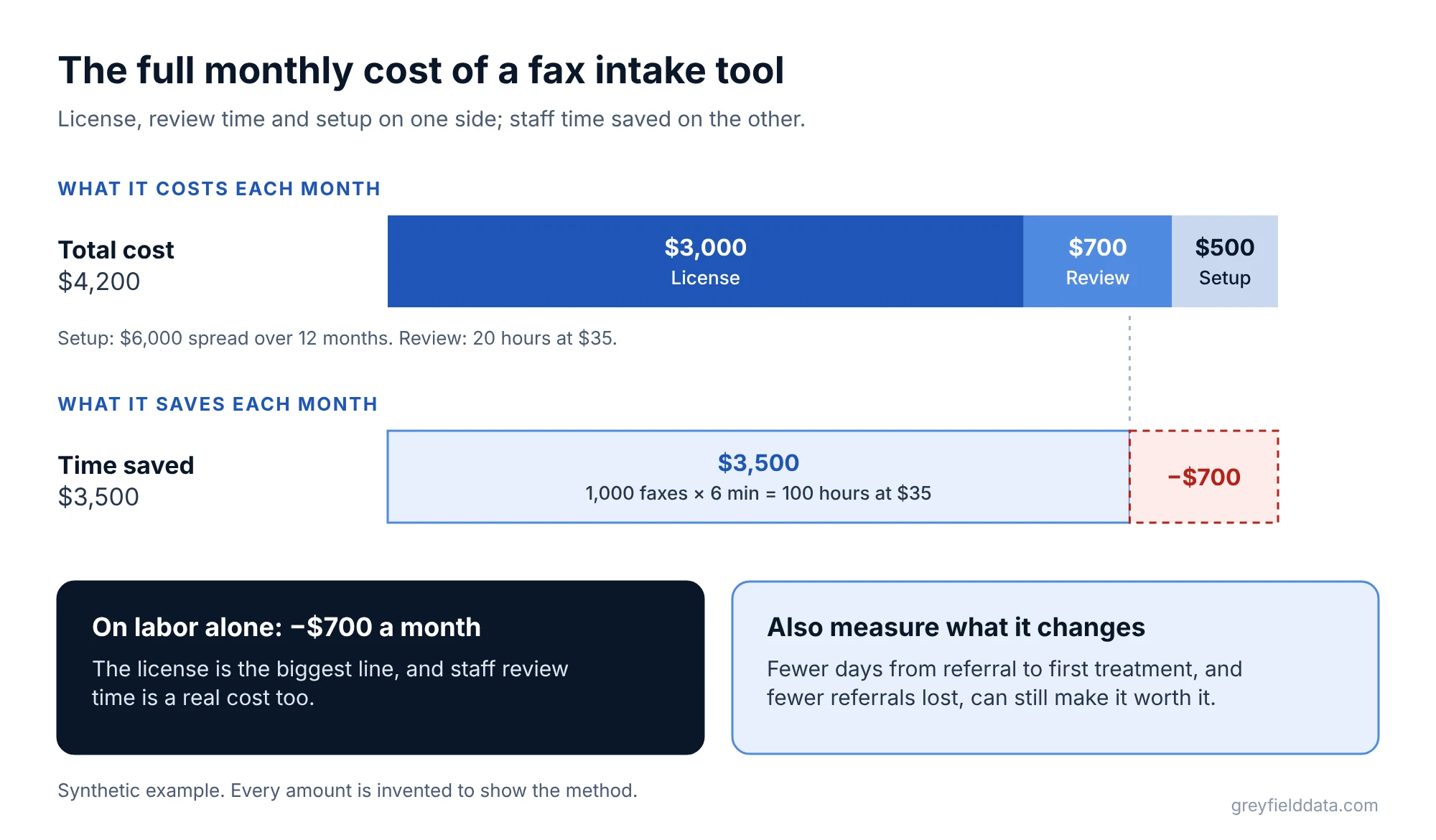
On labor alone, this tool loses money. It may still be worth it if it cuts days from referral to first treatment and fewer referrals drop out, so measure that too. The referral leakage calculator helps put a value on referrals you keep.
What has to be true before AI can help?
Three things have to be true: you know what one line of each report means, your systems agree on who the patient, order, and site are, and someone owns the workflow the tool will feed. That is the middle of the infusion data maturity path, and it is usually where the work is.
The free infusion data readiness check scores where you stand in a few minutes. If your systems still disagree, a single infusion data warehouse that every report reads from is usually the step that comes before any AI tool. The infusion analytics resource hub collects the guides on each step.
What to do next
Pick the one task where staff spend the most repetitive hours. Write the one-sentence task description, and audit a vendor against a sample of your own documents before you sign.
For the KPIs that tell you whether it worked, see the infusion center KPI glossary and the infusion center metrics playbook. The revenue leakage guide shows where automation can recover the most, and the infusion revenue leakage calculator puts a dollar figure on it. If you run an ambulatory infusion center and want help getting your data ready or checking a vendor's claims, book a call with me.
Frequently asked questions
How is AI used in infusion centers?
Mostly for referral and fax intake, document data extraction, eligibility automation, call summaries, and ranking work queues such as claims or authorizations. Clinical decisions stay with clinicians.
Can AI automate infusion prior authorizations?
Partly. It can gather the clinical facts a payer form asks for. Submission and follow-up for drug authorizations still run largely through portals, fax, and phone, and CMS's 2024 prior authorization rule excludes drugs from its prior authorization requirements.
How do I measure whether an AI intake tool is accurate?
Run it on recent referrals where you already know the right answer and score each field. Track confident errors separately from flagged ones, and repeat the audit after go-live.
Is an AI vendor's ROI estimate reliable?
Treat it as a claim to test. Rebuild it with your own volumes, your loaded labor cost, setup and integration costs, and the staff time to review outputs.
Part of the Infusion analytics guides, a reading path through related articles.
Linus Tse
Founder of Greyfield Data. Built 400+ dashboards. Certified in Sigma, Snowflake, Tableau, and Power BI.
About Linus