7 signs your infusion center needs a data warehouse (and 3 signs you don't yet)
Seven signs an infusion center or multi-site group needs a data warehouse as its single source of truth, three signs it can wait, and what to do first.

Written by Linus Tse, founder of Greyfield Data
· 9 min read
On this page 15 sections
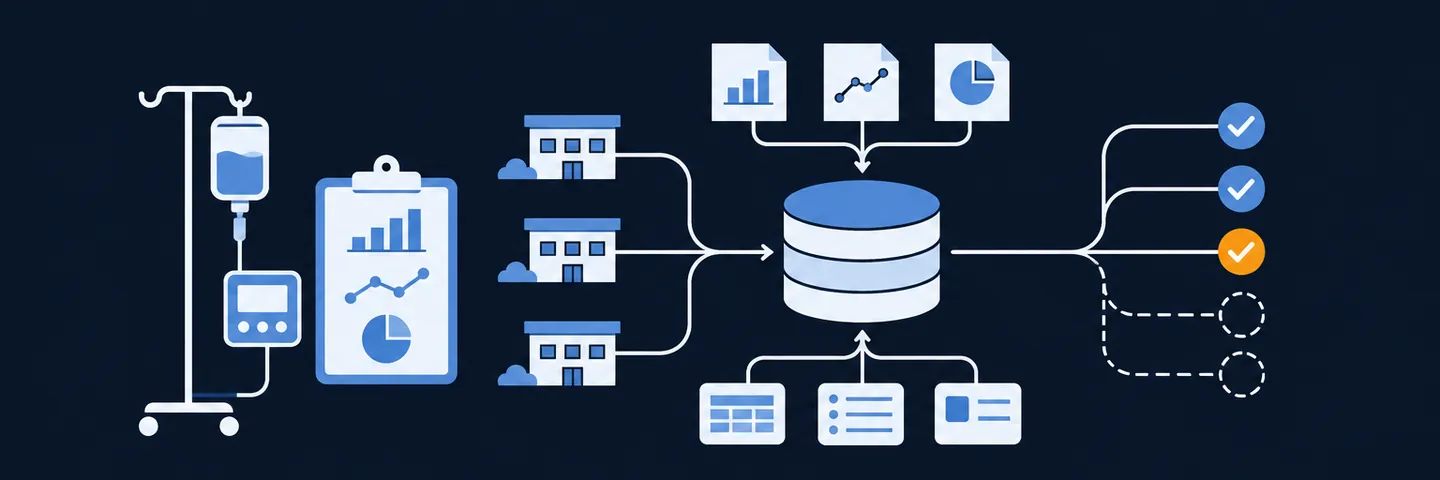
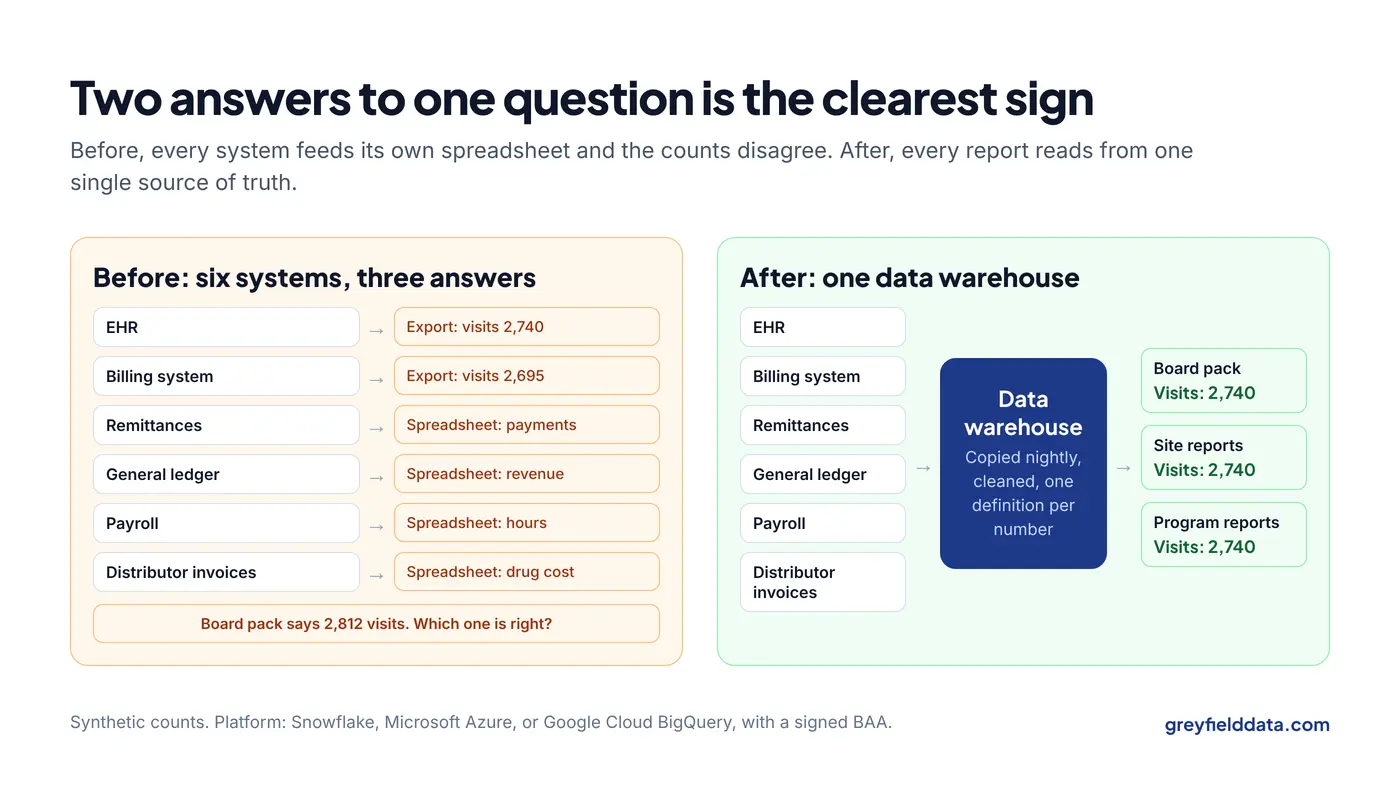
Your infusion center needs a data warehouse when the same question gets different answers from different systems, and people spend days each month stitching exports together to settle it. The usual signs are sites that count differently, billing that lives outside the EHR, board numbers that don't tie to the books, and program reports rebuilt by hand. If you run one site and your EHR's reports answer your questions, you can wait.
An infusion data warehouse is one secure database that holds copies of your EHR, billing, ledger, and inventory records, cleaned up so every site is counted the same way. It becomes your single source of truth. Building one for multi-site infusion groups is the work I do. The free white paper All Your Infusion Data in One Place explains how it works in plain words.
Key takeaways
- A data warehouse is worth it when combining systems by hand costs more than the warehouse, or when nobody trusts the combined number.
- The strongest sign is two answers to one question, such as two visit counts for the same month at the same site.
- Multi-site groups feel it first, because every new site adds its own way of counting.
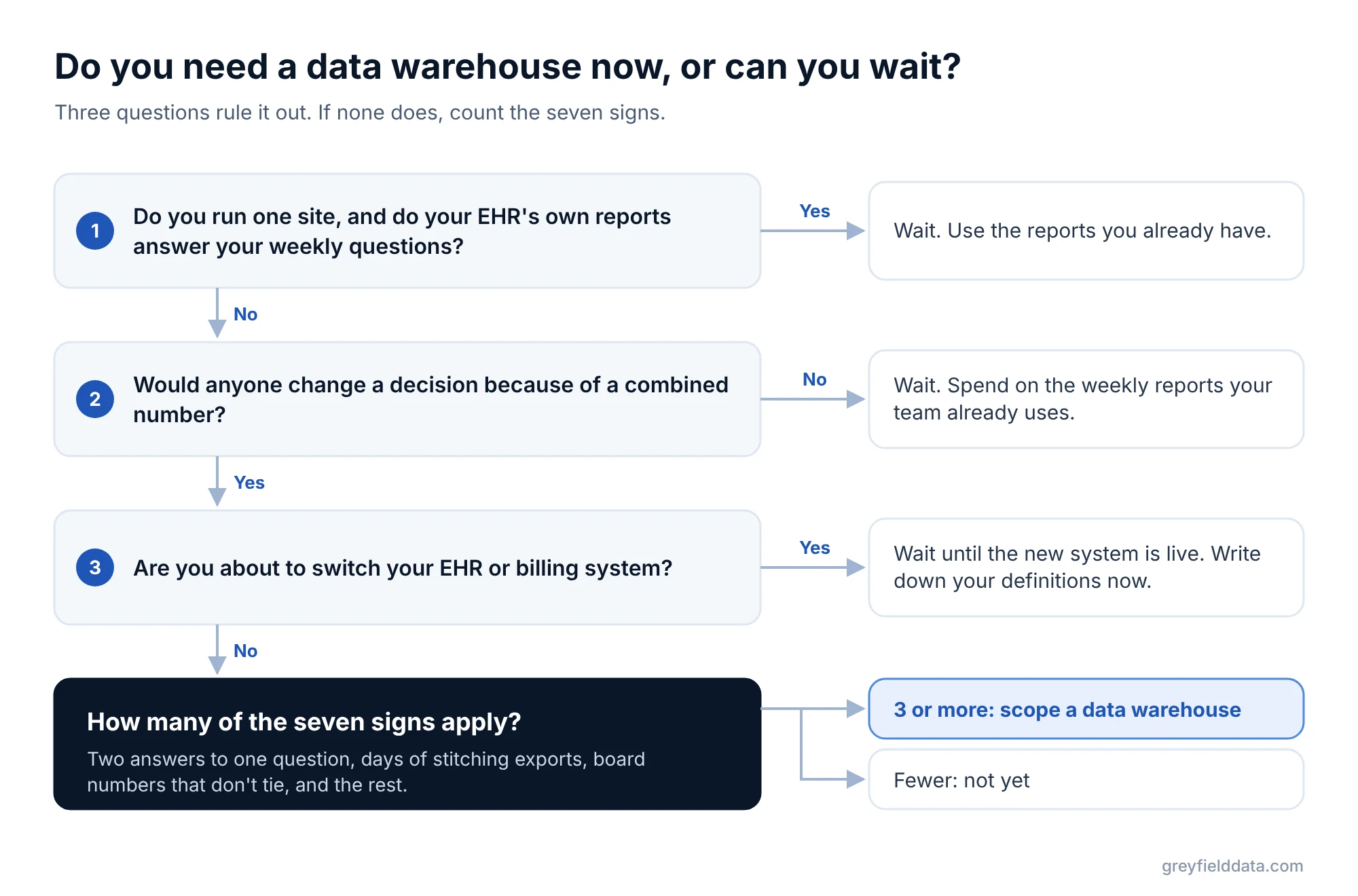
- Three signs you can wait: one site with reports that answer your questions, no one who would act on a combined number, or a system switch coming soon.
- Before building anything, write down what each number means. A warehouse built on unagreed definitions only gives you wrong answers faster.
Quick answers
- Best for: groups with two or more sites, or one site with billing in a separate system.
- Strongest single sign: the same question gets two answers in the same meeting.
- Not yet if: one site, one system, and its reports answer your weekly questions.
- First step: the free infusion data readiness check, ten plain questions about your reports, billing, and sites.
- Platform: Snowflake, Microsoft Azure, or Google Cloud BigQuery, matched to the cloud you already use.
- Before any patient data loads: a signed business associate agreement (BAA) with the cloud vendor.
How do you tell which signs apply to you?
Score yourself against the table. Each sign has a test you can run this week without new software.
| # | Sign | Test you can run this week | Usually felt by |
|---|---|---|---|
| 1 | Sites count the same thing differently | Ask two sites how they count a visit | Operations leads |
| 2 | Month-end means days of stitching exports | Time how long the monthly pack takes | Finance team |
| 3 | You can't trace a denial back to the order | Pick one denied claim and find its referral | Revenue cycle lead |
| 4 | Board numbers don't tie to the books | Compare reported collections with bank deposits | CFO |
| 5 | You can't see margin by drug and payer | Ask for last quarter's margin on your top drug, by payer | Owners, CFO |
| 6 | Program reports are rebuilt by hand each week | Count the hours spent on manufacturer program files | Program coordinator |
| 7 | You are adding sites or preparing for a sale | Ask how long a buyer's data request would take | CEO, CFO |
1. Do your sites count the same thing differently?
If two sites count a visit, a new patient, or chair use differently, a combined number means little. This is the most common sign in multi-site groups, and it gets worse with each site you add or buy.
One site may count injections as visits and another may not. One may count a new patient at the first referral and another at the first dose. Each choice is reasonable alone. Added together, they give a group total nobody can explain.
A warehouse fixes this by applying one written definition to every site's records. The multi-site KPI rollup guide shows how shared definitions and a site list work.
2. Does month-end mean days of stitching exports together?
If someone spends a day or more each month exporting reports, pasting them into a spreadsheet, and fixing the joins, you are paying for a warehouse already. You just get it by hand, once a month, with no history.
Ask the person who builds the monthly pack how long it takes and what breaks. If the answer includes "I fix the site names" or "I remove the duplicates," those steps can run on a schedule instead. The free reporting time calculator puts a yearly cost on those hours.
3. Can you trace a denial back to the order it came from?
If billing runs outside your infusion EHR, you probably can't. A denied claim sits in the billing system, and the referral, authorization, and visit sit in the EHR. Without a shared patient and visit key, nobody can say which intake step caused the denial.
Test it with one denied claim. If it takes more than a few minutes to find the original order and authorization, the systems need joining. The billing outside WeInfuse guide shows what goes missing when they aren't.
4. Do your board and lender numbers tie to the books?
If revenue or collections on the board page don't match the general ledger, the board stops trusting the page. Then the meeting turns into reconciling numbers instead of making decisions.
A warehouse lets finance compare the reporting tables with the ledger every month and write down the differences. Collections should tie closely to bank deposits. Revenue ties after listed differences. Charges never tie, because they reflect list prices. The CFO's guide to an infusion data warehouse covers what should tie and what never will, and the monthly board pack guide shows the page itself.
5. Can you see margin by drug and payer from real payments?
If your drug margin comes from expected amounts or list prices, it is an estimate. Real margin needs three things joined: what you paid the distributor, what the payer paid, and what the patient paid.
Those live in three systems: distributor invoices, remittance files, and patient payments. Until they sit together, margin by drug and payer is a guess. The buy-and-bill margin calculator gives a quick estimate for one drug. A warehouse gives the real number for every drug, every month.
6. Do you rebuild manufacturer program reports by hand every week?
If your team rebuilds the weekly reports a manufacturer or hub program agreement requires, the same rules get reapplied by hand every week. Small differences creep in, and files get sent back.
Saved reports with written rules, delivered on a schedule, remove most of that work. A warehouse helps when the program asks for information from more than one system. The free guide Manufacturer Programs Without the Manual Reporting covers what these programs ask for and how to automate it.
7. Are you adding sites or preparing for a sale?
If you plan to open, buy, or sell sites, you will need comparable numbers across sites and years. A buyer or lender asks for volumes, payer mix, drug margin, and collections by site and month, and expects them to tie.
Without a warehouse, every request is a new project. With one, most answers already exist. The M&A data readiness checklist lists what a buyer asks for. The new site ramp guide shows how to model a new site's first two years.
What are the 3 signs you don't need a data warehouse yet?
You can wait when the cost of joining systems is low or nobody would act on the result. These three signs are the most common.
A. You run one site, and your EHR reports answer your questions
If your weekly questions can be answered from one system's own reports, use them. Many infusion EHRs carry the operational data most centers need. For WeInfuse users, what your WeInfuse data can tell you lists ten questions it answers today, and the WeInfuse reporting guide covers its reports. WeInfuse is a trademark of its owner. Greyfield Data is independent and not affiliated with WeInfuse.
B. Nobody would act on a combined number
A warehouse is only worth it if someone changes a decision because of what it shows. If the combined number would sit unread, spend the money on the weekly reports your team already uses. The 12 weekly reports guide is a good place to start.
C. You are about to switch your EHR or billing system
Wait until the new system is live, then build on it. Building on a system you are leaving means doing the work twice. Use the switch to write down your definitions, so the new system starts with them.
How is an infusion data warehouse built, in plain words?
Scheduled Python code copies records from each system into one data warehouse every night. Inside, the records are cleaned, matched across systems, and turned into the tables every report reads from.
The platform should fit the cloud you already use: Snowflake, Microsoft Azure, or Google Cloud BigQuery. Two rules are non-negotiable. The services you use must be eligible for patient data under HIPAA, and a business associate agreement with the cloud vendor must be signed before any patient record is loaded.
The infusion data warehouse guide has a 30, 60, and 90 day plan. Most projects that disappoint fail on unclear definitions, not on technology.
What should you do first?
Write down what each of your top ten numbers means, where it comes from, and who owns it. Do it before you choose a platform or a partner.
Then take the infusion data readiness check to see which of four stages you are at. If you are weighing partners, the guide to choosing an infusion analytics partner lists the questions to ask.
What to do next
If three or more of the seven signs apply, it is time to scope a data warehouse. Start with the free CFO's guide to an infusion data warehouse if you lead finance for a multi-site group.
More guides sit on the infusion analytics resources page. If you want a second opinion on whether your group needs a single source of truth now, book a call with me.
Frequently asked questions
What is an infusion data warehouse?
It is one secure database that holds copies of your EHR, billing, general ledger, payroll, and inventory records, cleaned up so every site is counted the same way. Reports, board packs, and program files all read from it, so they agree.
When does an infusion center need a data warehouse?
Usually when it has two or more sites, or when billing runs in a separate system from the EHR. The clearest sign is the same question getting two answers from two reports.
Can a single-site infusion center skip a data warehouse?
Often, yes. If one system's reports answer your weekly questions and you aren't joining billing, ledger, or inventory data, a warehouse can wait.
What makes a data warehouse a single source of truth?
Written definitions applied the same way to every site, one place every report reads from, and a monthly comparison with the general ledger. Without the definitions, it is just another copy of the data.
Is a data warehouse safe for patient information?
It can be, if it runs on HIPAA-eligible services and a business associate agreement with the cloud vendor is signed before any patient record is loaded. Access should be limited to the people and reports that need it.
Part of the Infusion analytics guides, a reading path through related articles.
Linus Tse
Founder of Greyfield Data. Built 400+ dashboards. Certified in Sigma, Snowflake, Tableau, and Power BI.
About Linus