Infusion center data warehouse: connecting your systems in one place
How infusion centers connect WeInfuse, billing, prior authorization and referral data in one data warehouse, when it is worth it, and a 90-day plan.

Written by Linus Tse, founder of Greyfield Data
· 9 min read
On this page 11 sections
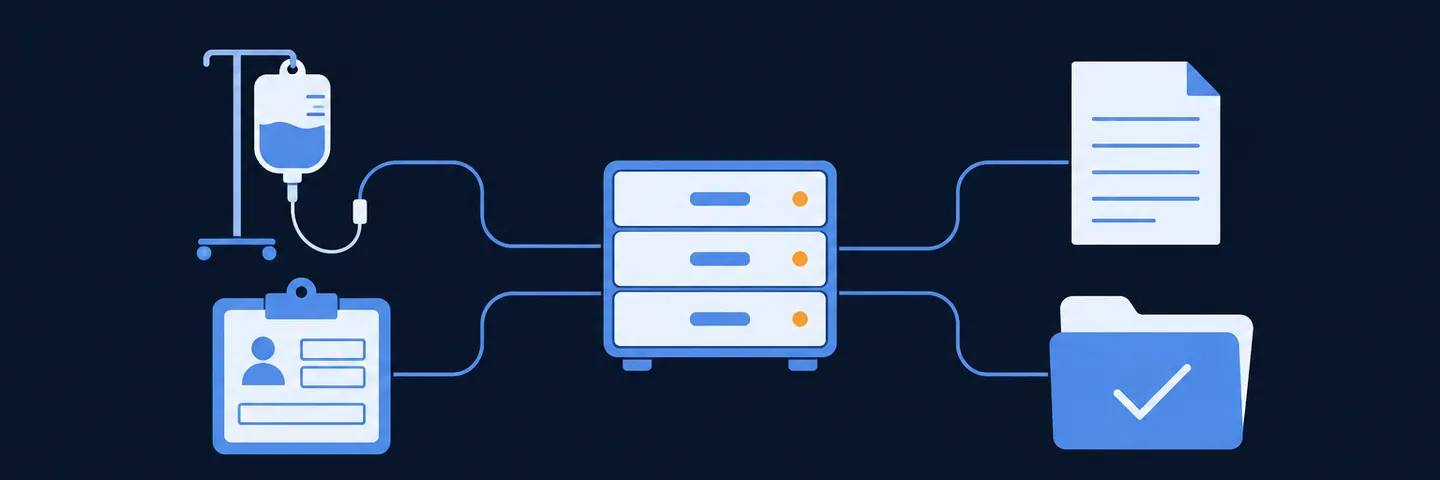
An infusion center data warehouse is one secure place where copies of your referral list, WeInfuse, prior authorization tool, billing and distributor records are lined up. It lets you follow every patient from referral to deposit. I wrote a free 15-page white paper, All Your Infusion Data in One Place, on how it works in plain words, what it lets you see, and how to tell whether you need one yet.
You can get the white paper (free PDF). If your Monday meeting starts with three different numbers, connecting these systems is the work I do for ambulatory infusion centers, and you can book a call to talk through yours.
Key takeaways
- Your systems disagree because each one holds part of the story. The liaison team, intake and billing can each report a different number of new patients and all be right.
- Not every center needs this. One site with a monthly export and a spreadsheet is fine. It becomes worth it when two or more of your weekly questions need a second system.
- It works in four plain steps: scheduled Python programs copy your records, the copies land in one data warehouse such as Snowflake, Microsoft Azure, or Google Cloud, they are matched and cleaned up, and everyone reports from the same tables: a single source of truth for every site.
- With the records in one place you can see referrals lost between systems, denials traced back to the order and approval, margin by drug, payer and site, and all your sites on the same rules.
- A sensible plan delivers something useful at 30, 60 and 90 days. Most delays come from logins, billing company files, and undecided definitions, not from the build.
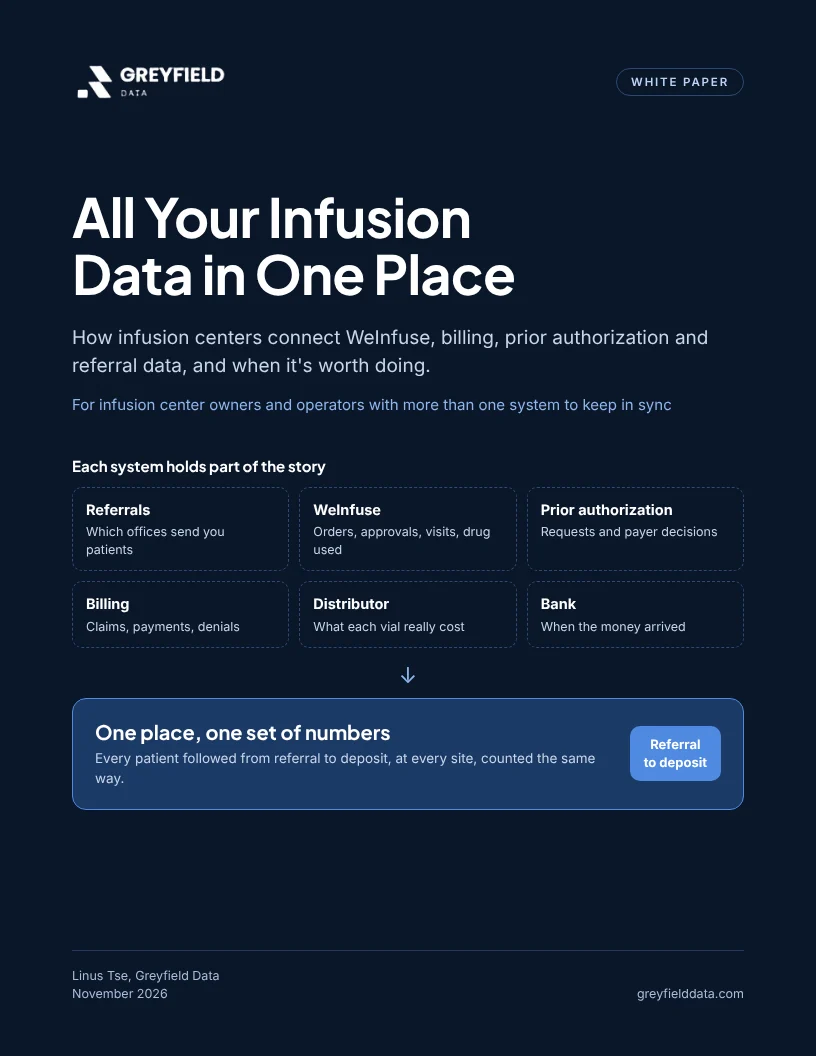
All Your Infusion Data in One Place: how infusion centers connect WeInfuse, billing, prior authorization and referral data, and when it's worth doing.
Who is the white paper for?
It is for infusion center owners and operators with more than one system to keep in sync.
Those systems are usually a referral list or contact system, WeInfuse, a prior authorization tool, a billing system or billing company, and distributor invoices. A one-page appendix covers the technical detail for whoever builds it.
WeInfuse is a trademark of its owner. Greyfield Data is independent and not affiliated with WeInfuse.
Why do infusion center systems disagree?
Because each one is right about its own part of the story, and the questions that matter cross two or more of them.
| System | What it knows | What it cannot see |
|---|---|---|
| Referral list or contact system | Which offices your liaisons visit, and who referred whom | Whether a referral became an order or a visit |
| WeInfuse | Orders, approvals entered, visits, drug used, charges | What the payer paid, if billing happens elsewhere |
| Prior authorization tool | Requests sent, payer decisions, dates | Whether the patient was then treated on time |
| Billing system or company | Claims, payments, denials, balances | Which referring office or approval a claim traces back to |
| Distributor invoices | What you paid per vial after credits and rebates | Which patient, payer, or visit used each vial |
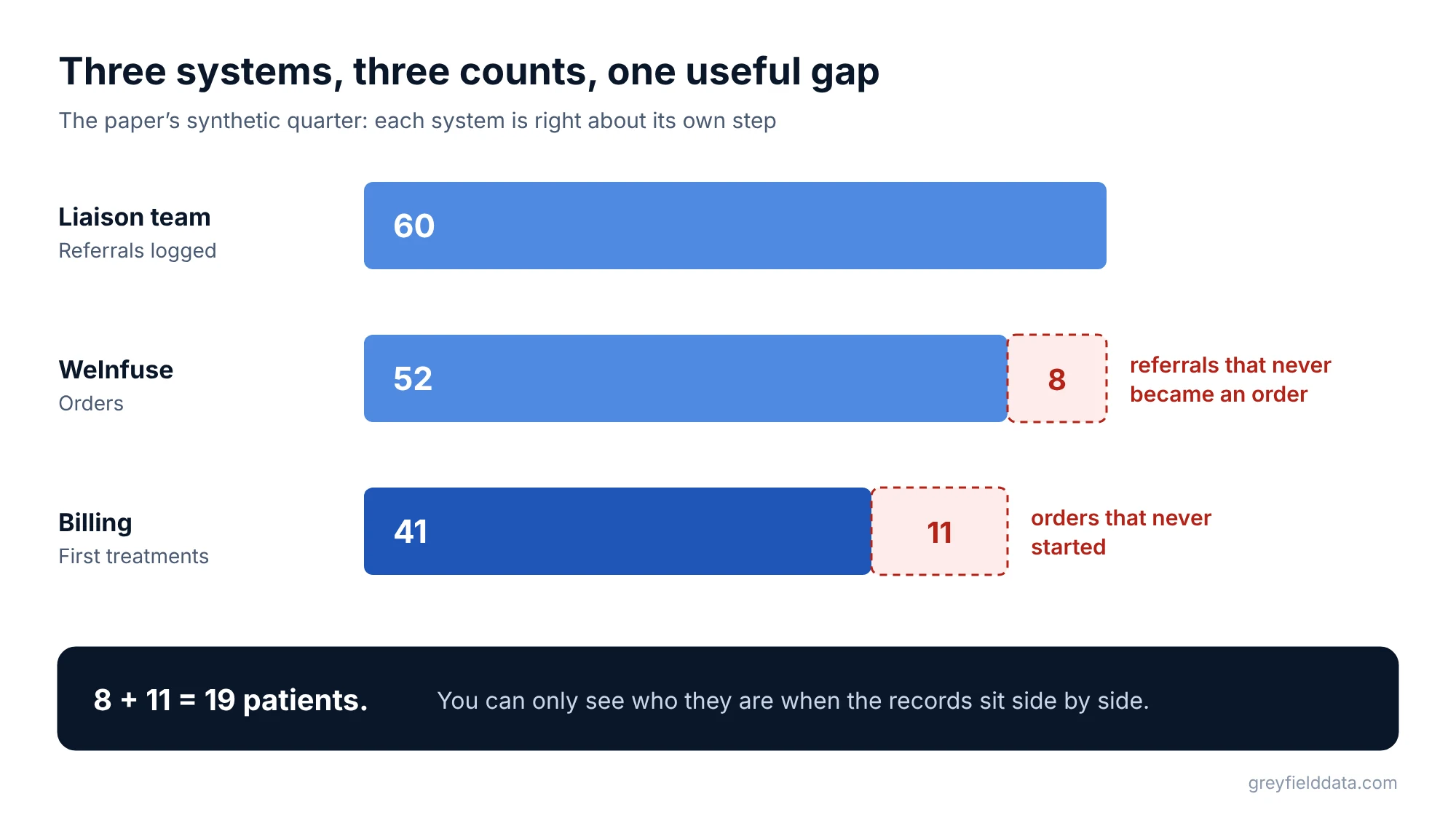
In the paper's synthetic example, the liaison team logs 60 referrals in a quarter, WeInfuse shows 52 orders, and billing shows 41 first treatments. The useful part is the gap: 8 referrals that never became an order and 11 orders that never started. You can only see who those 19 patients are when the records sit side by side. The referral leakage calculator puts a dollar value on referrals that never start.
Do you need an infusion data warehouse yet?
Maybe not. It is probably time if any of these are true.
- You have more than one site, and each reports a little differently.
- Billing happens outside WeInfuse and you want denials traced back to the order. The billing outside WeInfuse guide shows what goes missing.
- You want margin by drug and payer from real payments and invoice cost.
- Someone spends a day or more each week stitching exports together.
It is probably not time if you run one site and a monthly export answers your questions. The same goes if nobody would act on a combined number, or if you are about to switch billing companies. If your weekly questions can be answered from WeInfuse alone, start with what your WeInfuse data can tell you instead. The WeInfuse reporting guide covers what its own reports can do. The free infusion data readiness check gives a quick score in ten questions.
How does it work, in plain words?
Four steps, and none of them changes how your staff work:
- Copy. Small Python programs run on a schedule, such as every night, and pull a copy of new and changed records from each system.
- Store. The copies land in one secure database built for reporting, called a warehouse. Snowflake, Microsoft Azure, and Google Cloud's BigQuery are common choices. Whichever you pick must be approved for patient data (HIPAA) with a signed business associate agreement.
- Clean up. The same patient, order, and referring doctor are matched across systems, using what they share, such as the order number on a claim or the prescriber's NPI. Uncertain matches go to a person to check.
- Report. A short set of tidy tables, one each for referrals, visits, claims and so on, that every dashboard and spreadsheet reads from.
Nothing is written back. Your systems stay the place where work happens.
What does one patient look like, from referral to deposit?
The paper follows one made-up patient, Jordan, through every system. Each system sees one or two lines. None sees the whole thing.
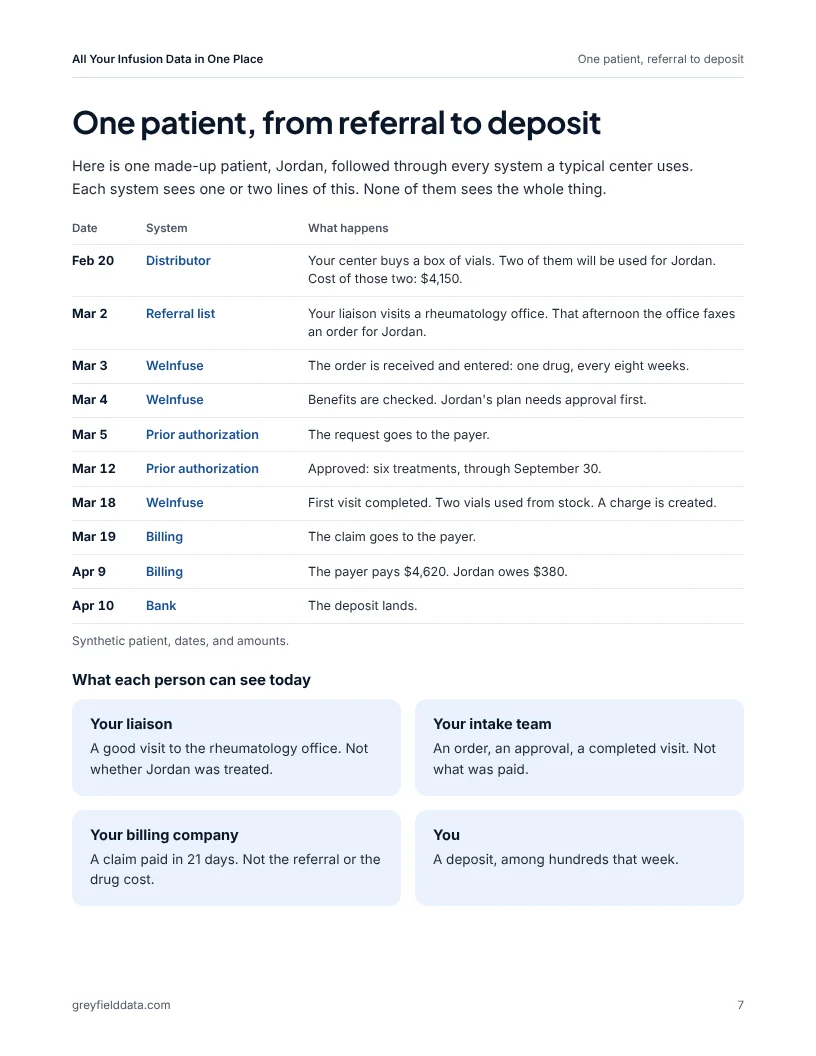
Put side by side, Jordan's lines show three things:
- Speed to first visit: 16 days from referral to first visit (March 2 to 18).
- Speed to cash: 23 days from first visit to the deposit (March 18 to April 10).
- What the visit earned: the payer paid $4,620 against a drug cost of $4,150, so $470 so far, or $850 if Jordan pays the $380 balance.
They also show a problem coming. At one visit every eight weeks, only four of the six approved treatments fit before the approval ends on September 30. The renewal can then show up on a list in August instead of as a denial in November, as in the expiring authorizations report.
What can you see with everything in one place?
Four things most centers cannot see today:
- Referrals lost between systems, by referring office, so your liaisons call the office losing patients before the order.
- Denials traced back to the order and approval. In the paper's example, 9 of 14 denials were visits after an approval had ended, which intake can prevent with a list of approvals ending soon. The infusion denial analysis guide shows how to trace rejected claims to the step that caused them.
- Margin by drug, payer and site, from what was actually paid and what the drug actually cost. The buy-and-bill margin calculator shows the per-dose math.
- All your sites in one view, counted with the same rules, as in multi-site infusion KPI rollups.
How do you keep patient information safe?
Sign a business associate agreement with anyone outside your organization who handles patient information for you, before any records move. Then:
- Bring only the fields each question needs, in the spirit of the minimum necessary standard. Names and phone numbers can usually stay behind.
- Set access in the database by site and role, so each site sees only its own patients.
- Use personal logins, removed the day someone leaves, and keep the warehouse account in your organization's name.
This is a plain-language summary, not legal advice.
What does a 30, 60 and 90 day plan look like?
| Days | Focus | What you get |
|---|---|---|
| 1 to 30 | Agree three to five questions and their definitions, sign the BAA, connect WeInfuse and billing | A first connected report, checked against numbers you trust |
| 31 to 60 | Match claims and payments to orders and visits, add the prior authorization tool | Denials traced to orders, days from visit to cash, one weekly scorecard |
| 61 to 90 | Add distributor invoices, the referral list, and other sites; set access; hand over notes | Margin by drug, payer and site, lost referrals by office, all sites in one view |
From your team it takes a point person who knows how the center works, logins, and decisions on what each number means. It also takes your billing company's cooperation and time to check the first results. It does not take new software for your nurses or intake team.
Frequently asked questions
What is a data warehouse for an infusion center?
It is one secure database where copies of your records from WeInfuse, billing, prior authorization, referrals and distributors are kept and lined up for reporting. Your staff keep working in the same systems; the warehouse only reads copies.
Do I need a data warehouse if I only use WeInfuse?
Usually not. If your questions can be answered from WeInfuse alone, its reporting and a careful spreadsheet are enough. It becomes worth it when your weekly questions need billing, payment, or invoice data too.
Which warehouse should an infusion center use?
One that will sign a business associate agreement and that your organization owns. Snowflake, Microsoft Azure, and Google Cloud are all good choices; the choice matters less than clear definitions and access rules.
How long does it take to connect infusion center systems?
The paper lays out a 90-day plan with something useful at 30, 60 and 90 days. Most delays come from waiting on logins, billing company files, or decisions, not the build itself.
Is the white paper free?
Yes. Enter your work email on the download page and the PDF downloads right away. Every example uses synthetic patients and numbers.
What to do next
Get the white paper and run its quick test: write down the three questions you would ask every Monday and which systems each one needs.
Multi-site CFOs should also read the CFO white paper on the infusion data warehouse, which covers tying to the books and board reporting. If you run WeInfuse, WeInfuse reporting help covers the connection on that side. Before you connect anything, agree what each number means with the Infusion Center Metrics Playbook. If two or more of your questions need a second system every week, book a call and bring the list of systems you use today.
Part of the Infusion analytics guides, a reading path through related articles.
Linus Tse
Founder of Greyfield Data. Built 400+ dashboards. Certified in Sigma, Snowflake, Tableau, and Power BI.
About Linus