Where does infusion drug inventory go missing? Measuring shrink
Measure infusion drug shrink with one monthly count: what you had, bought, gave, wasted, returned and expired, against what's on the shelf, drug by drug.

Written by Linus Tse, founder of Greyfield Data
· 8 min read
On this page 9 sections
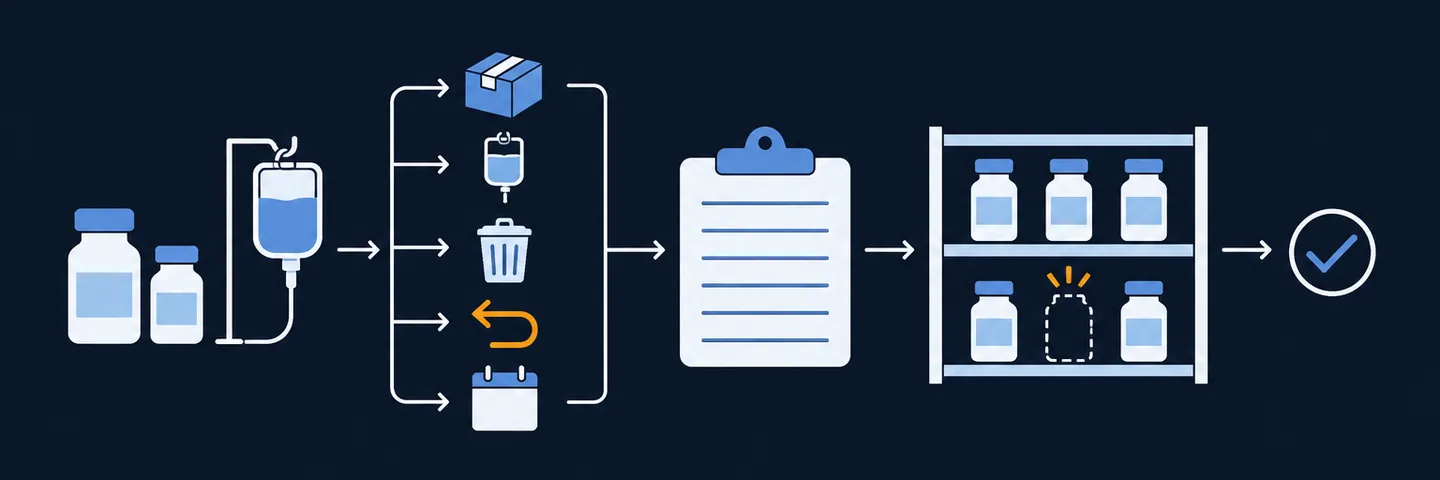
Drug shrink is the gap between what your records say should be on the shelf and what's actually there. To find it, run one count per drug each month. Start with what you had and add what you received. Subtract what you gave, documented as waste, returned, and threw away for expiry or damage. Then compare that to a physical count. The leftover is unexplained loss. At infusion drug prices, a few missing units a month on one drug can cost more than a year of supplies.
I build reporting for infusion providers that lines up purchases, administrations, waste, and counts for every drug, so owners can see where units disappear. To see how inventory loss compares with your other leaks, use the infusion revenue leakage calculator. More on this work is on the infusion analytics page.
Key takeaways
- Shrink is what's left after every known movement is counted. It's not the same as waste, expiry, or excursion loss, which you can explain.
- One formula, per drug, per month: opening count plus received, minus administered, waste, returns, and expired or damaged, gives what should be on the shelf. Compare it with the physical count.
- Count in billing units or vials, never both. Mixing them is the most common reason a count looks wrong when nothing is missing.
- Check record gaps first: undocumented waste, patient-specific drug mixed with your stock, transfers between sites, and doses given but not recorded.
- Rank by dollars, not units. One missing vial of an expensive drug outweighs a box of cheaper ones.
Quick answers
- Count weekly: the short list of drugs that make up most of your drug spend.
- Count monthly: every other buy-and-bill drug.
- Count separately: patient-specific and free-drug-program stock, never in your own count.
- When in the day: at the same time each day, after the last administration is recorded.
- Where to look first: undocumented waste, then a mix-up between vials and billing units.
What counts as inventory shrink?
Shrink is the loss you can't explain. Every other movement of a drug has a record: you bought it, gave it, wasted part of a vial, sent it back, or threw it out because it expired or was damaged. When the shelf has less than those records add up to, the difference is shrink.
Keeping known losses separate matters because each has its own fix. Excursion losses point to storage, covered in how much temperature excursions cost. Waste from single-dose vials is billable for Medicare with the JW modifier, covered in the JW and JZ modifier guide. Shrink is what's left, and it usually means a record is missing somewhere.
How do you calculate shrink?
Use one formula per drug, per site, per month:
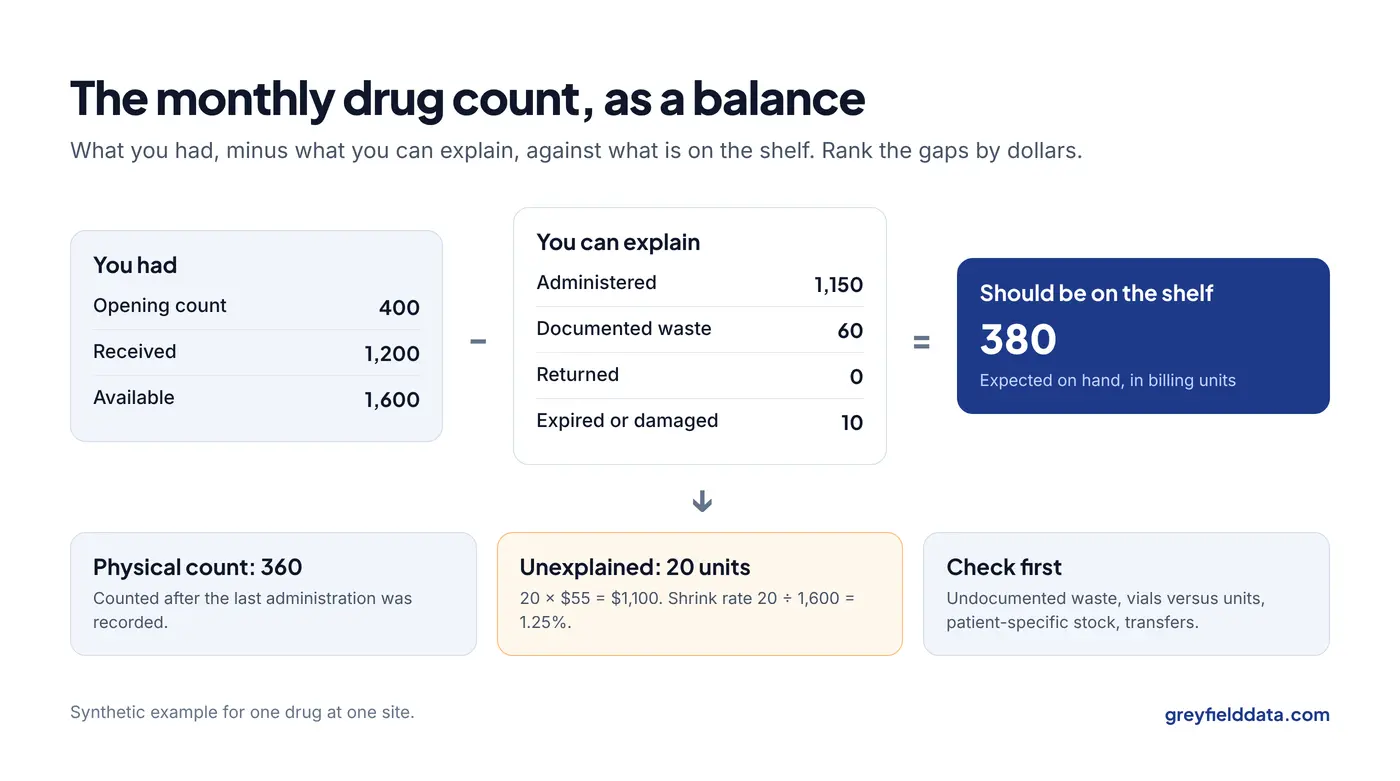
Expected on hand = opening count + received − administered − documented waste − returned − expired or damaged
Unexplained loss = expected on hand − physical count
Shrink rate = unexplained loss ÷ (opening count + received)
Here is one month at one site. All numbers are synthetic: replace them with your own. Units are billing units for each drug.
| Drug | Opening | Received | Administered | Waste | Returned | Expired or damaged | Expected on hand | Counted | Unexplained | Cost per unit | Dollars |
|---|---|---|---|---|---|---|---|---|---|---|---|
| Drug A | 400 | 1,200 | 1,150 | 60 | 0 | 10 | 380 | 360 | 20 | $55 | $1,100 |
| Drug B | 50 | 100 | 120 | 0 | 0 | 5 | 25 | 25 | 0 | $140 | $0 |
| Drug C | 30 | 60 | 70 | 4 | 2 | 0 | 14 | 10 | 4 | $900 | $3,600 |
| Total | $4,700 |
Drug A's shrink rate is 20 ÷ (400 + 1,200) = 1.25%. Drug C's is 4 ÷ (30 + 60) = 4.4%. Drug C has fewer missing units but costs more than three times as much, which is why the report ranks by dollars. The buy-and-bill margin calculator shows how much margin one dose of each drug carries, so you can see what a missing unit wipes out.
What if the count is higher than expected?
A negative gap means the shelf has more than your records say. That's not good news. It usually means a receipt was recorded twice, an administration was recorded that didn't happen, or a white-bagged dose was counted as your stock. Investigate it the same way. The white-bagging revenue impact guide explains how payer-mandated pharmacy shipments change what sits on your shelf.
Where does inventory usually go missing?
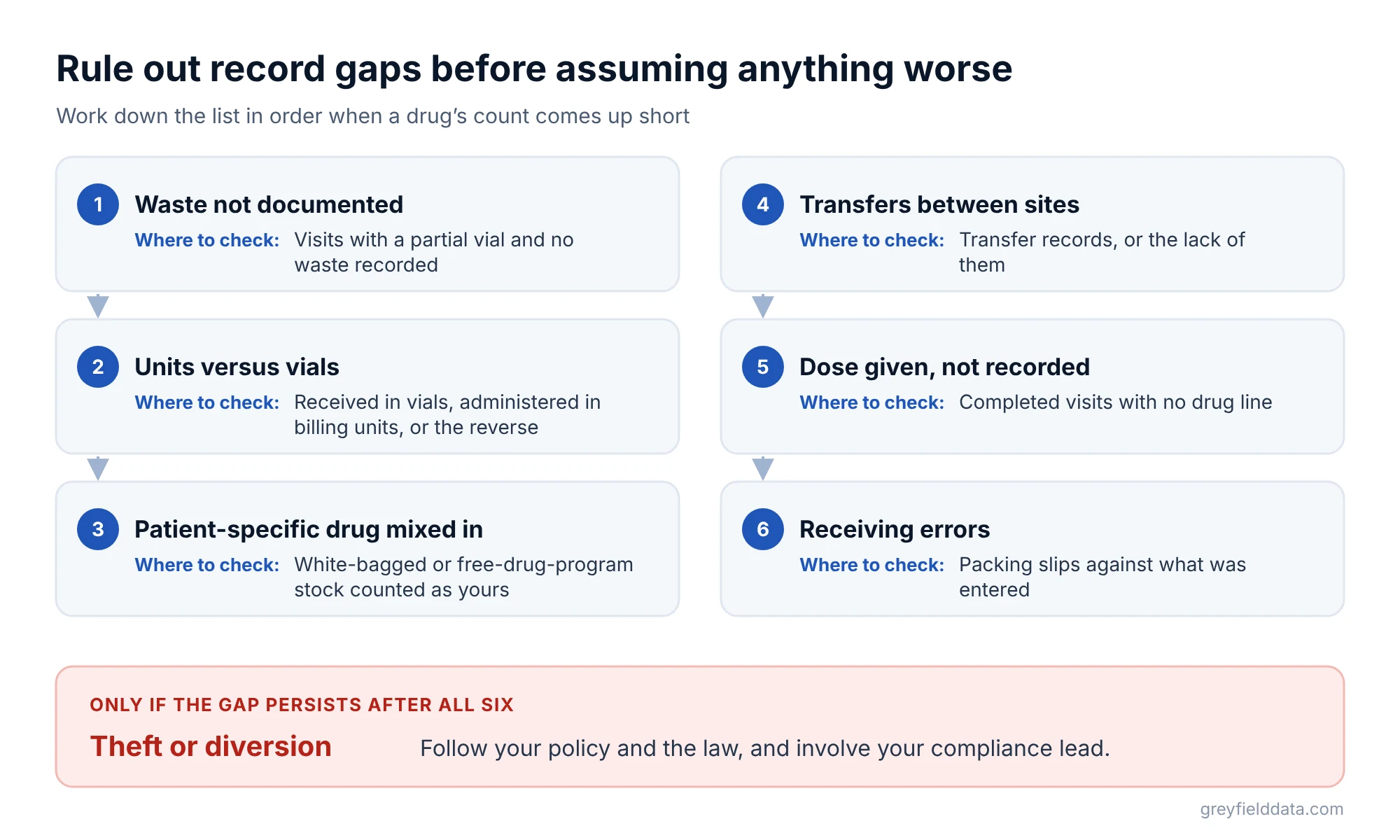
Most causes are gaps in records, so check those before assuming anything worse. The common ones, and where to look:
| Cause | What it looks like | Where to check |
|---|---|---|
| Waste not documented | Missing units roughly match vial leftovers | Visits with a partial vial and no waste recorded |
| Units versus vials | A large gap on one drug that appears suddenly | Received in vials, administered in billing units, or the reverse |
| Patient-specific drug mixed in | Negative gaps, or units "appearing" | White-bagged or free-drug-program stock counted as yours |
| Transfers between sites | One site short, another over, same drug | Transfer records, or the lack of them |
| Dose given, not recorded | Gap matches a visit with no administration entry | Completed visits with no drug line |
| Receiving errors | Gap matches one shipment | Packing slips against what was entered |
| Theft or diversion | Gaps that persist after the above are ruled out | Follow your policy and the law; involve your compliance lead |
For groups with several sites, the multi-site KPI rollup guide shows how to report transfers so the group total still balances.
The "dose given, not recorded" cause is also a billing problem: if the administration isn't recorded, the visit may never be billed. That's one of the ten leaks in where infusion centers lose revenue between order and deposit.
How often should you count?
Count your most expensive drugs more often than the rest. A common approach:
- Weekly for the drugs that make up most of your drug spend. Usually that's a short list.
- Monthly for everything else that's buy-and-bill.
- Separately for patient-specific and free-drug-program stock, which should never be in your own count at all. The white-bagging waste calculator estimates what unused shipments of that stock cost you.
Count at the same point in the day, after the last administration is recorded, so the counts and the records describe the same moment.
Where do the numbers come from?
Each input lives in a different place, which is why shrink is rarely measured.
- Opening and physical counts: your count sheets or inventory system.
- Received: purchase invoices or your distributor's shipment records.
- Administered and waste: your infusion EHR's administration records.
- Returns and expired: return authorizations and your disposal log.
If you run WeInfuse, inventory on hand and lot details come from its inventory reporting. How to report WeInfuse inventory on hand by location and drug explains how to total it without double counting lots, and WeInfuse reporting help covers building the monthly count.
Keep in mind that drug used at visits isn't the same as approved supply or treatments remaining, as this explainer on the three inventory numbers covers. WeInfuse is a trademark of its owner; Greyfield Data is independent.
When these records sit in four systems, a single infusion data warehouse lines them up so the count runs itself.
This post is educational. Follow your state's rules and your own policies on inventory, disposal, and reporting suspected diversion.
What to do next
Pick your five most expensive drugs and run the count above for last month at one site. If a gap shows up, check the causes in the table in order, starting with undocumented waste and unit mix-ups.
The purchased versus billed report in the 12 weekly reports guide keeps the same check on a weekly cadence. The infusion analytics resource hub links every related guide. If you'd like the count built from your purchase, administration, and inventory records so it runs every month for every site, book a call with me.
Frequently asked questions
What is a normal drug shrink rate for an infusion center?
There is no reliable public benchmark. Track your own rate by drug and site, aim for zero unexplained loss on high-cost drugs, and investigate any gap rather than accepting a threshold.
What is the difference between drug waste and shrink?
Waste is drug you documented discarding, such as the leftover part of a single-dose vial. Shrink is loss with no record at all. Waste can be billable; shrink never is.
Why does my drug count not match my records?
The most common causes are undocumented waste, counting in vials while records are in billing units, patient-specific drug mixed with your stock, and transfers between sites that weren't recorded.
How often should infusion centers count drug inventory?
Count your highest-cost drugs weekly and the rest monthly. Count at the same time of day, after the last administration is recorded.
Part of the Infusion analytics guides, a reading path through related articles.
Linus Tse
Founder of Greyfield Data. Built 400+ dashboards. Certified in Sigma, Snowflake, Tableau, and Power BI.
About Linus