How white bagging changes infusion center revenue and workload
White bagging removes drug margin from a visit and adds coordination work. Here is what the bagging terms mean and how to measure the effect on your center.

Written by Linus Tse, founder of Greyfield Data
· 8 min read
On this page 9 sections
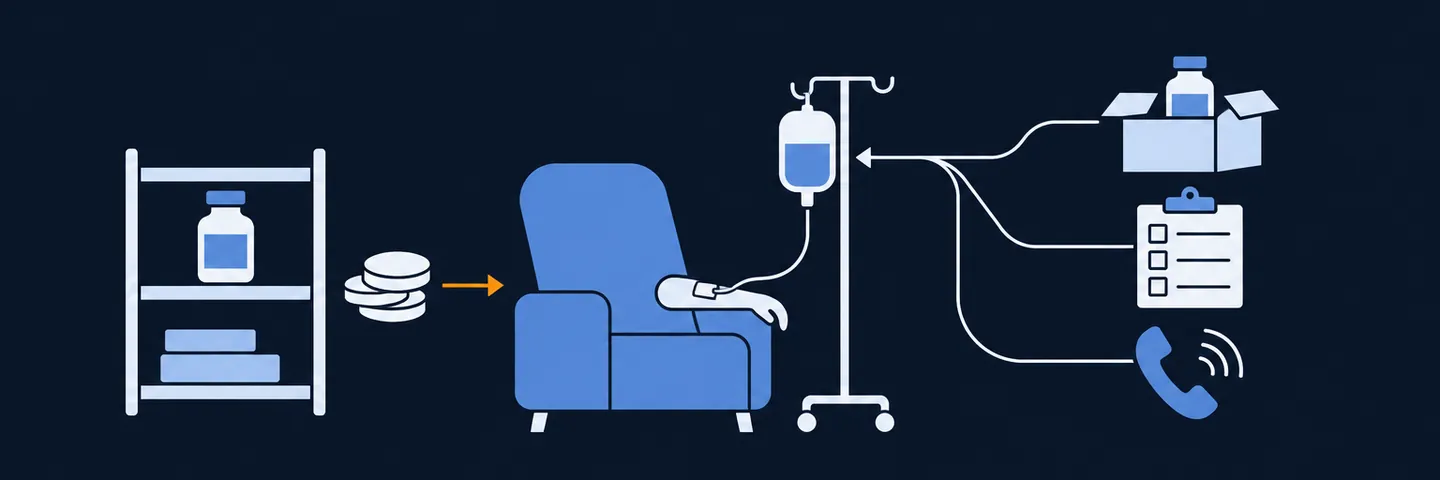
White bagging means a specialty pharmacy ships a patient's drug to your center, and you give it. Your center no longer buys or bills the drug, so the drug margin on that visit drops to nothing. Meanwhile the work of chasing the shipment, storing it separately, and rescheduling when it's late lands on your staff. To measure the effect, compare white-bagged and buy-and-bill visits on two numbers: what each visit earns you, and how many staff minutes each takes.
I build reporting for ambulatory infusion centers that splits every visit by how the drug arrived, so owners can see which payers and drugs have shifted to white bagging and what it costs. To see what one drug earns you when you buy and bill it, try the buy-and-bill margin calculator.
Key takeaways
- Buy-and-bill: you buy, store, give, and bill the drug. You carry the risk and keep any margin.
- White bagging: a specialty pharmacy dispenses the drug for one patient and ships it to you. You bill only the administration.
- Brown bagging: the patient picks up the drug and carries it in. Clear bagging: a health system's own pharmacy supplies its own clinic.
- White bagging changes two numbers per visit: revenue falls to administration only, and staff time often rises because of coordination work no one pays for.
- There is no reliable public figure for the impact on a typical center. Measure your own: share of visits by drug supply route, earnings per visit by route, and staff minutes per white-bagged dose.
What do white, brown and clear bagging mean?
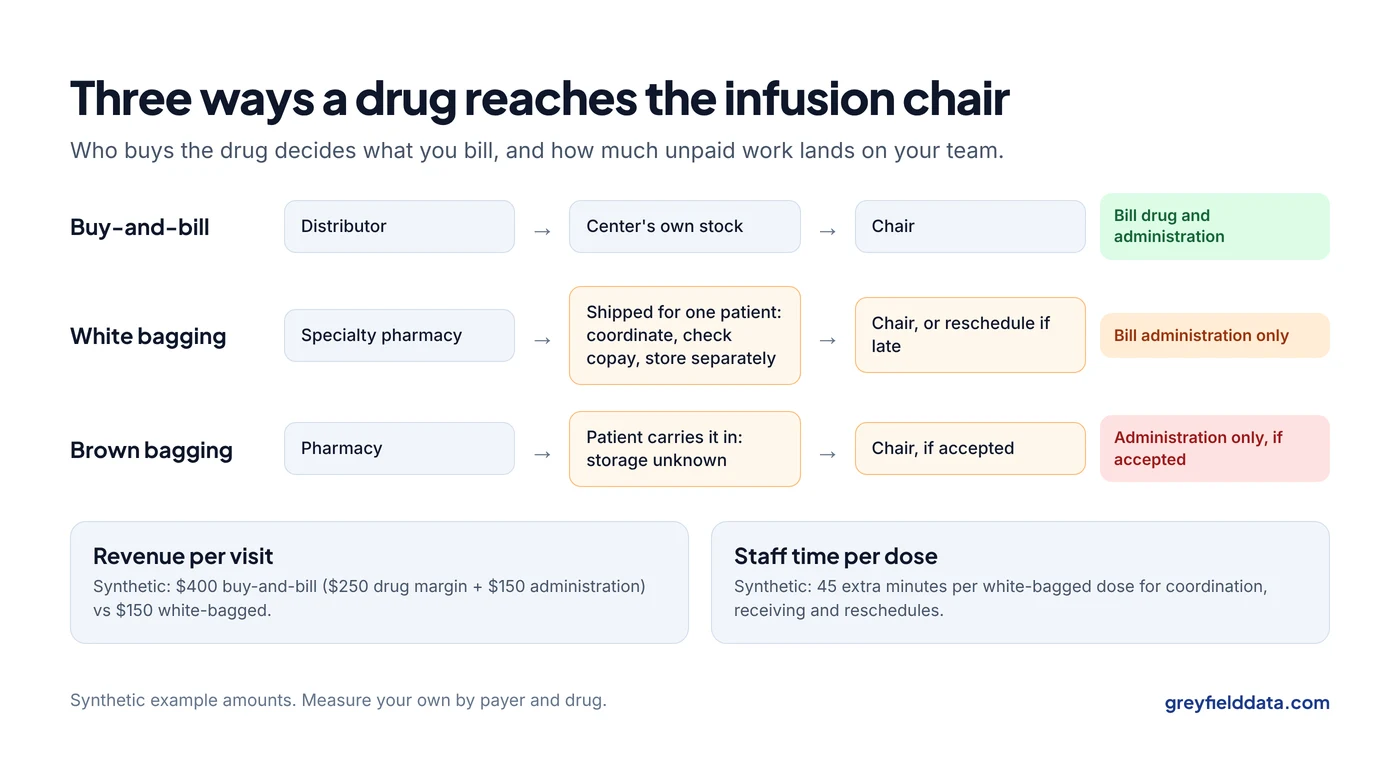
The four terms describe who buys the drug and how it reaches the chair. The table puts them side by side.
| Term | Who buys and dispenses the drug | How it reaches your center | What your center bills |
|---|---|---|---|
| Buy-and-bill | Your center buys from a distributor | Your own stock | Drug and administration |
| White bagging | A specialty pharmacy, often chosen by the payer | Shipped to your center for one named patient | Administration only |
| Brown bagging | A pharmacy dispenses to the patient | The patient brings it in | Administration only, if you accept it |
| Clear bagging | A health system's own pharmacy | Delivered to its own clinic | Depends on the system's setup |
Payers often require white bagging for certain drugs, and some centers choose a specialty pharmacy for drugs they rarely use, very expensive drugs, or patients on free drug programs. Rules about payer-required white bagging and brown bagging vary by state and by contract, so check both. Many centers decline brown bagging because they can't confirm how the drug was stored before it arrived.
How does white bagging change your revenue?
White bagging removes the drug from your bill. On a buy-and-bill visit, you are paid for the drug and the administration. On a white-bagged visit, you are paid only for the administration, and the drug line, if your payer wants one, carries no real charge.
For many drugs, the drug margin is a large part of what a visit earns, so the revenue drop is bigger than the visit count suggests. The chair and the nurse are just as busy as before, but the visit earns less.
What one industry study found
A survey Avalere ran for the National Infusion Center Association (NICA) and two other provider groups covered 35 organizations. It estimated the cost of drug that is shipped for a specific patient and then cannot be used at $35,000 to $652,000 per site per year, depending on how many patients a site serves.
It put the extra cost of special handling at $13,000 to $67,500. In the same survey, 81% of respondents said they used this kind of drug sourcing because a payer contract required it. Treat these as one study's ranges, not a benchmark for your center. The white bagging waste calculator estimates the unusable-drug cost from your own numbers. You can also read the Avalere white bagging report.
How does white bagging change your workload?
White bagging usually adds work rather than removing it. The center no longer orders that drug from its distributor, but it takes on tasks no one pays for.
- Coordinating each shipment with the pharmacy, often for every dose.
- Confirming the patient's copay was paid to the pharmacy, or the drug won't ship.
- Receiving and storing it separately, labeled for one patient. Mixing it with your own stock means giving away drug. The WeInfuse inventory report guide shows how to keep the two counts apart.
- Rescheduling when the drug is late or arrives at the wrong site.
- Handling dose changes. If the dose changes, a patient-specific shipment may be unusable.
None of these show up in billing data, which is why white bagging often looks harmless on a revenue report. It's one of the quieter leaks described in where infusion centers lose revenue between order and deposit.
How do you measure the effect on your center?
Measure four numbers, by payer and by drug, every month. The first two come from your records. The last two need a short time study.
- Share of visits by drug supply route. Buy-and-bill, white-bagged, and any other. Watch the trend by payer.
- Earnings per visit by route. Payment minus drug cost for buy-and-bill. Administration payment only for white-bagged.
- Staff minutes per white-bagged dose. Time two weeks of coordination work: calls, emails, receiving, storage, and rescheduling.
- Reschedules caused by drug not on site. Count them, and count the chair time lost. The no-show cost calculator puts a price on each empty chair.
A simple readiness check helps with the fourth: the share of white-bagged doses on site at least two days before the visit. If it is low, you're rescheduling a lot. The same check appears as stall point 8 in where referrals stall before the first infusion. Related measures, such as drug margin per visit and payer mix, are defined in the infusion center KPI glossary. The referral leakage calculator puts a yearly margin figure on referred patients who never reach a first infusion.
What does the math look like?
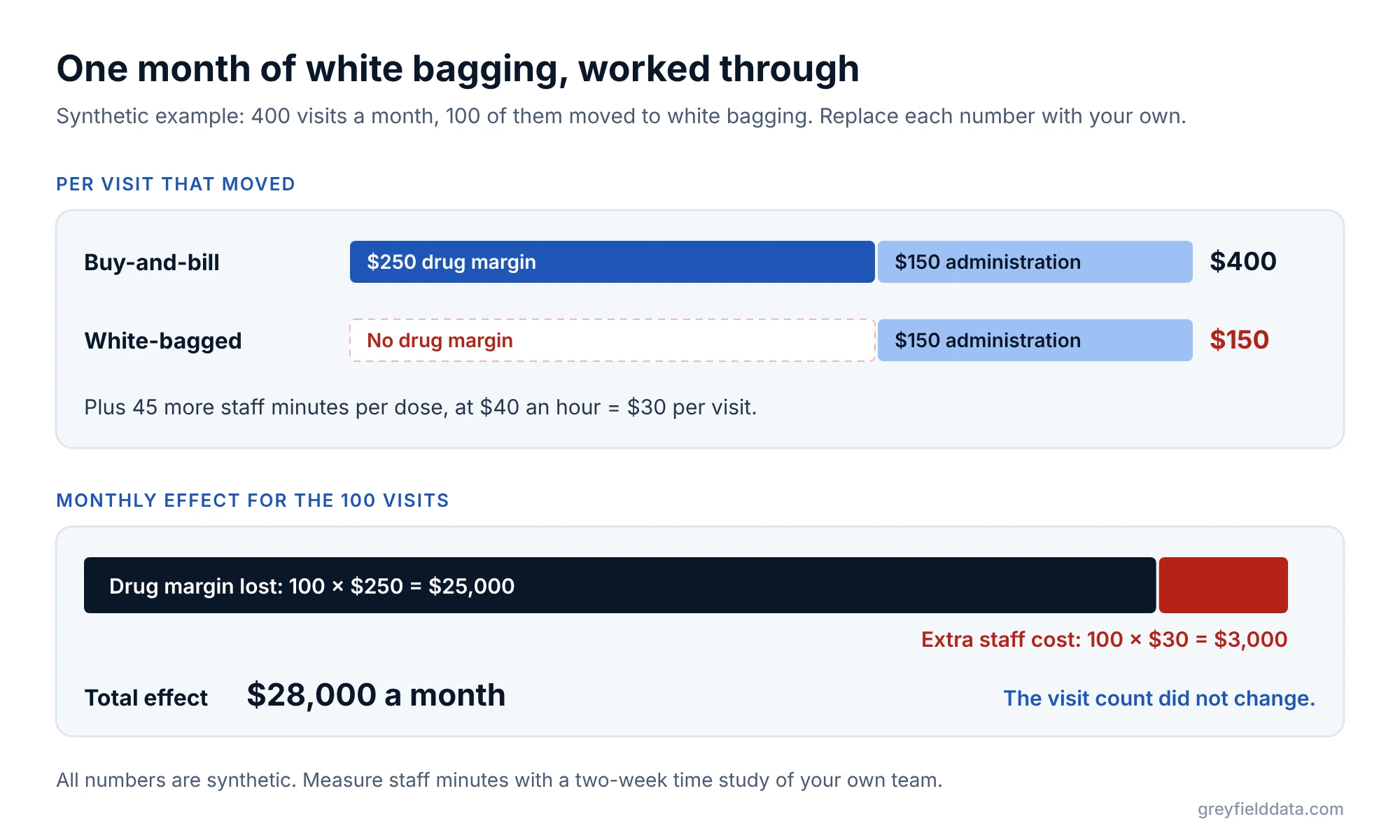
Here is one month for a center with 400 visits. All numbers are synthetic: replace each with your own.
| Input | Value |
|---|---|
| Visits per month | 400 |
| Visits that moved to white bagging | 100 |
| Drug margin per buy-and-bill visit | $250 |
| Administration payment per visit (both routes) | $150 |
| Extra staff minutes per white-bagged dose | 45 |
| Staff cost per hour | $40 |
| Effect | Calculation | Monthly amount |
|---|---|---|
| Drug margin lost | 100 × $250 | $25,000 |
| Extra staff cost | 100 × (45 ÷ 60) × $40 = 100 × $30 | $3,000 |
| Total effect | $25,000 + $3,000 | $28,000 |
Revenue per visit for those 100 visits fell from $400 ($250 + $150) to $150, while each took 45 more minutes of staff time. The visit count didn't change, which is exactly why the shift is easy to miss.
The buy-and-bill margin calculator runs the first half of this for a single drug.
What can you do with the numbers?
Once you can see the effect by payer and drug, you have choices to discuss with your team and contracts lead:
- Bring the numbers to payer conversations. Showing the cost of coordination, reschedules, and lost chair time is stronger than a general complaint. Showing payers you cost less than the hospital uses the same approach.
- Ask whether an administration rate covers the added work. Some centers discuss coordination or handling fees in contracts.
- Choose specialty pharmacy on purpose for drugs where buy-and-bill risk is high, such as rarely used or very expensive drugs.
- Tighten the readiness check, so late shipments are caught days before the visit.
Value white-bagged visits fairly for your referral team too. The referral was just as real; see how to give your infusion sales team a fair value per visit.
This post is educational and isn't legal, billing, or contract advice.
WeInfuse is a trademark of its owner. Greyfield Data is independent and not affiliated with WeInfuse.
What to do next
Tag last month's visits by how the drug arrived, and count white-bagged visits by payer. If one payer stands out, run the math above for its drugs.
For the specialty pharmacy side of this work, see analytics for specialty pharmacy relationships. The infusion center metrics white paper and the infusion analytics resource hub cover the related measures. If you want help building the split into your weekly reports, book a call with me.
Frequently asked questions
How does white bagging affect our revenue and how do I quantify it?
It removes the drug margin from each white-bagged visit and adds staff time. Quantify it by multiplying white-bagged visits by your average drug margin per buy-and-bill visit, then adding staff minutes per dose times your staff cost.
What is the difference between white bagging and brown bagging?
In white bagging, the pharmacy ships the drug directly to your center for one patient. In brown bagging, the patient picks up the drug and brings it in, so you can't confirm how it was handled.
Does white bagging reduce work for the infusion center?
Usually not. You stop ordering that drug, but you take on shipment coordination, separate storage, copay checks, and reschedules when the drug is late.
Is white bagging ever a good choice for an infusion center?
It can be, for drugs you rarely use, very expensive drugs where one unpaid claim is a large loss, or patients on free drug programs. Decide drug by drug with your own numbers.
Part of the Infusion analytics guides, a reading path through related articles.
Linus Tse
Founder of Greyfield Data. Built 400+ dashboards. Certified in Sigma, Snowflake, Tableau, and Power BI.
About Linus