How much drug do temperature excursions cost your infusion center?
Turn your fridge temperature log into a monthly drug-loss report: excursions by unit, doses quarantined, dollars discarded, and visits rescheduled.

Written by Linus Tse, founder of Greyfield Data
· 9 min read
On this page 9 sections
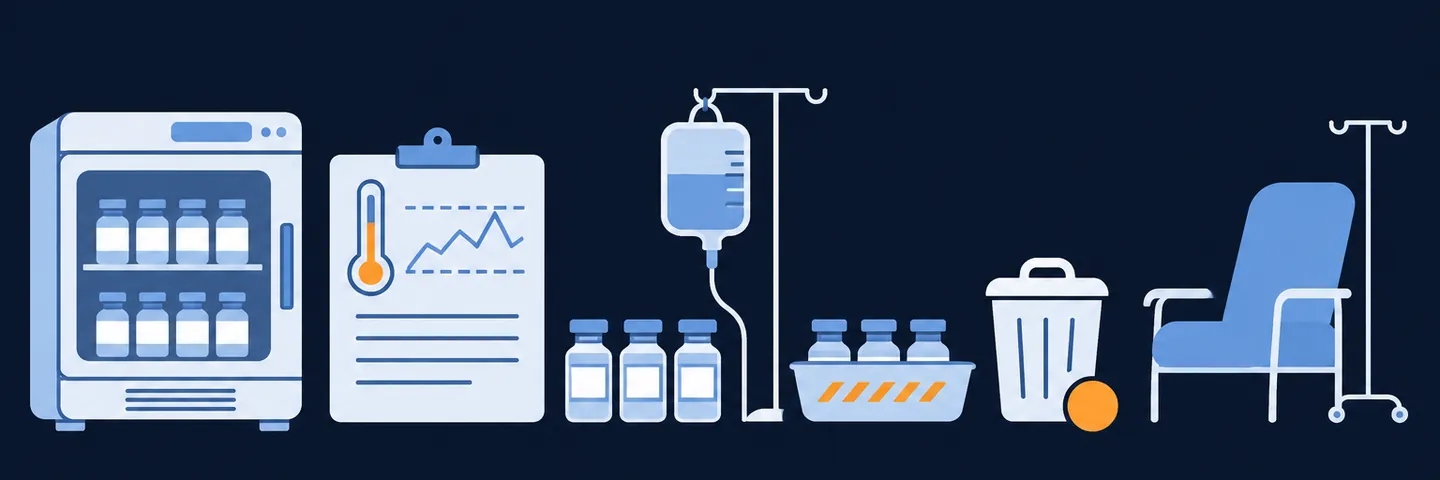
A temperature excursion costs you the drug you throw away, plus the visits you reschedule while you wait to hear whether the rest is still usable. Most centers never add it up, because the temperature log, the discard record, and the schedule live in three different places. Put four numbers on one monthly page: excursions by storage unit, doses quarantined, dollars discarded, and visits rescheduled. That page tells you whether you have a bad fridge, a bad habit, or a slow process.
I build reporting for ambulatory infusion centers that ties drug loss back to the event that caused it, so owners see the dollars, not just the log. The infusion revenue leakage calculator shows how drug loss fits with the other places money slips away. The infusion analytics page shows the rest of this work.
Key takeaways
- An excursion is an event, not a loss. Many quarantined doses turn out to be usable once the manufacturer confirms stability. Track quarantined and discarded separately.
- The real cost has three parts: discarded drug at what you paid for it, rescheduled visits, and staff hours spent investigating.
- Speed matters most. The longest delay is usually waiting for the manufacturer's stability answer. Keeping that information on file ahead of time saves hours and saves drug.
- Four numbers each month: excursions per storage unit, share of quarantined doses discarded, dollars discarded, and visits rescheduled.
- A complete log is evidence. The share of expected temperature readings actually recorded supports your storage policy and your accreditation file.
What counts as a temperature excursion?
A temperature excursion is any time a drug sits outside the storage range on its label. Common causes are a fridge that drifts warm overnight, a freezer that fails, a power outage, or a vial left on a counter.
The label and the manufacturer set the range and decide whether the drug is still usable. Your job is to record what happened, quarantine the stock, and get an answer fast.
The National Infusion Center Association (NICA) published a practical walkthrough of this situation, from the first phone call to root cause, in its post on medication temperature excursions. Its advice to keep excursion information for every drug you stock on file, rather than calling the manufacturer only after something goes wrong, is the single biggest time saver. This post is about the next step: turning those events into numbers you can manage.
What does an excursion actually cost?
The cost has three parts, and only the first shows up anywhere in your books.
| Cost | What it is | Where the number comes from |
|---|---|---|
| Discarded drug | Doses the manufacturer says can't be used, at what you paid | Discard record plus your purchase invoices |
| Rescheduled visits | Patients moved because their dose was in quarantine | Schedule changes with an excursion reason |
| Staff time | Investigating, calling the manufacturer, recounting, documenting | A simple time note per event |
Drug cost is usually the largest, and it lands entirely on you under buy-and-bill. You paid for the vial weeks ago and nobody pays you back for a dose you couldn't give.
The buy-and-bill margin calculator shows what each dose earns you, which puts one lost vial in context. Rescheduled visits cost you chair time you can't resell at short notice, and they cost the patient a delayed treatment. Staff time is smaller but real, and it repeats every time. The no-show cost calculator prices an empty chair, a useful guide to what a short-notice reschedule costs.
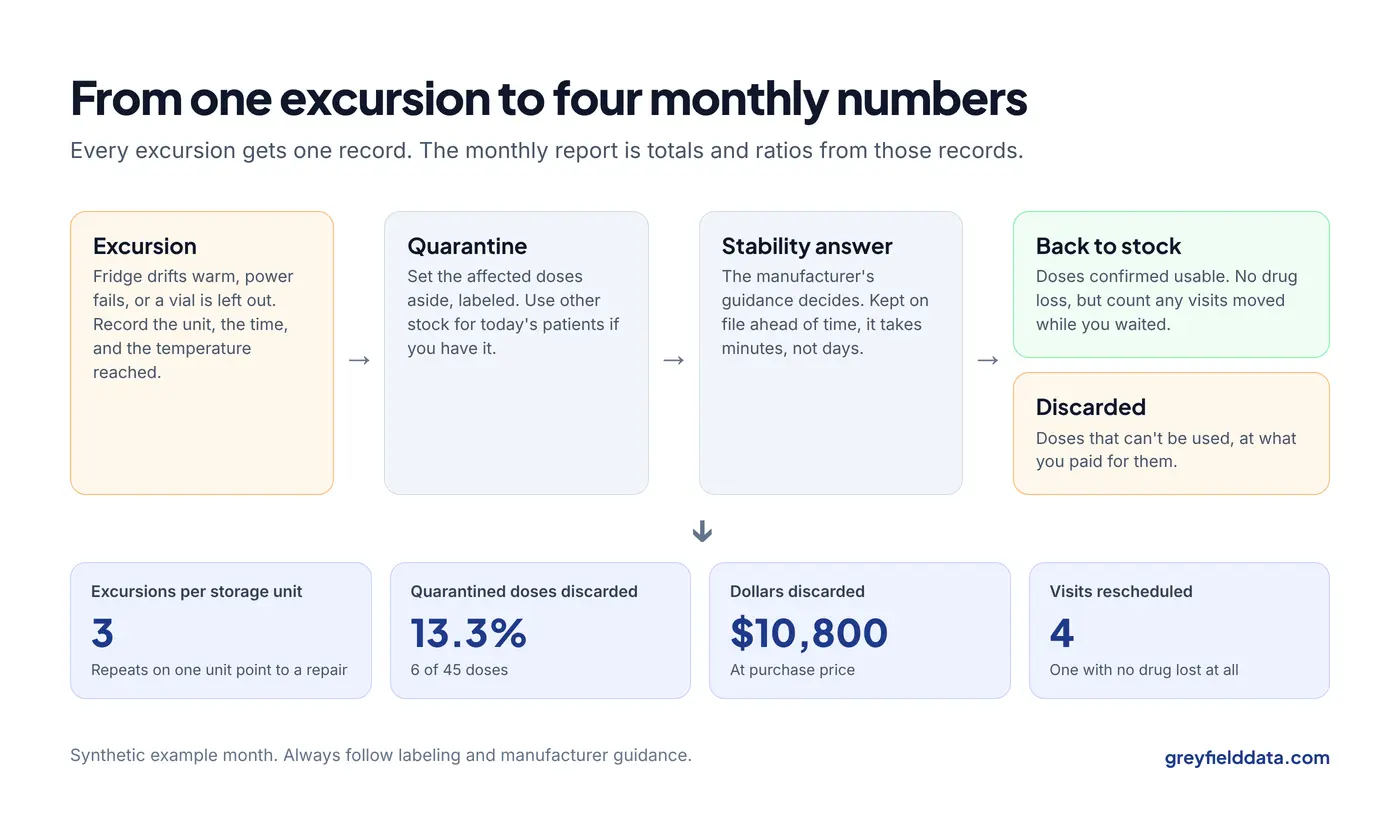
How do you turn a temperature log into a drug-loss report?
Give every excursion one row in a simple event list, and link everything else to it. You don't need new software to start. A shared spreadsheet with these columns works:
- Event: date, site, storage unit, and what happened (door left open, power loss, unit failure, item left out).
- Exposure: highest or lowest temperature reached, and for how long. Continuous monitors give you this directly; manual logs give you a range.
- Doses quarantined: each drug, lot, and quantity set aside.
- Stability answer: when you asked the manufacturer, when you got the answer, and what it said.
- Outcome per drug: quantity returned to stock and quantity discarded.
- Dollars discarded: quantity discarded times what you paid per unit, from your invoices. If you use WeInfuse, the WeInfuse inventory report guide shows where lot and quantity data sit.
- Visits rescheduled: count, plus patient appointment references so you can check them later.
- Root cause and fix: one line each.
Once the list exists, the monthly report is just totals and ratios from it. The hard part is discipline: every excursion gets a row, even the ones where nothing was lost. Those are the ones that tell you a unit is starting to fail.
Measure the log itself too
If you record temperatures by hand, count how many readings you expected and how many were recorded. Two readings a day for a fridge open 22 days a month is 44 expected readings. If 41 are on file, the log is 93.2% complete. A gap in the log is a gap in your evidence, and it is often where an excursion hides.
What does the monthly report look like?
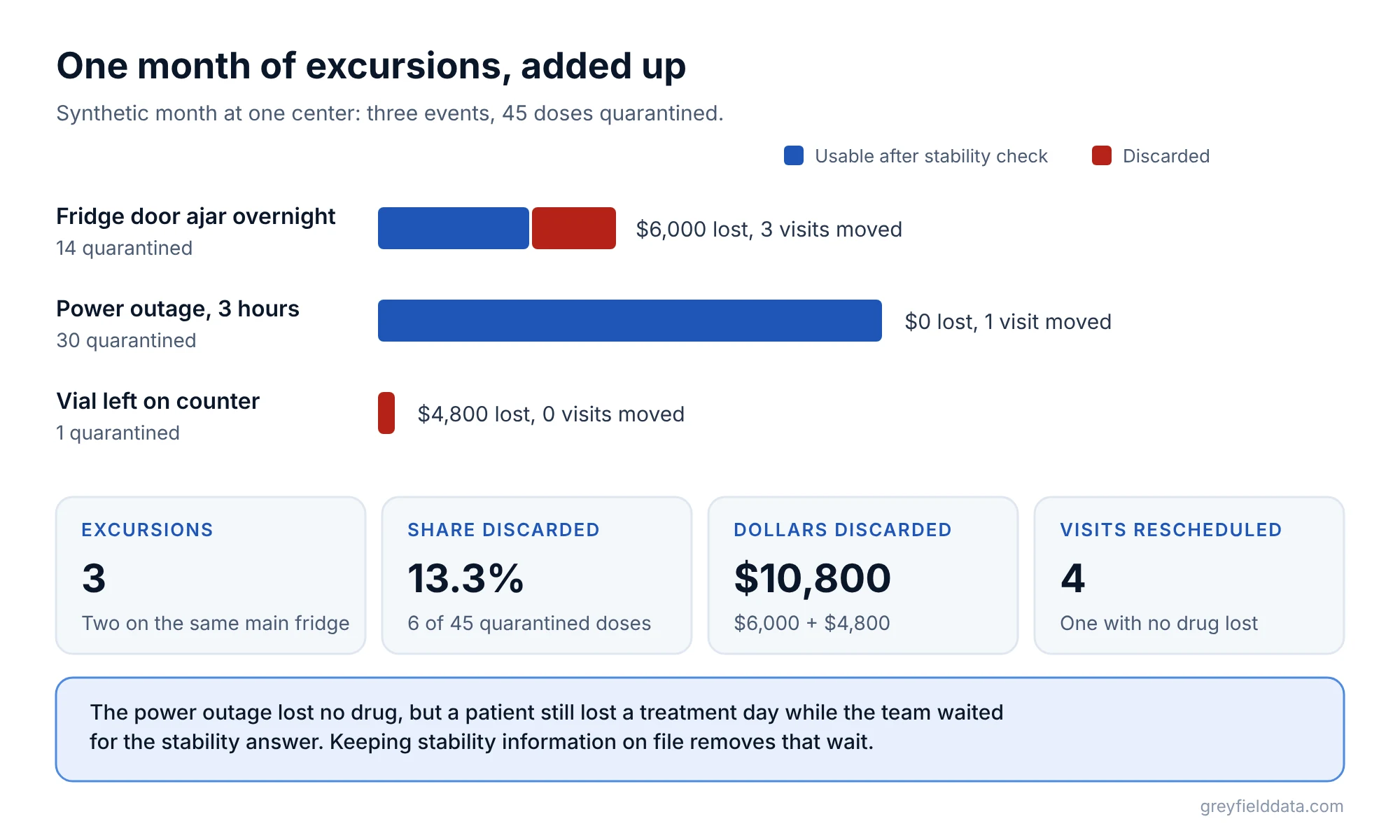
Here is one month for a center with three excursions. All numbers are synthetic: replace them with your own.
| Event | Doses quarantined | Usable after stability check | Discarded | Cost per dose | Dollars discarded | Visits rescheduled |
|---|---|---|---|---|---|---|
| Fridge door ajar overnight | 14 | 9 | 5 | $1,200 | $6,000 | 3 |
| Power outage, 3 hours | 30 | 30 | 0 | various | $0 | 1 |
| Vial left on counter | 1 | 0 | 1 | $4,800 | $4,800 | 0 |
| Month total | 45 | 39 | 6 | $10,800 | 4 |
The four numbers for the month:
- Excursions: 3, two of them on the same site's main fridge across the quarter.
- Share of quarantined doses discarded: 6 ÷ 45 = 13.3%.
- Dollars discarded: $6,000 + $4,800 = $10,800.
- Visits rescheduled: 4. The power outage caused one reschedule even though no drug was lost, because the stability answer took most of a day.
The lesson in this example is the power outage. Nothing was wasted, but a patient still lost a treatment day while the team waited. That is a process cost, and keeping stability information on file would have removed it.
Which patterns should you look for?
Look at three months together, because a single month is mostly noise. The patterns that matter:
- The same storage unit repeating. Two or more events on one unit in a quarter usually means it needs service or replacement. Compare the repair cost with the drug you've lost.
- Long waits for stability answers. Track hours from quarantine to answer. If it's often more than a few hours, build the stability file for your top drugs first.
- High-cost drugs in shared fridges. One expensive vial lost can outweigh a month of smaller events. Consider where your most expensive drugs sit.
- Excursions after hours. Events found in the morning point to alarms that nobody hears overnight.
- Discards with no matching event. If drug is being thrown away for temperature reasons with no event row, either the list is incomplete or something else is going on. That's a shrink question, covered in how to measure infusion drug inventory shrink.
Where does this fit with waste and accreditation?
Excursion loss is not billable waste, and it belongs in your accreditation evidence. Drug discarded after an excursion is not the same as drug left over from a single-dose vial.
Medicare's JW modifier reports the leftover part of a single-dose container opened for a patient's dose. Drug lost in a fridge failure was never opened for anyone's dose, so there is no claim to put it on. Keep the two apart in your records, and see the guide to JW and JZ modifiers for the billing side.
Your excursion list and temperature log also support the evidence you keep for an accreditation survey. NICA's policy template bundle includes a medication storage, handling, and disposal policy with a temperature log, according to its policy templates page. What a surveyor may ask for, and how to keep it current, is in what records to keep ready for accreditation.
This post is educational. Always follow the drug's labeling and the manufacturer's guidance on whether a drug can be used after an excursion.
WeInfuse is a trademark of its owner. Greyfield Data is independent and not affiliated with WeInfuse.
What to do next
Start the event list this week and back-fill the last three months from your discard records and incident notes.
Then pull your ten most expensive refrigerated drugs and collect the manufacturer's stability information for each before you need it. For where drug loss sits among the other money leaks, read where infusion centers lose revenue between order and deposit. The infusion analytics resource hub and the infusion center metrics white paper cover the wider set of monthly measures.
If you want the excursion list tied to your purchase prices and schedule so the monthly page builds itself, my WeInfuse reporting service covers that work, or book a call with me.
Frequently asked questions
How do you calculate the cost of a temperature excursion?
Multiply the doses discarded by what you paid per dose, then add the visits rescheduled and the staff hours spent. Count only discarded doses as drug loss; doses the manufacturer confirms as usable go back to stock.
Should every temperature excursion be logged, even if no drug was lost?
Yes. Events with no loss still show which storage units are failing and how long stability answers take. They are often the early warning before a costly event.
Can you bill for drug discarded after a temperature excursion?
Generally no. The JW modifier reports drug left over from a single-dose container opened for a patient's dose. Drug lost in storage was never part of a dose, so there is no claim line for it. Check your payer's and your billing advisor's guidance.
How often should a manual temperature log be checked?
Follow your policy, your state's rules, and the drug's labeling. Whatever the schedule, measure how many expected readings were recorded each month so gaps are visible.
Part of the Infusion analytics guides, a reading path through related articles.
Linus Tse
Founder of Greyfield Data. Built 400+ dashboards. Certified in Sigma, Snowflake, Tableau, and Power BI.
About Linus