What records should your infusion center keep ready for accreditation?
The records an infusion center accreditation survey looks at, where each one lives, and five monthly completeness checks that keep your evidence ready.

Written by Linus Tse, founder of Greyfield Data
· 7 min read
On this page 8 sections

An accreditation survey looks at your written policies and then at proof you follow them: patient charts, personnel files, training records, temperature and cleaning logs, event reports, and quality measures. Centers that struggle are rarely missing a policy. They're missing the proof, scattered across binders, shared drives, and three software systems. Keep one evidence pack, organized by area, and check five completeness numbers every month so the pack is ready whenever a survey is scheduled.
I build reporting for infusion providers. The same records an accreditor asks for are the ones that show whether a center runs the way its policies say. To see which of your records are ready to report on, take the infusion data readiness check. More on this work is on the infusion analytics page and the ambulatory infusion center page.
Key takeaways
- Surveys check proof, not just policies. Expect a review of policies plus charts, personnel files, interviews, and a site tour.
- Accreditation is not a one-time event. NICA's ambulatory infusion center accreditation runs for three years, with annual quality reporting in between.
- Organize evidence by area: people, patient care, medication and storage, environment and safety, and quality.
- Five monthly checks keep it ready: log completeness, current competencies, complete personnel files, chart audit results, and events reviewed on time.
- Reports support your evidence; they don't certify anything. Only the accrediting body decides whether you meet its standards.
What does an accreditation survey look at?
It looks at your documents first and then checks them against what actually happens.
The National Infusion Center Association (NICA) runs an accreditation program for ambulatory infusion centers. Its public site lists ten steps, running in this order:
- an application and a self-evaluation
- a benchmark assessment where you submit supporting evidence
- an assessment that can include chart and personnel-file review, interviews, observation, and a site tour
- a findings summary and a committee decision
Accreditation lasts three years and is kept through annual quality reporting. All of that is on the accreditation program's site.
The detailed requirements are in NICA's Standards of Excellence for Ambulatory Infusion Centers, which are sold separately. Read the current edition yourself; this post covers how to keep evidence organized, not what the standards say. Other accrediting bodies follow a similar pattern: policy, proof, and follow-up.
What evidence should the pack hold?
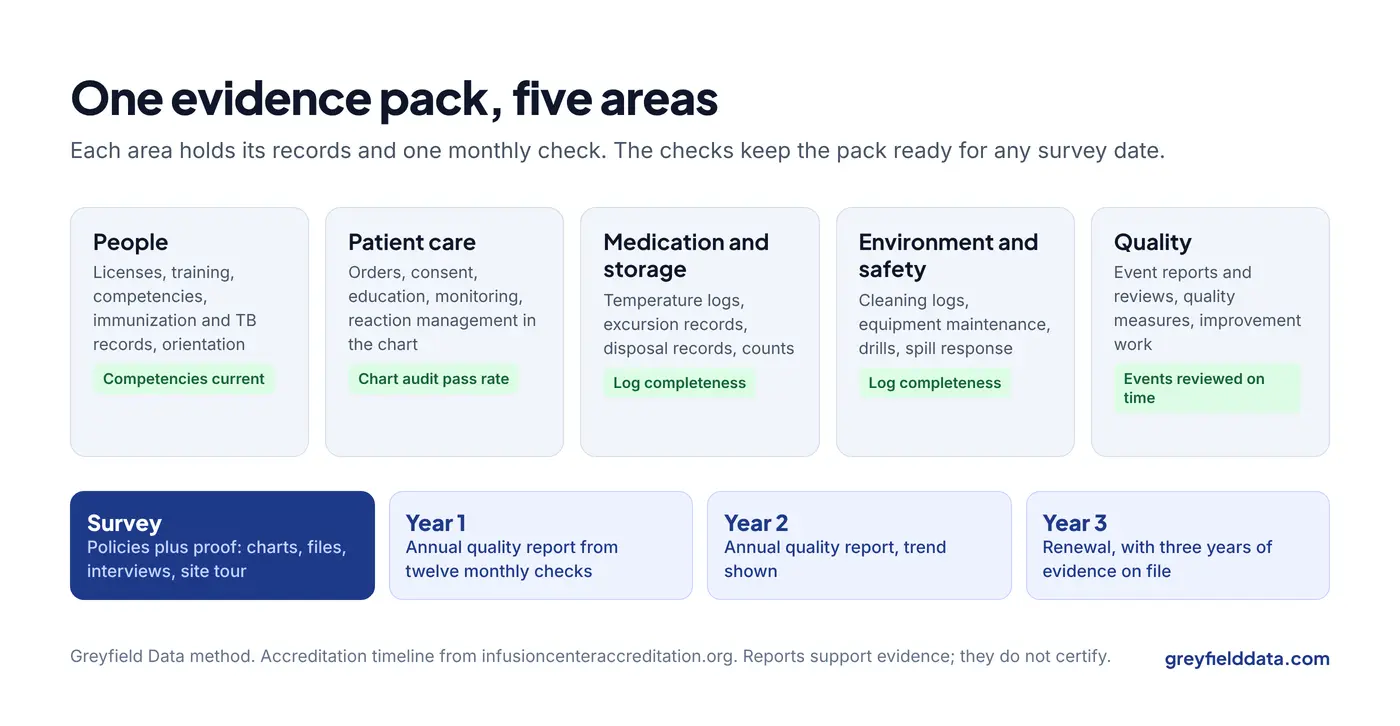
Organize it in five areas. The table lists what a surveyor may ask to see in each, where it usually lives, and the monthly check that keeps it current.
| Area | Evidence a surveyor may ask for | Where it usually lives | Monthly check |
|---|---|---|---|
| People | Licenses, training records, competency checks, immunization and TB records, orientation | HR files, a learning platform, spreadsheets | Competencies current; personnel files complete |
| Patient care | Valid orders, consent, education, monitoring, reaction management in the chart | Your infusion EHR | Chart audit pass rate |
| Medication and storage | Temperature logs, excursion records, storage and disposal records, inventory counts | Monitoring system, paper logs, inventory records | Log completeness |
| Environment and safety | Cleaning logs, equipment maintenance, emergency drills, spill response | Paper logs, facilities vendor reports | Log completeness |
| Quality | Event and incident reports, reviews, quality measures, improvement projects | Incident forms, meeting notes, reports | Events reviewed on time |
NICA's policy template bundle shows how these areas fit together. According to its policy templates page, the bundle includes:
- personnel topics such as training and competency
- event reporting with a report form
- environment of care with a daily cleaning log
- medication storage, handling, and disposal with a temperature log If you use templates, keep the logs and forms they call for in the same pack as the policy.
Which five numbers keep the pack ready?
Five completeness numbers, checked monthly, catch most gaps long before a surveyor does.
- Log completeness. Readings recorded ÷ readings expected, for temperature and cleaning logs. Expected readings come from your policy: for example, two temperature readings a day per storage unit.
- Competencies current. Clinical staff with every required competency in date ÷ all clinical staff.
- Personnel files complete. Files with every required item on your checklist ÷ all files.
- Chart audit pass rate. Charts that pass your audit checklist ÷ charts sampled. Pick a fixed sample each month, such as ten charts per site.
- Events reviewed on time. Event reports reviewed within your policy's window ÷ events reported.
Here is one quarter for a three-site group. All numbers are synthetic: replace them with your own.
| Check | Calculation | Result |
|---|---|---|
| Temperature log completeness | 1,287 readings recorded ÷ 1,320 expected (10 storage units × 2 a day × 66 open days) | 97.5% |
| Competencies current | 23 of 25 clinical staff | 92.0% |
| Personnel files complete | 30 of 32 files | 93.8% |
| Chart audit pass rate | 37 of 40 charts sampled | 92.5% |
| Events reviewed on time | 5 of 6 events | 83.3% |
Every number below 100% points to a named list. Here, that means the 33 missing readings with their units and days, the two staff with lapsed competencies, and the two incomplete files. It also means the three charts that failed and the one late review.
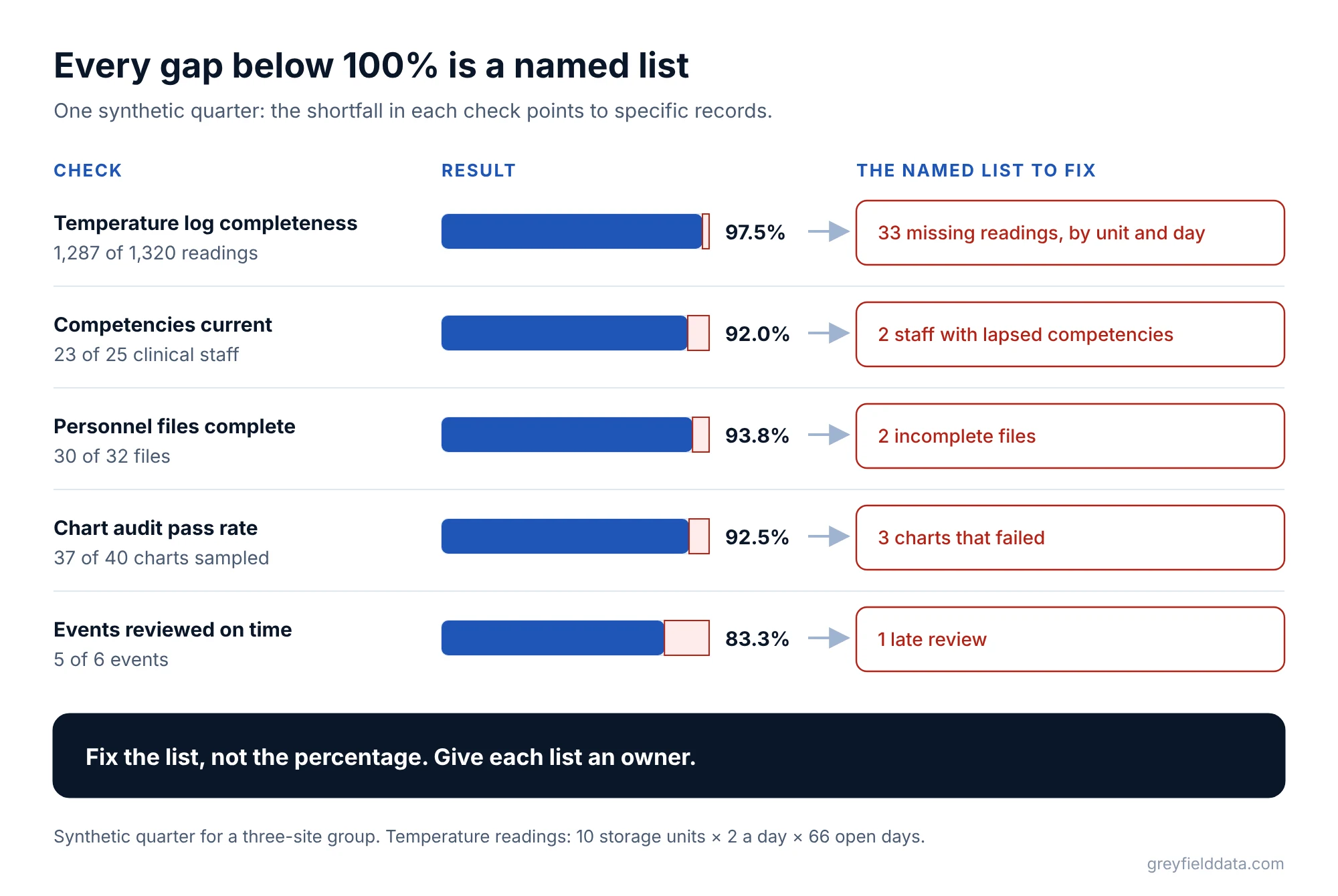
Fix the list, not the percentage. Named lists with an owner work the same way as the red flag reports operators use for billing and authorizations. For a multi-site group, the multi-site KPI rollup guide shows how to compare sites on the same definitions.
How do you get these numbers without a project?
Start with what you already have. Most of the inputs exist; they just aren't counted.
- Logs. If you use a continuous monitoring system, export its readings and alerts monthly. If logs are on paper, have each site enter a simple count of missed readings at month end.
- Competencies and files. One spreadsheet, one row per person, one column per required item with its expiry date. Count the blanks and the expired dates. If your headcount is changing, the infusion staffing planner shows how many nurses your chairs need, and so how many rows to track.
- Charts. Your EHR can usually list visits by date. Sample from that list and record pass or fail per checklist item, so you see which item fails most.
- Events. One list with report date, review date, and outcome. The excursion list in how to track temperature excursion drug loss is one example of this pattern. Inventory counts follow the method in the infusion drug inventory shrink guide.
Once the five numbers come from the same places every month, they can move into your regular reporting alongside your operating measures, so quality is reviewed with the same attention as volume. The infusion center KPI glossary defines the operating side. The infusion center metrics playbook shows how to put quality and operating measures on one monthly page.
What goes into the annual quality report?
Keep the year's monthly checks, your quality measures, and what you changed because of them. An annual report is much easier when twelve monthly snapshots already exist.
Check the accrediting body's instructions for what it requires each year, and keep your own trend lines alongside so you can show improvement, not just compliance.
Use careful wording when you talk about this work. Reports support your evidence for a standard; they don't make you accredited or certify that you meet it. Only the accrediting body decides that.
What to do next
List every record in the table above, note where each one lives today, and assign one owner per area. Then run the five checks for last month.
Owners and boards often want these results next to the finance numbers, as in the board monthly finance pack guide. The infusion analytics resource hub links every related guide.
If you'd like the checks built into a monthly report that pulls from your EHR, logs, and HR records, book a call with me.
Frequently asked questions
How long does ambulatory infusion center accreditation last?
NICA's ambulatory infusion center accreditation lasts three years, with annual quality reporting in between, according to the program's website. Other accrediting bodies set their own terms.
What do surveyors review during an infusion center accreditation?
NICA's program lists policies and supporting documents, quality activity records, patient charts, personnel files, interviews, observation, and a site tour. Keep proof for each policy, not just the policy itself.
How do we prepare for an accreditation survey without a scramble?
Keep the evidence pack current every month instead of building it before the survey. Five completeness checks, each tied to a list of what's missing, keep gaps small.
Can software make an infusion center accreditation-ready?
No software can make you accredited. Good reporting supports your evidence by showing gaps early, but the accrediting body decides whether you meet its standards.
Part of the Infusion analytics guides, a reading path through related articles.
Linus Tse
Founder of Greyfield Data. Built 400+ dashboards. Certified in Sigma, Snowflake, Tableau, and Power BI.
About Linus