How do copay accumulators hit your infusion patients and your A/R?
How copay accumulators turn into surprise mid-year patient bills, how to spot affected patients early, and how to measure the cost in your A/R and missed doses.

Written by Linus Tse, founder of Greyfield Data
· 8 min read
On this page 8 sections

A copay accumulator lets a health plan take a patient's manufacturer copay assistance without counting it toward the patient's deductible or out-of-pocket maximum. The assistance runs out partway through the year, and the patient suddenly owes the full cost share as if they'd paid nothing yet. For your center, that shows up as a jump in patient balances mid-year, then cancellations and missed doses.
You can measure it: flag patients on assistance by plan, project the month each one's assistance runs out, and track patient balances and missed doses around that month.
I build reporting for infusion providers that follows patient balances and missed visits by payer, so financial counselors can call patients before the bill arrives, not after. To see what missed doses cost your schedule, try the infusion no-show cost calculator. More on this work is on the infusion analytics page and the ambulatory infusion center page.
Key takeaways
- Accumulators don't count assistance toward the deductible or out-of-pocket maximum. When assistance runs out, the patient starts from zero.
- Maximizers spread the assistance evenly across the plan year, so it lasts all year but the patient still never reaches the maximum through assistance.
- The month assistance runs out is predictable. Divide the assistance cap by the patient's cost share per visit.
- Measure three things: patients on assistance in accumulator plans, projected run-out month, and patient balances and missed doses after it.
- State laws vary, and many employer plans follow federal rules instead. Check which rules apply to each plan before telling a patient what to expect.
What are copay accumulators and maximizers?
Both are health plan policies that change how manufacturer copay assistance counts. The National Infusion Center Association (NICA) defines both on its copay accumulators and maximizers issue page.
| Policy | What the plan does with assistance | What the patient feels |
|---|---|---|
| Standard plan | Counts assistance toward the deductible and out-of-pocket maximum | Assistance covers the cost share until the maximum is met, then the plan pays in full |
| Copay accumulator | Takes the assistance but doesn't count it toward the deductible or maximum | Pays nothing at first, then a large bill when assistance runs out |
| Copay maximizer | Spreads the assistance's full value evenly through the plan year, without counting it toward the maximum | Steady cost share covered all year, but never reaches the maximum through assistance |
NICA's page also has a state map of "all copays count" laws, which require plans to count payments made on a patient's behalf. It notes that many employer plans are regulated under federal law rather than state law, so a state protection may not apply to a patient's plan. The plan administrator can say which rules apply.
What does an accumulator do to one patient's year?
Here's one patient over a plan year. All numbers are synthetic: they show the pattern, not any real plan or drug.
- Allowed amount per visit (drug and administration): $5,000
- Visits: every four weeks, 13 a year
- Deductible: $3,000. Coinsurance after the deductible: 20%. Out-of-pocket maximum: $6,000
- Manufacturer assistance cap: $15,000 a year
On a standard plan, the cost share is $3,400 at the first visit ($3,000 deductible plus 20% of the remaining $2,000), then $1,000, $1,000, and $600, which reaches the $6,000 maximum at visit four. Assistance pays all $6,000. The patient pays nothing.
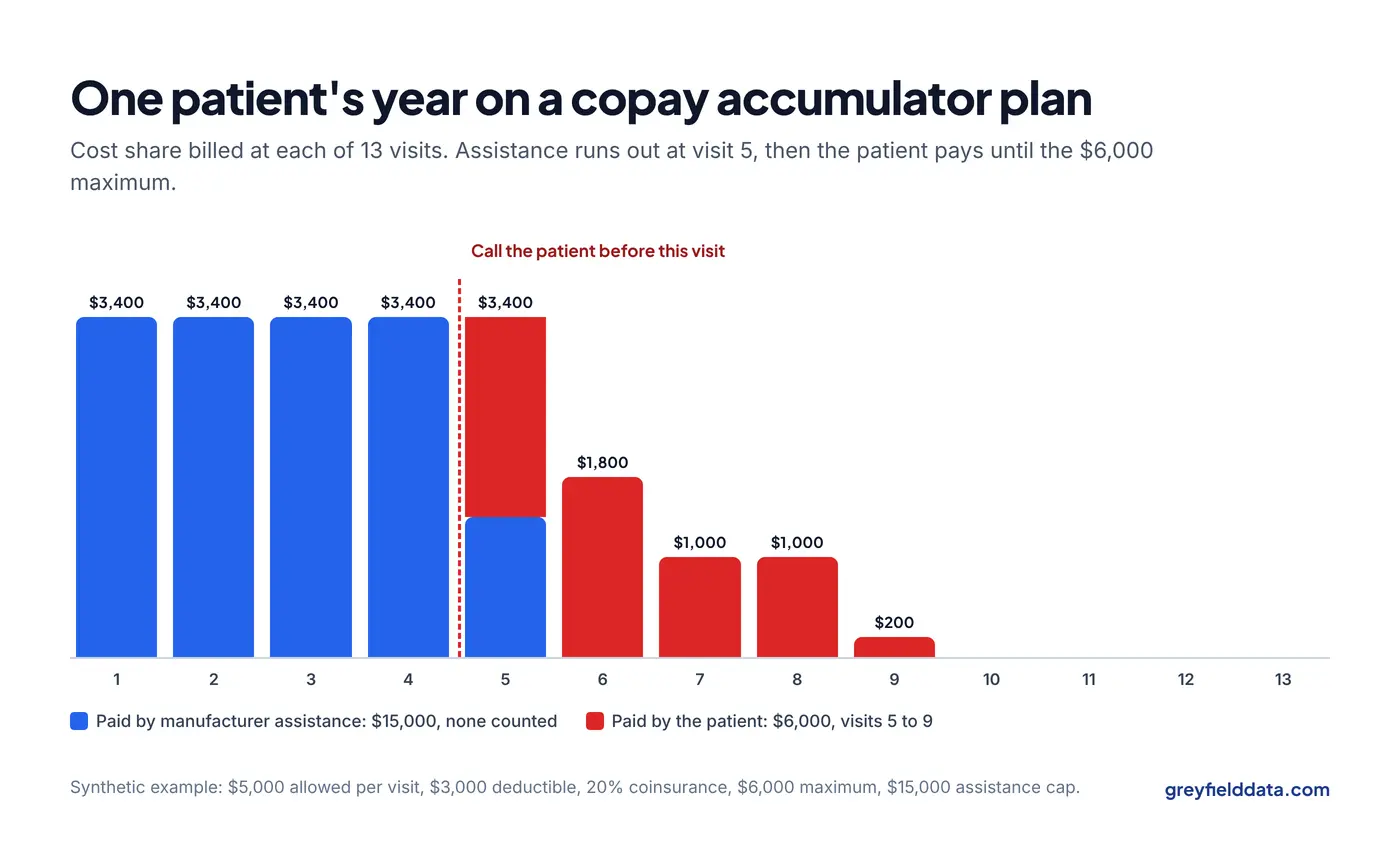
On an accumulator plan, assistance pays but nothing counts, so every visit is billed as if it were the first:
| Visit | Cost share billed | Paid by assistance | Paid by patient | Patient's amount counted toward the maximum |
|---|---|---|---|---|
| 1 to 4 | $3,400 each | $3,400 each ($13,600 total) | $0 | $0 |
| 5 | $3,400 | $1,400 (cap reached) | $2,000 | $2,000 |
| 6 | $1,800 | $0 | $1,800 | $3,800 |
| 7 | $1,000 | $0 | $1,000 | $4,800 |
| 8 | $1,000 | $0 | $1,000 | $5,800 |
| 9 | $200 | $0 | $200 | $6,000 |
| 10 to 13 | $0 | $0 | $0 | $6,000 |
Visit 6 works like this: $1,000 of deductible is left after the patient's $2,000, plus 20% of the remaining $4,000, or $800, for $1,800.
The totals: assistance pays its full $15,000, and the patient still pays $6,000, all of it between visits 5 and 9. Total cost share collected is $21,000 instead of $6,000. The patient who paid nothing for four months gets a $2,000 bill at the fifth visit and $4,000 more over the next four. That's when patients call to cancel.
How do you spot affected patients before the bill?
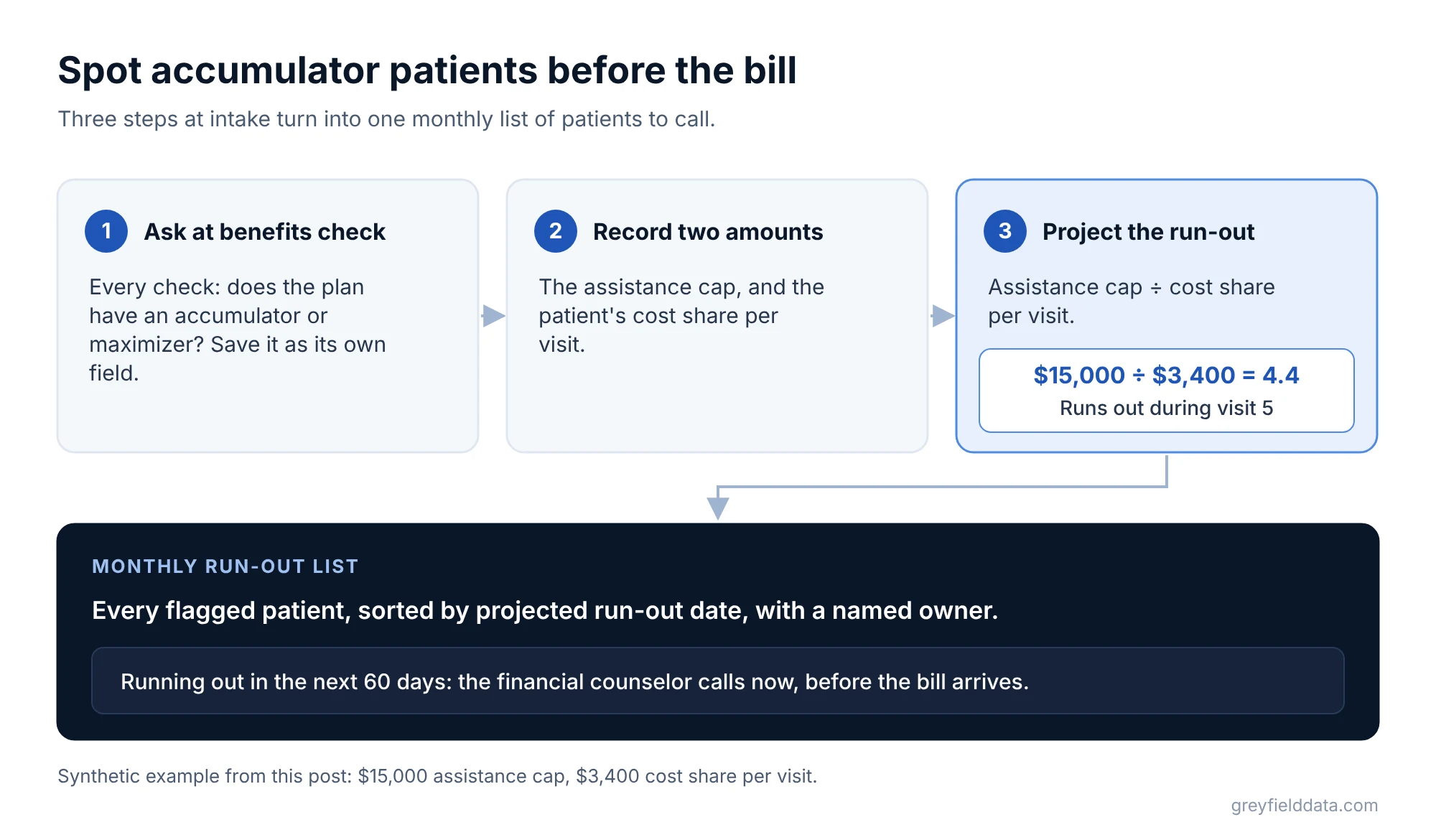
Flag them during benefits checks, then predict the run-out month. Three steps:
- Ask during every benefits check whether the plan has an accumulator or maximizer program, and record the answer as its own field, not in a free-text note. NICA's 2027 open enrollment guide for providers is a useful checklist for the questions to ask.
- Record the assistance cap and the patient's cost share per visit.
- Project the run-out visit: assistance cap ÷ cost share per visit. In the example, $15,000 ÷ $3,400 = 4.4, so assistance runs out during the fifth visit.
Put every flagged patient on a monthly list sorted by projected run-out date. The ones running out in the next 60 days need a call from your financial counselor now, while there's time to apply for other help or plan for the cost. This list works best as one of your standing red flag reports, with a named owner.
How do you measure the cost to your center?
Track four numbers each month, split between patients in accumulator or maximizer plans and everyone else:
| Number | Calculation | What it shows |
|---|---|---|
| Patients in accumulator or maximizer plans | Count from your benefits-check field | How big the exposure is |
| Patient balance per patient | Open patient balances ÷ patients | Whether accumulator patients carry larger balances |
| Missed or cancelled doses | Doses missed within 60 days after run-out ÷ doses scheduled | Whether the bill is driving patients off therapy |
| Patient balances written off | Write-offs over the period | What you're absorbing |
Compare the two groups, not just the totals. The infusion center KPI glossary has standard definitions for missed doses and patient balances, so both groups are counted the same way.
If accumulator patients carry similar balances and miss no more doses than others, your counseling is working. If their missed doses jump after run-out, you have a clear case for earlier outreach and for raising the issue in payer and employer conversations.
Patients who stop therapy never show up as a denial or a write-off. They just stop booking. That's the same quiet loss covered in where referrals stall before the first infusion, only later in the patient's journey. Separating what's billed from what's collected, as in charges, claims, expected payment, and collections, shows where patient balances sit in your A/R. The revenue leakage guide shows the other places money slips between order and deposit, and the infusion revenue leakage calculator sizes them in dollars.
When should you run this?
Two moments matter most:
- Open enrollment and January. Plans change, so recheck every patient's benefits for the new year.
- Monthly, for the run-out list. It changes every month as patients use their assistance.
If you also dispense through a pharmacy, the same run-out list helps there. The specialty pharmacy page covers reporting for that side of the business.
This post is educational and isn't legal or insurance advice. Rules on accumulators depend on the plan type and state, and they change. Check current law and each plan's documents.
What to do next
Add an "accumulator or maximizer" field to your benefits check this month, and back-fill it for patients on your highest-cost drugs. Then build the run-out list and call the patients due to run out in the next 60 days.
The infusion center metrics playbook shows where these numbers sit next to your other monthly measures. The infusion analytics resource hub links every related guide. If you'd like the run-out list and the four monthly numbers built from your intake and billing records, book a call with me.
Frequently asked questions
What is a copay accumulator in infusion?
It's a health plan policy that accepts manufacturer copay assistance but doesn't count it toward the patient's deductible or out-of-pocket maximum. When assistance runs out, the patient owes the full cost share.
What is the difference between a copay accumulator and a copay maximizer?
An accumulator lets assistance run out early in the year. A maximizer spreads the assistance's full value evenly across the year. Neither counts the assistance toward the patient's maximum.
How do I know if a patient's plan has a copay accumulator?
Ask during the benefits check and read the plan documents. Record the answer as its own field so you can report on it.
Are copay accumulators legal?
It depends on the plan and the state. Some states have "all copays count" laws, but many employer plans follow federal rules instead. NICA keeps a state map of these laws.
Part of the Infusion analytics guides, a reading path through related articles.
Linus Tse
Founder of Greyfield Data. Built 400+ dashboards. Certified in Sigma, Snowflake, Tableau, and Power BI.
About Linus