Charges, claims, expected payment and collections in infusion
Charges, claims, expected payment and collections are four different infusion numbers. Here is what each means, which to use for what, and a worked example.

Written by Linus Tse, founder of Greyfield Data
· 8 min read
On this page 9 sections
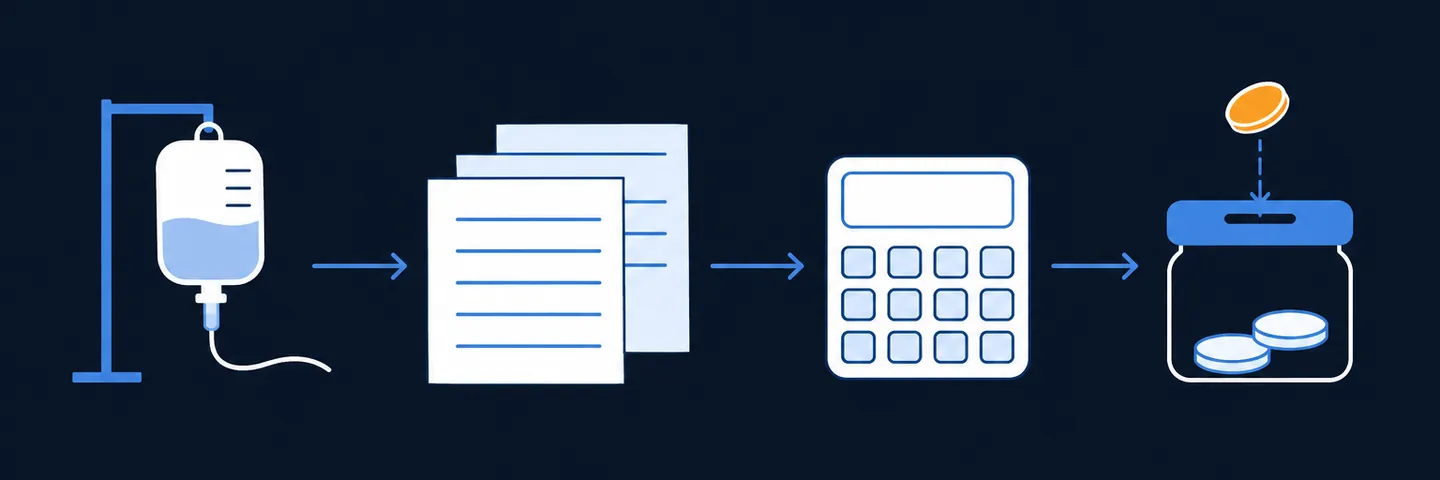
Charges, claims, expected payment and collections are four different numbers, and an infusion center needs all four. Charges are your list prices. A claim is the bill you send. Expected payment is what your contract or fee schedule says the payer should allow. Collections are the cash that actually arrived. Use charges to check nothing was missed, expected payment to check the payer, and collections to plan cash. Mixing them is how a center ends up celebrating a record month that never shows up in the bank.
I build reporting for infusion providers that keeps these numbers in separate columns on the same page, so the owner, the billing lead, and the sales team stop arguing about whose revenue figure is right. To see how much a missed claim costs on one drug, try the buy-and-bill margin calculator.
Key takeaways
- Charges are your own list prices times units. They are set by you, not the payer, and are usually far above what anyone pays.
- Expected payment is what the payer should allow under your contract or fee schedule. It is the right yardstick for underpayments.
- Allowed is what the payer decided on the remittance. Paid is the payer's share of allowed. The patient's share is the rest.
- Collections are cash received from payers and patients. They are the only one of the four you can spend.
- Each question has one right number: volume and completeness use claims and charges, payer behavior uses expected versus allowed, and cash planning uses collections.
What does each number mean?
Each number comes from a different point in the life of a visit. The table defines them in order.
| Number | Plain meaning | Who sets it | Where you find it |
|---|---|---|---|
| Charge | Your list price for each line, times units | You (your fee schedule or chargemaster) | Billing system |
| Claim (billed amount) | The bill sent to the payer; total of the charges on it | You | Billing system, clearinghouse |
| Expected payment | What the payer should allow under contract or fee schedule | Your contract, or Medicare's published rates | Your contract terms, loaded into billing |
| Allowed | What the payer decided the service is worth | Payer | Remittance (835) |
| Paid | What the payer sent you | Payer | Remittance and bank deposit |
| Patient responsibility | Deductible, coinsurance, copay | Payer's decision, patient owes it | Remittance |
| Collections | Cash actually received, from payer and patient | Reality | Bank deposits, posted payments |
For Medicare Part B drugs, the expected payment for the drug line starts from the quarterly payment limit CMS publishes (ASP pricing files). The gap between your charge and the allowed amount usually appears on the remittance as a contractual adjustment, often with claim adjustment reason code 45, "charge exceeds fee schedule/maximum allowable" (X12 claim adjustment reason codes).
How do the four numbers play out on one visit?
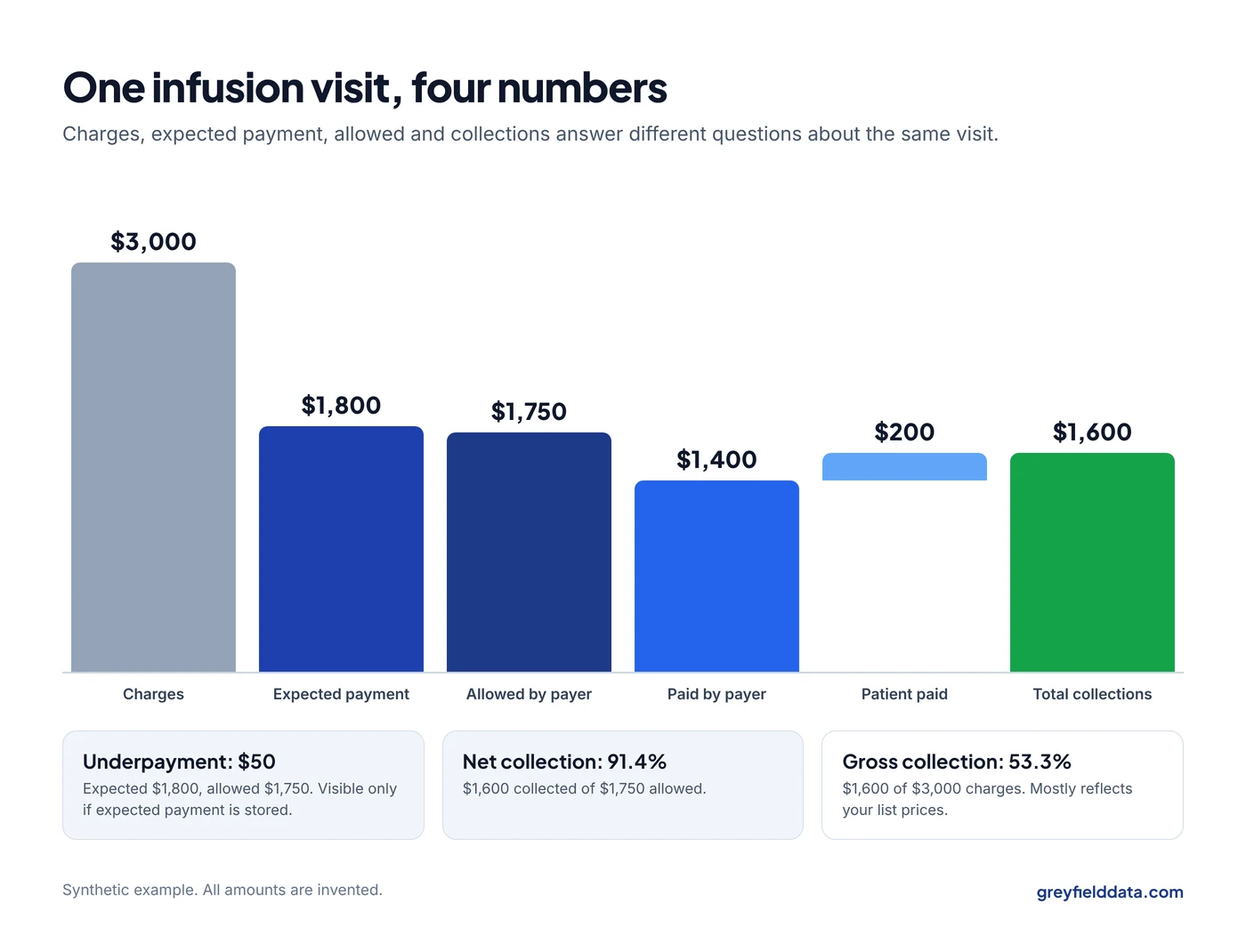
Here is one visit from start to cash. All numbers are synthetic.
| Step | Amount | How it's calculated |
|---|---|---|
| Charges on the claim | $3,000 | Drug and administration lines at your list prices |
| Expected payment | $1,800 | Your contract rate for these lines |
| Allowed by payer | $1,750 | From the remittance |
| Paid by payer | $1,400 | From the remittance |
| Patient responsibility | $350 | $1,750 − $1,400 |
| Collected from patient | $200 | Patient has paid part so far |
| Total collections | $1,600 | $1,400 + $200 |
Four questions, four answers from the same visit:
- Did we bill everything? Compare charges with what was documented. Here, yes.
- Did the payer pay what it should? Expected $1,800, allowed $1,750. The payer underpaid by $50. That shows up only if expected payment is stored somewhere.
- How much of what we're owed have we collected? $1,600 of $1,750 allowed, or 91.4 percent ($1,600 ÷ $1,750).
- How does cash compare with charges? $1,600 of $3,000, or 53.3 percent. This ratio mostly reflects how high your list prices are, not how well you collect.
Which number should you use for what?
Use the number that matches the decision. This is the table I hand to owners when two reports disagree.
| Question | Use | Don't use |
|---|---|---|
| Did every visit get billed? | Claim count and units against visits documented | Collections (too late, too noisy) |
| Is a payer paying below contract? | Allowed versus expected payment, line by line | Charges (you set them, payer ignores them) |
| How healthy is our collecting? | Collections ÷ allowed (net collection rate) | Collections ÷ charges |
| How much cash will we have next month? | Collections trend and A/R by age | Charges or claims sent |
| Is a drug worth carrying? | Expected or actual payment minus drug cost | Charges |
| How is the sales team doing? | Visits or a fixed reference value per visit | Charges, or contract rates |
The last row matters more than it looks. Charges inflate a rep's numbers and vary with your price list. Contract rates are confidential and swing with payer mix. A fixed reference value per visit is fairer, as explained in how to give your infusion sales team a fair value per visit.
Why do reports from different teams disagree?
Reports disagree because each team picks a different one of these numbers and calls it "revenue".
The billing company reports charges or claims sent. The owner looks at deposits. The finance team books expected payment when the visit happens. All three can be correct and still not match.
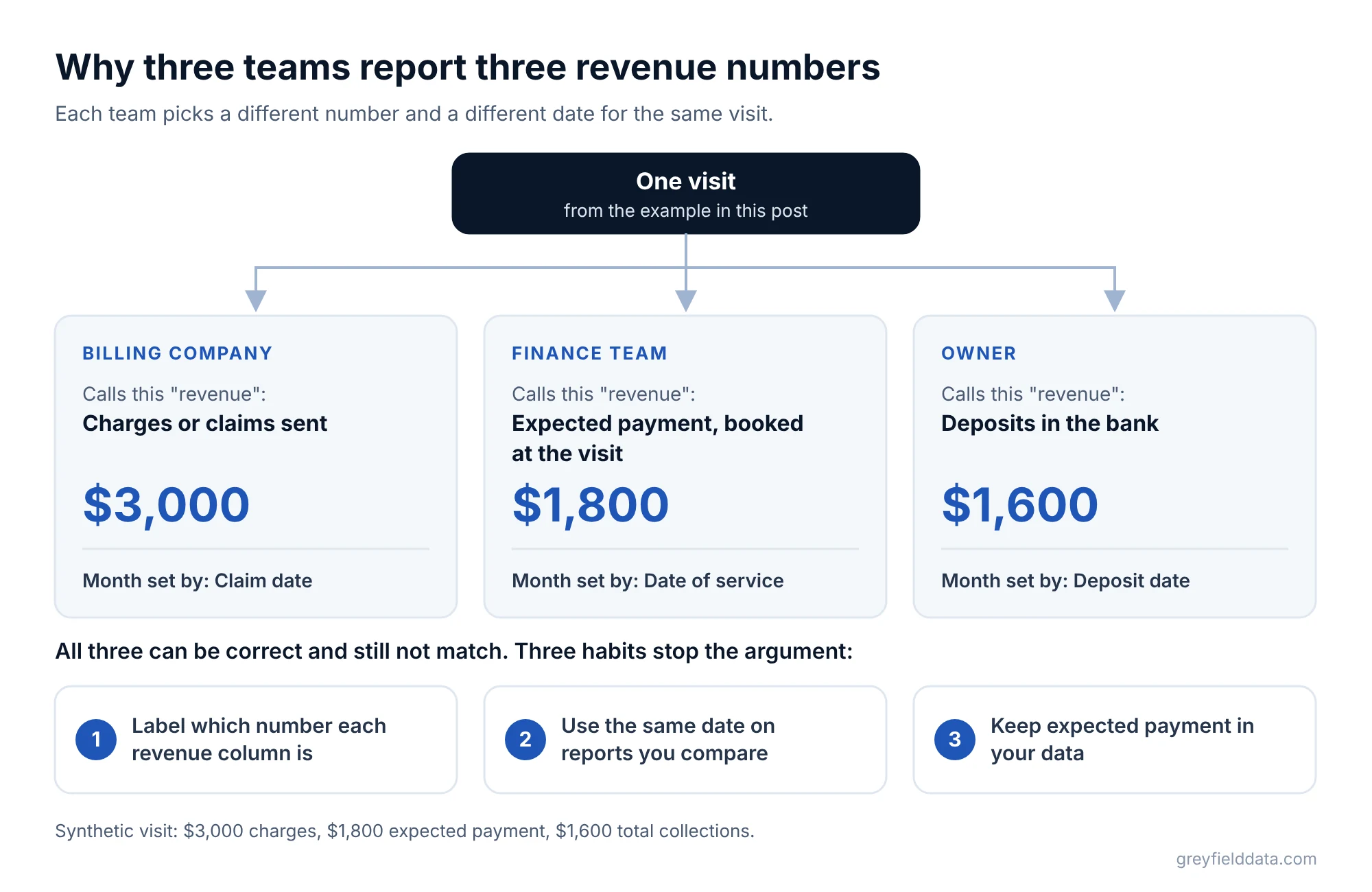
Three habits stop the argument:
- Label every revenue column with which number it is. "Revenue" alone is not a label.
- Use the same date on every report you compare. Date of service, claim date, and deposit date give different months for the same visit.
- Keep expected payment in your data. Without it, you can't tell an underpayment from a normal contractual adjustment.
Definitions and formulas for the related measures, including net collection rate and days in A/R, are in the infusion center KPI glossary. For multi-site groups, a data warehouse that ties to the books keeps these labels the same at every site.
What's the difference between net and gross collection rate?
Net collection rate divides what you collected by what you were allowed to collect. Gross collection rate divides collections by charges.
Net tells you how well you collect. Gross mostly tells you how high your prices are.
From the example: net is $1,600 ÷ $1,750 = 91.4 percent, and gross is $1,600 ÷ $3,000 = 53.3 percent. If you raised your list prices tomorrow, gross would fall and nothing real would have changed.
Some teams subtract write-offs they consider unavoidable before dividing. That's fine if it's written down and applied the same way every month.
Where does money get lost between these numbers?
Money gets lost at each gap:
- Between visit and charge: units or waste never reach the claim. See the JW and JZ modifier guide.
- Between charge and allowed: denials and underpayments. See the denial analysis guide.
- Between allowed and collected: patient balances never collected, and payments posted but never deposited. Copay accumulator programs widen this gap, as the copay accumulator guide shows.
The full path, with a weekly report for each gap, is in where infusion centers lose revenue between order and deposit. The infusion revenue leakage calculator puts a monthly dollar figure on those gaps.
This post is educational. It isn't accounting or billing advice; ask your accountant how to recognize revenue in your books.
What to do next
Take last month's revenue report and write next to each column which of the four numbers it is. If any column is unclear, or expected payment is missing, that's where to start.
The infusion revenue cycle dashboards guide shows how to lay them out on one page. The board monthly finance pack guide shows which of the four belong in front of owners and lenders. The infusion analytics resource hub links every related guide. If you want help getting all four into one report, book a call with me. More on this work is on the infusion analytics page and the ambulatory infusion center page.
Frequently asked questions
What should our net collection rate be?
There is no reliable public benchmark for infusion centers, because centers define the rate differently. Write down your formula, measure it for a quarter, and track the trend by payer.
Why are my charges so much higher than my payments?
Charges are your list prices, and payers pay their own contracted or published rates instead. The difference is a contractual adjustment, not lost money, unless the allowed amount is below what your contract says.
Is expected payment the same as allowed amount?
No. Expected payment is what you think the payer should allow, and allowed is what the payer actually decided. The gap between them is where underpayments hide.
Which revenue number should I report to my board?
Report collections for cash, and expected or allowed revenue for performance, each clearly labeled. Ask your accountant which figure matches how your books recognize revenue.
Part of the Infusion analytics guides, a reading path through related articles.
Linus Tse
Founder of Greyfield Data. Built 400+ dashboards. Certified in Sigma, Snowflake, Tableau, and Power BI.
About Linus