Ordering vs rendering vs referring provider in infusion
Ordering, referring, rendering and supervising are different roles on an infusion claim. What each means, and why reports disagree on who sent a patient.

Written by Linus Tse, founder of Greyfield Data
· 8 min read
On this page 9 sections

On an infusion claim, each provider role answers a different question:
- The referring or ordering provider is the clinician who sent the patient or wrote the order.
- The rendering provider is the clinician whose ID is on the service line as performing it.
- The supervising provider is the clinician who oversaw it, when Medicare requires one to be reported. In a stand-alone infusion center these are often different people. That's why your EHR, your billing reports, and public Medicare data can each name a different doctor as the one who "sent" the same patient.
I've had to pin these rules down in two kinds of work. One was a reporting connector for a hub-services company, where enrollment depended on getting ordering and rendering right. The other was referral reporting for ambulatory infusion centers, where sales credit depended on it. If referral credit is your problem, how to give your infusion sales team a fair value per visit shows the other half of the fix.
Key takeaways
- Referring provider: requests the service for the patient. Ordering provider: orders the service, such as a drug given incident to their care. On the paper Medicare claim form both go in item 17, with a code that says which role (CMS Claims Processing Manual, chapter 26).
- Rendering provider: the clinician whose ID goes on the service line (item 24J). For a service given incident to another clinician's care, when the ordering clinician isn't supervising, CMS says to enter the supervisor's ID there.
- Supervising provider: reported in item 17 with its own code when Medicare policy requires it.
- Public Medicare Part B provider data is organized by the rendering provider, so it often names the infusion center's clinician rather than the doctor who referred the patient.
- For "who sent this patient", use the referring or ordering clinician on the order, tied to their practice. Write that rule down and use it in every report.
What does each provider role mean?
Each role answers a different question about the same visit. CMS defines them in its instructions for the paper claim form, and the electronic claim carries the same roles.
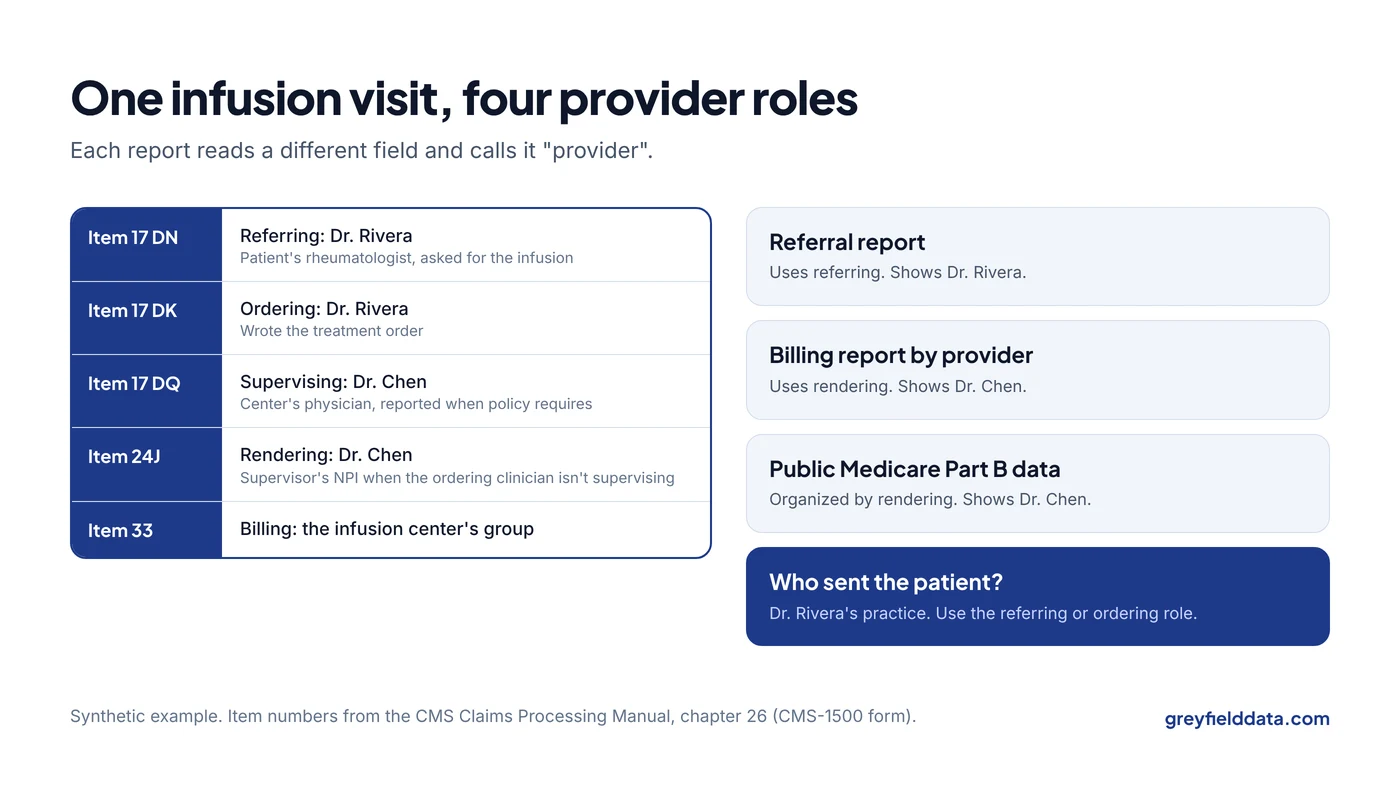
| Role | Plain meaning | Where on the paper claim (CMS-1500) | Usual person in a stand-alone infusion center |
|---|---|---|---|
| Referring | Asked for the service for this patient | Item 17, qualifier DN, NPI in 17b | The patient's specialist |
| Ordering | Ordered the service, such as the infusion | Item 17, qualifier DK, NPI in 17b | The patient's specialist, or the center's clinician if they wrote the treatment order |
| Supervising | Supervised the service, when Medicare policy requires it | Item 17, qualifier DQ, NPI in 17b | The center's physician or practitioner on site |
| Rendering | Clinician whose ID is on the service line | Item 24J | Often the center's supervising clinician |
| Billing | Entity that bills and gets paid | Item 33 | The infusion center's group |
Source: item-by-item instructions in the CMS Claims Processing Manual, chapter 26. The manual defines a referring physician as one "who requests an item or service for the beneficiary." It defines an ordering physician as one who "orders non-physician services for the patient", including "services incident to that physician's or non-physician practitioner's service."
When a claim involves more than one referring, ordering, or supervising clinician, the manual says to use a separate claim form for each.
Why are rendering and referring often different in infusion?
They differ because many infusions are billed under Medicare's "incident to" rules, where nurses give the drug under the supervision of a physician or practitioner. For those services, the manual says that when the person who ordered the service is not supervising, the supervisor's ID goes in the rendering field (item 24J).
In a physician's own infusion suite, the same doctor may order, supervise, and render. In a stand-alone infusion center, the patient's specialist refers, and the center's clinician often supervises and is listed as rendering. Incident-to rules have detailed requirements about who must start and stay involved in the course of care. Check them with your billing team and current CMS policy; this post isn't billing advice.
Why do reports disagree on who sent the patient?
Reports disagree because each one reads a different field and calls it "provider".
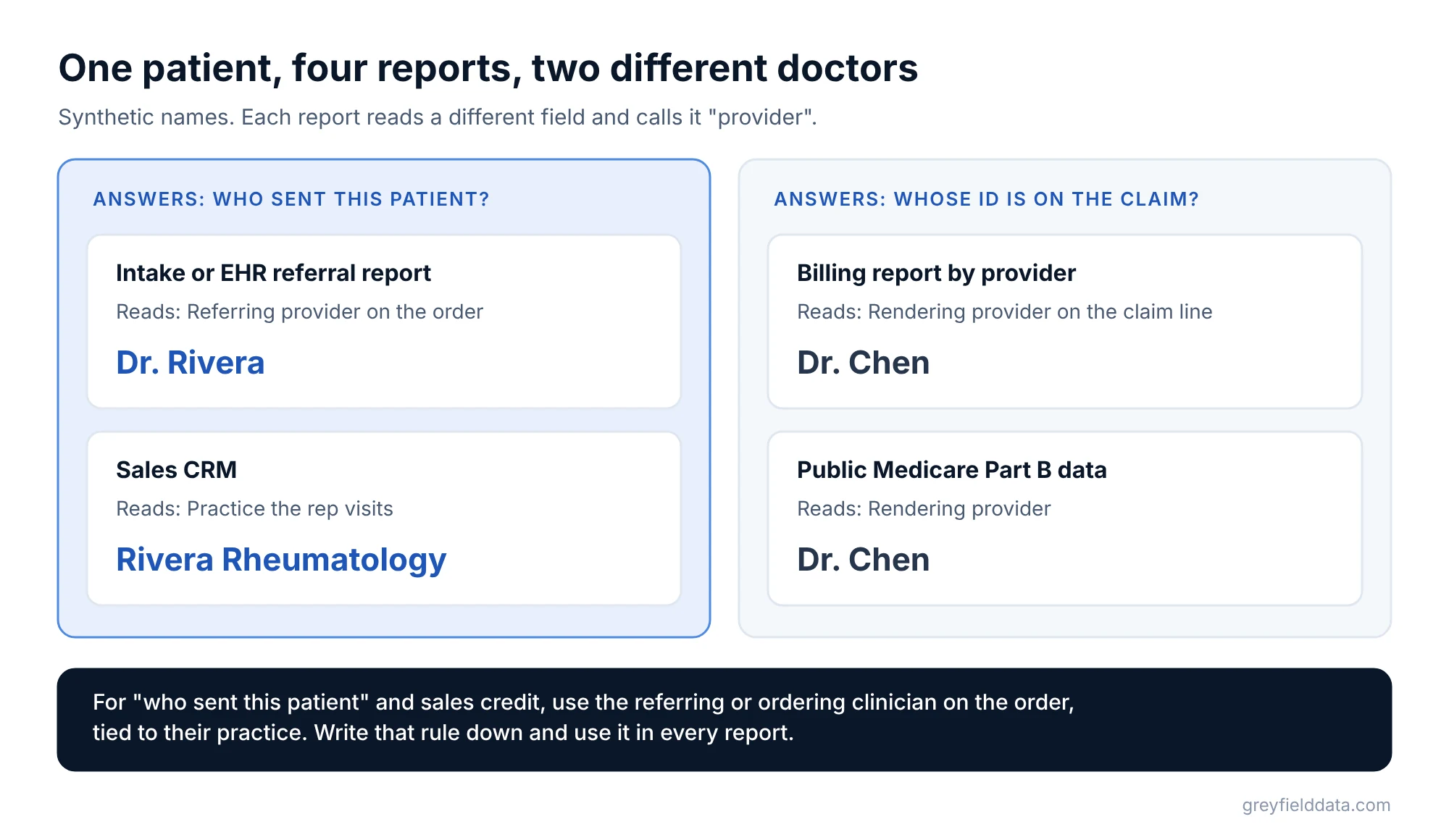
Here is one patient, seen through four reports. All names are synthetic.
| Report | Field it uses | Provider it shows |
|---|---|---|
| Intake or EHR referral report | Referring provider on the order | Dr. Rivera (patient's rheumatologist) |
| Billing report by provider | Rendering provider on the claim line | Dr. Chen (center's supervising physician) |
| Public Medicare Part B data | Rendering provider | Dr. Chen |
| Sales CRM | Practice the rep visits | Rivera Rheumatology |
All four are "right". Only the first and last answer who sent the patient.
This explains a common surprise with public data. The Medicare Part B provider file is organized by the rendering provider (data dictionary), so an infusion center's own physician can look like the area's top prescriber of a drug they never prescribe. More on reading that file in how to find infusion drug prescribers with free Medicare data.
Which provider should each report use?
Pick the role that matches the question, and write the rule down.
| Question | Use | Why |
|---|---|---|
| Which practices send us patients? | Referring or ordering clinician on the order, tied to a practice | That's who chose to send the patient |
| Which rep gets credit? | Same as above | Credit follows the referral |
| Who supervised this visit? | Supervising provider | Compliance and staffing |
| Whose ID is on the claim, and is it enrolled? | Rendering and billing provider | Claims can be rejected if IDs are missing or not enrolled |
| Which clinicians bill this drug in a market? | Rendering provider in public data | Matches how CMS publishes it |
For the referral questions, also check that the referring clinician is enrolled to order and refer in Medicare. CMS publishes the list as the Order and Referring file, and the manual says all physicians who order services or refer Medicare beneficiaries must report this data on the claim.
What goes wrong when the roles are mixed up?
Four problems show up again and again:
- Sales credit goes to the wrong practice. Credit follows the rendering clinician, so the center's own physician "refers" everyone.
- Referral trends look flat when they're not. One referring practice grows while another shrinks, but the report shows one rendering doctor with steady volume.
- Portals show the wrong patients. A referring office logs in and sees no patients because referrals were tied to the rendering ID. See a referring provider portal for infusion centers.
- Claims get rejected. A missing or unenrolled ordering or referring ID can stop a Medicare claim. The infusion denial analysis guide shows how to group these payer refusals by cause.
How do you fix it in your data?
Fix it by storing each role separately and choosing one on purpose for each report.
- Keep four fields, not one. Referring, ordering, supervising, and rendering, each with an NPI.
- Capture the referring NPI at intake. It's on the referral; don't wait for billing to fill it in.
- Tie each referring clinician to a practice, with dates, so moves don't rewrite history. Addresses from the NPI Registry are a good start. A clean practice list also lets you measure where referrals stall before the first infusion by practice.
- Label every report with the role it uses. "Provider" alone isn't a label.
If you're on WeInfuse, the WeInfuse reporting guide explains where provider fields sit in its reports. The WeInfuse data guide covers the same ground for whoever builds your reports, and the data readiness check shows which fields you already capture.
WeInfuse is a trademark of its owner. Greyfield Data is independent and not affiliated with WeInfuse.
What to do next
Take your last month's referral report and your billing report by provider, and check which field each uses. If they use different roles under the same "provider" label, that's your first fix.
To see how many referrals you lose before a first visit, try the referral leakage calculator. Separating the roles and rebuilding referral reporting by practice is part of my WeInfuse reporting service. If you want help with it, book a call with me. More on this work is on the infusion analytics page.
Frequently asked questions
What is the difference between an ordering and a referring provider?
CMS defines a referring physician as one who requests an item or service for the patient, and an ordering physician as one who orders non-physician services, such as services incident to their care. Both are reported in item 17 of the paper claim, with a code for the role.
Is the rendering provider the same as the billing provider?
Not necessarily. The rendering provider is the clinician on the service line. The billing provider is the entity that bills and is paid, often the infusion center's group.
Who is the rendering provider for an infusion given incident to a physician's care?
CMS says that when the person who ordered an incident-to service isn't supervising it, the supervisor's NPI goes in the rendering field (item 24J). Confirm current rules with your billing team.
Why does Medicare data show our center's doctor as the top prescriber?
The Medicare Part B provider file is organized by rendering provider. If your center's physician is listed as rendering on infusion claims, they appear as the clinician billing those drugs, even though other doctors referred the patients.
Part of the Infusion analytics guides, a reading path through related articles.
Linus Tse
Founder of Greyfield Data. Built 400+ dashboards. Certified in Sigma, Snowflake, Tableau, and Power BI.
About Linus