How to give your infusion referral team a fair value per visit
Price drug units at a public reference rate, include waste, and every infusion visit gets the same yardstick, without showing liaisons your contract rates.

Written by Linus Tse, founder of Greyfield Data
· Updated · 7 min read
On this page 9 sections
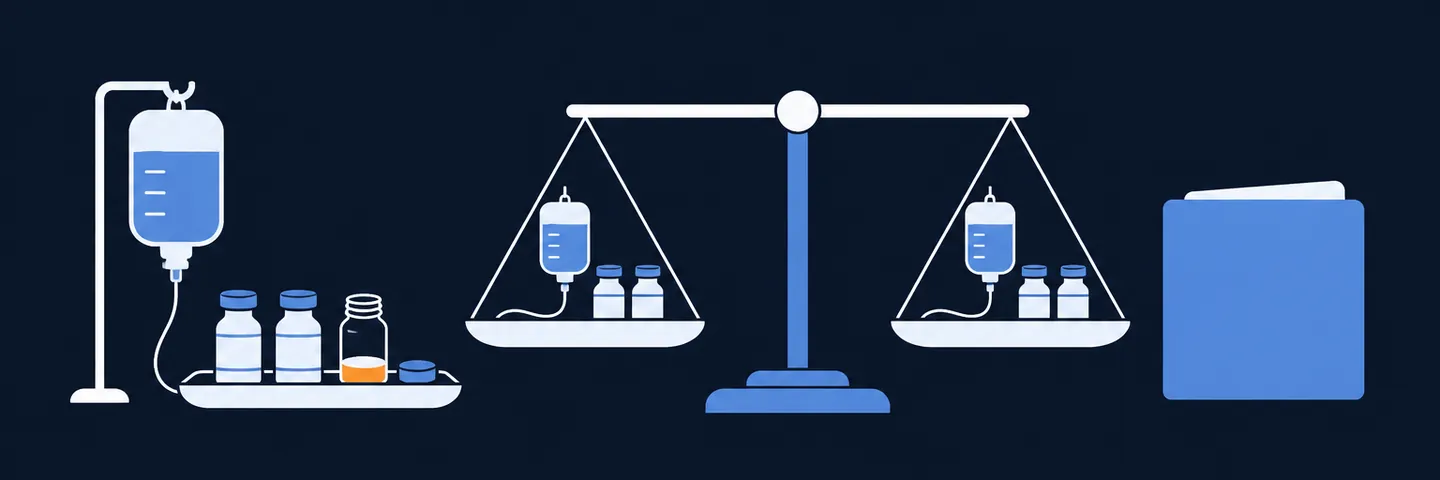
Give every infusion visit the same yardstick. Count the billing units of the main drug given at the visit, including any waste. Then multiply by a public reference price per unit, such as Medicare's published payment limit. That value doesn't change with the payer, the distributor, or whether a specialty pharmacy supplied the drug. Physician liaisons see a fair, consistent number for the patients they bring in, and nobody outside finance sees your contract rates.
I built this for a growing multi-site infusion center whose liaisons were paid on infusions they generated, while drug contracts and specialty pharmacy visits made "value per visit" swing wildly. Some visits showed zero even though the team did the work. If you're sizing what your referrals are worth overall, start with the referral leakage calculator.
Key takeaways
- A fair visit value uses the same price for the same drug units, no matter who paid or who supplied the drug.
- Count billing units of the primary drug at each administered visit, by billing code, with waste included. Leave out secondary insurance claims so a visit isn't counted twice.
- Multiply the units by a public reference price, such as the quarterly Medicare payment limit from the CMS ASP files.
- Freeze the reference price for each compensation period, so a quarterly rate change doesn't move a liaison's numbers after the fact.
- Keep actual margin for the owner and finance. Use the reference value for the referral team.
Why doesn't actual revenue work for the referral team?
Actual revenue makes the same patient worth very different amounts for reasons a liaison can't control. Three common distortions:
- Payer mix. The same drug can pay very differently by payer, so a liaison looks better or worse depending on insurance, not effort.
- Drug supply route. When a specialty pharmacy ships the drug (white bagging), your center bills only the administration, so the visit can show almost no drug revenue. The team still did the intake, authorization, and scheduling work. More on this in how white bagging changes infusion center revenue.
- Timing. Payments arrive weeks after the visit, and denials can reverse them months later. Paying liaisons on collections means paying them on the billing team's calendar.
There's also confidentiality. Contract rates are commercially sensitive. Putting them in a referral team tool means every liaison can see what each payer pays you.
How is a fair visit value calculated?
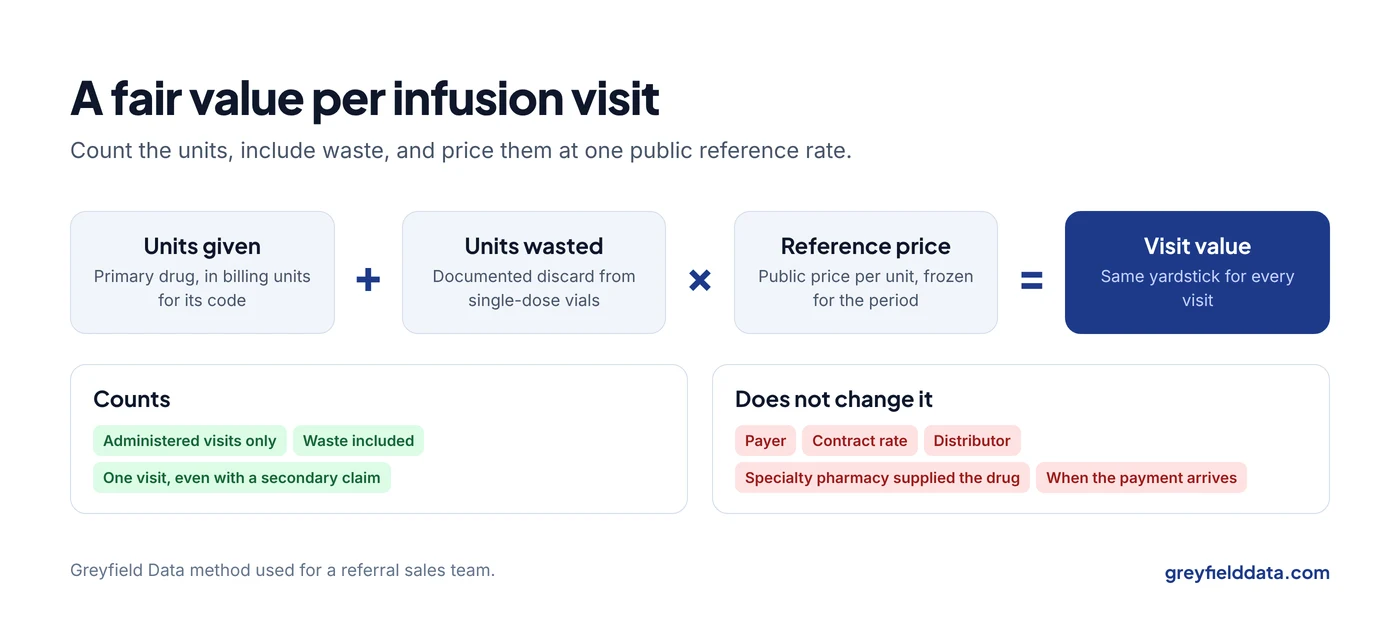
A fair visit value is the units of the visit's primary drug, waste included, times a reference price per unit. Optionally add a fixed amount for the administration.
Visit value = (units given + units wasted) × reference price per unit
Four rules keep it consistent:
- Count only administered visits. A scheduled or cancelled visit is worth zero.
- Use billing units by billing code. Each drug's billing code (HCPCS) defines what one unit is, such as 10 mg. Count in those units, not in vials or milligrams.
- Include waste. Discarded drug from a single-dose vial is part of the dose the center had to buy. For Medicare it is reported with the JW modifier; see the JW and JZ modifier guide.
- Leave out secondary claims. A visit billed to a primary and a secondary payer is still one visit.
What does it look like on real visits?
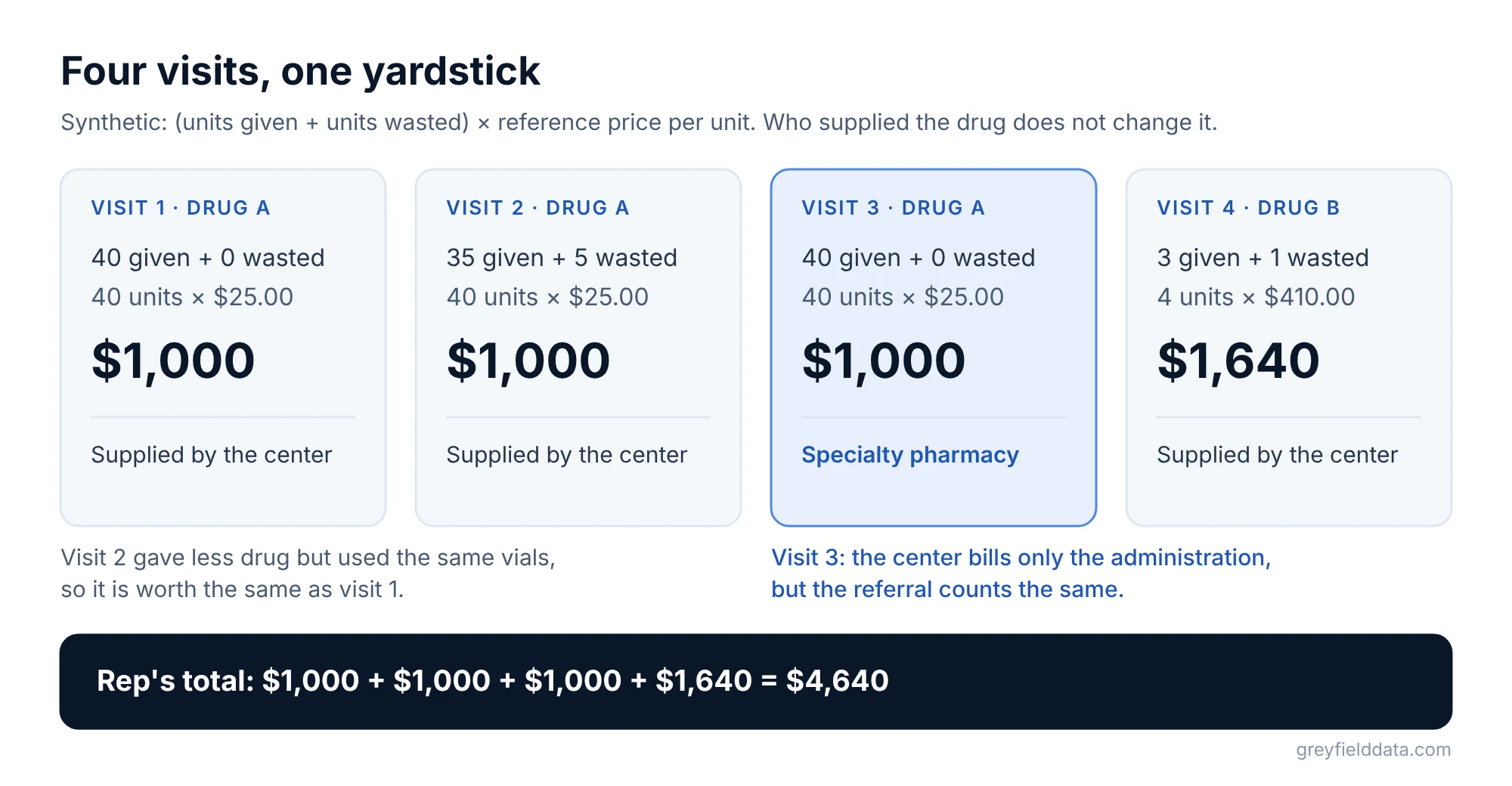
Here are four visits. All numbers are synthetic: invented drugs and reference prices, not real ASP values.
| Visit | Drug | Units given | Units wasted | Reference price per unit | Visit value | Who supplied drug |
|---|---|---|---|---|---|---|
| 1 | Drug A | 40 | 0 | $25.00 | 40 × $25.00 = $1,000 | Center (buy-and-bill) |
| 2 | Drug A | 35 | 5 | $25.00 | 40 × $25.00 = $1,000 | Center (buy-and-bill) |
| 3 | Drug A | 40 | 0 | $25.00 | 40 × $25.00 = $1,000 | Specialty pharmacy |
| 4 | Drug B | 3 | 1 | $410.00 | 4 × $410.00 = $1,640 | Center (buy-and-bill) |
Visits 1, 2, and 3 are worth the same, which is the point. Visit 2 gave less drug but used the same vials. Visit 3 brought the center no drug revenue, but the referral was just as real. The total for the liaison is $1,000 + $1,000 + $1,000 + $1,640 = $4,640.
Which reference price should you use?
Use one public price list for every drug, and freeze it for each compensation period. The Medicare Part B payment limit is the most common choice because CMS publishes it every quarter at no cost, by billing code (ASP pricing files).
| Choice | Pros | Cons |
|---|---|---|
| Medicare payment limit, frozen each quarter | Public, no cost, by billing code, same for everyone | Changes quarterly; some drugs missing |
| Medicare payment limit, frozen for the year | Stable for annual targets | Drifts from reality during the year |
| Your own internal price list | Can include drugs not on the CMS file | Someone has to maintain it; harder to explain |
| Actual contract rates | Closest to real revenue | Confidential; swings with payer mix |
Medicare rates change every quarter, based on manufacturer sales two quarters earlier. How that works is explained in how quarterly ASP updates change your infusion drug margin. For compensation, pick one rate per drug per period and don't recalculate past visits when a new file comes out.
For a new drug that isn't on the CMS file yet, set a temporary internal price and write down when you'll replace it.
How do you hold a referral team accountable with this number?
Hold the team accountable on value per referring practice, not only on totals. A liaison with one huge practice and a liaison building ten new ones need different conversations.
The monthly report I'd start with:
- Visit value by liaison and by referring practice, this month and last.
- New referring practices with a first administered visit this month. To find practices worth calling on, see how to find infusion prescribers in Medicare data.
- Referrals that haven't started treatment, by practice, with days waiting. Those are where a liaison can help most, by getting a missing note or signature. The referral to first treatment guide shows the nine places they stall, and a referring provider portal lets practices check status themselves.
- Value per visit by drug, so nobody is surprised when the mix shifts.
Attribution matters as much as the value. Each visit should be credited to the referring clinician on the order, and each clinician to a practice and a liaison. The ordering, rendering, referring and supervising guide explains why the provider on the claim is often the wrong one to credit. If liaisons cover several sites, the multi-site KPI rollups guide keeps the definition the same everywhere.
What mistakes break the number?
- Counting vials instead of billing units. Two vial sizes of the same drug give different units.
- Pulling units from claims instead of visits. If a claim is denied and rebilled, the units appear twice.
- Recalculating history every quarter. Liaisons lose trust when last month's number changes.
- Hiding the method. Write the formula and rules on one page and share it with the team.
What to do next
Pick your top five drugs and look up this quarter's Medicare payment limit for each. Recalculate last month's visits with units given plus waste. Compare that with the revenue number liaisons see today.
If you want the visit value built into your CRM or weekly reports, book a call with me. To see what one drug is really worth to you, use the buy-and-bill margin calculator. More on this work is on the infusion analytics page and the infusion analytics resource hub. The infusion center metrics white paper puts visit value next to the other measures owners track.
Frequently asked questions
How do I hold my referral team accountable with data?
Give every administered visit a fixed reference value, credit it to the referring practice and liaison, and review value by practice each month alongside referrals that haven't started treatment.
Should infusion physician liaisons see contract rates?
Usually not. Contract rates are confidential and vary by payer, which makes liaisons' numbers depend on insurance mix. A public reference price gives a fair number without exposing contracts.
How do I value a visit when a specialty pharmacy supplied the drug?
Use the same reference value as a buy-and-bill visit for the same drug and units. The referral was just as real, even though the center billed only the administration.
Should waste count toward visit value?
Yes, if it's documented. The center bought the whole single-dose vial, and Medicare pays discarded amounts reported with the JW modifier when its rules are met (CMS discarded drugs).
Part of the Infusion analytics guides, a reading path through related articles.
Linus Tse
Founder of Greyfield Data. Built 400+ dashboards. Certified in Sigma, Snowflake, Tableau, and Power BI.
About Linus