What analytics do home infusion providers need?
The reports and KPIs home infusion providers need: what carries over from clinic infusion, what nursing visits and per diem billing add, and what to watch.

Written by Linus Tse, founder of Greyfield Data
· 8 min read
On this page 9 sections
Home infusion providers need most of what clinic infusion centers need: referral-to-first-dose tracking, authorization and denial reports, drug margin, and inventory. On top of that, they need reports for two things clinics don't have. Nurses drive to patients' homes, and billing pays for therapy days rather than visits to a chair. If you can see referral speed, therapy days, nursing visits, and denials by reason on one page, you're covering most of what matters.
A note on where this comes from. My infusion work so far has been with ambulatory infusion centers and the companies that serve them, not with home infusion pharmacies. This post is what carries over from that work, plus what the public billing rules say is different. Treat it as a starting list to test against your own operation. For the services side, see analytics for home infusion providers.
Key takeaways
- Most of the revenue path is the same as in a clinic: referral, benefits check, authorization, first dose, documentation, claim, denial, payment. The same reports apply.
- The biggest differences are nursing visits in the home (travel, visits per nurse per day, missed visits) and billing based on therapy days, not chair visits.
- Medicare's home infusion therapy services benefit pays for professional services for each "infusion drug administration calendar day" in the patient's home, with separate codes for first visits (CMS 2026 rates).
- Commercial contracts often pay a per diem for pharmacy services, supplies, and care coordination, with drug and nursing billed separately. Check each contract, because terms vary.
- Referral speed matters even more at home, because many referrals come from hospital discharges that can't wait.
Quick answers
- First report to build: therapy days billed versus therapy days documented.
- Speed measure to watch: referral to first dose, because many referrals are hospital discharges.
- Medicare professional services codes: G0068, G0069 and G0070, plus G0088, G0089 and G0090 for first visits.
- First cut for denials: split drug, per diem and nursing lines before looking at reasons.
- Systems you'll need to join: pharmacy, nursing schedule, billing, remittance and delivery records.
What carries over from clinic infusion?
Almost the whole revenue path carries over. A patient is referred, benefits are checked, therapy is authorized, the first dose is given, it is documented, a claim goes out, and the payer pays or denies.
So the clinic reports carry over too, with small changes:
| Clinic report | Same at home? | What changes |
|---|---|---|
| Open referrals by stage | Yes | Add "waiting on hospital discharge" and "waiting on delivery" stages |
| Expiring authorizations | Yes | Authorizations may cover therapy days or a date range, not doses |
| Unbilled completed services | Yes | Count therapy days and nursing visits, not chair visits |
| Waste units billed vs documented | Partly | Compounded doses and returned supplies need their own rules |
| Denials by payer and reason | Yes | Per diem and nursing lines deny for different reasons than drug lines |
| Inventory and purchased vs billed | Yes | Add stock that sits in patients' homes |
The weekly versions of these are in 12 reports every infusion center should run weekly. Most of them work for home infusion with the changes above. For stock that sits in patients' homes, the infusion drug inventory shrink guide shows how to balance what you bought against what you billed.
What is different about home infusion?
Two things are different enough to need their own reports: nurses travel to patients, and payment is often tied to therapy days.
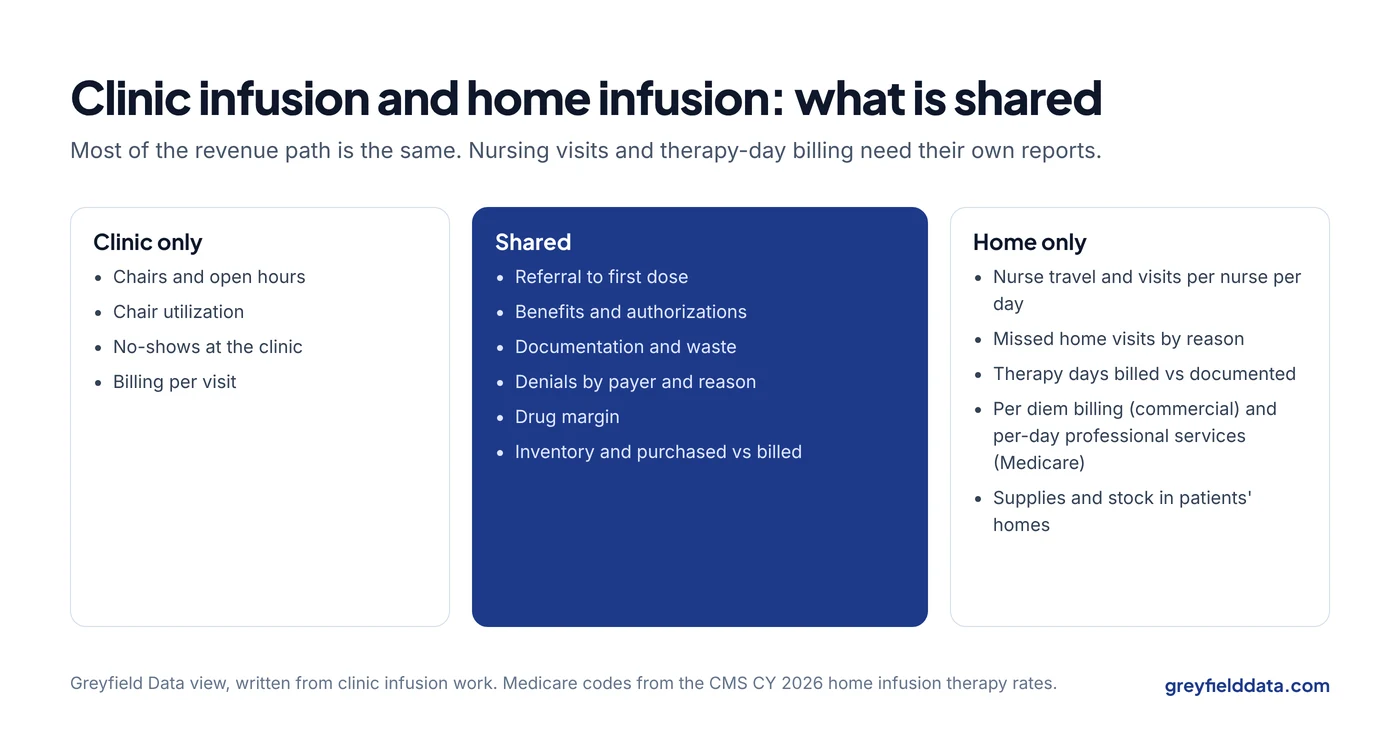
Nursing visits in the home
A clinic has chairs and a schedule. Home infusion has nurses on the road. The questions change:
- How many visits does each nurse complete per day, and how much of the day is driving?
- How many visits were missed or rescheduled, and why: patient not home, supplies not delivered, nurse unavailable?
- How long from referral to the first nursing visit?
Some nursing visits are paid and some are part of a bundled payment, depending on the payer. Knowing which visits are paid is what turns a nursing schedule into a margin report. The infusion staffing planner turns visits and hours into the nurse and pharmacy time you need each week.
Billing by therapy day
Clinic infusion bills each visit. Home infusion often bills each day of therapy.
For Medicare, the home infusion therapy services benefit pays for professional services for each infusion drug administration calendar day in the patient's home. CMS lists three codes by drug category (G0068, G0069, G0070) and three for the first visit (G0088, G0089, G0090), each with a national rate for 2026 (CMS 2026 home infusion therapy rates). The benefit has its own eligibility rules, so check current CMS guidance before relying on it.
Many commercial contracts pay a per diem for the pharmacy's services, supplies, and care coordination, with the drug and nursing visits billed separately. Terms vary a lot by payer, so the per diem rules belong in your expected payment table, one row per payer and therapy. The difference between expected payment, allowed and collected is explained in charges, claims, expected payment and collections.
This post is educational and isn't billing advice. Confirm current rules with your billing team and payers.
Which home infusion metrics should you watch?
Watch a short set that covers referral speed, nursing, billing, and denials. The definitions below are mine. Adjust them to your operation and write them down, using the format in the infusion center KPI glossary.
| Metric | How to calculate it | What it tells you |
|---|---|---|
| Referral to first dose | Days from referral received to first dose given at home | Whether you're fast enough for discharges |
| Referrals not started | Referrals with no first dose ÷ referrals received, by reason | Where patients drop out |
| Therapy days billed vs delivered | Therapy days on claims ÷ therapy days documented | Whether every day of therapy is billed |
| Nursing visits per nurse per day | Completed visits ÷ nurse working days | Nurse capacity and travel load |
| Missed visit rate | Missed or rescheduled visits ÷ scheduled visits, by reason | Avoidable wasted trips |
| Denial rate by line type | Denied lines ÷ billed lines, for drug, per diem, and nursing separately | Which part of billing breaks |
| Drug margin per therapy | Drug payment minus drug cost, per course of therapy | Which therapies pay for themselves |
A worked example
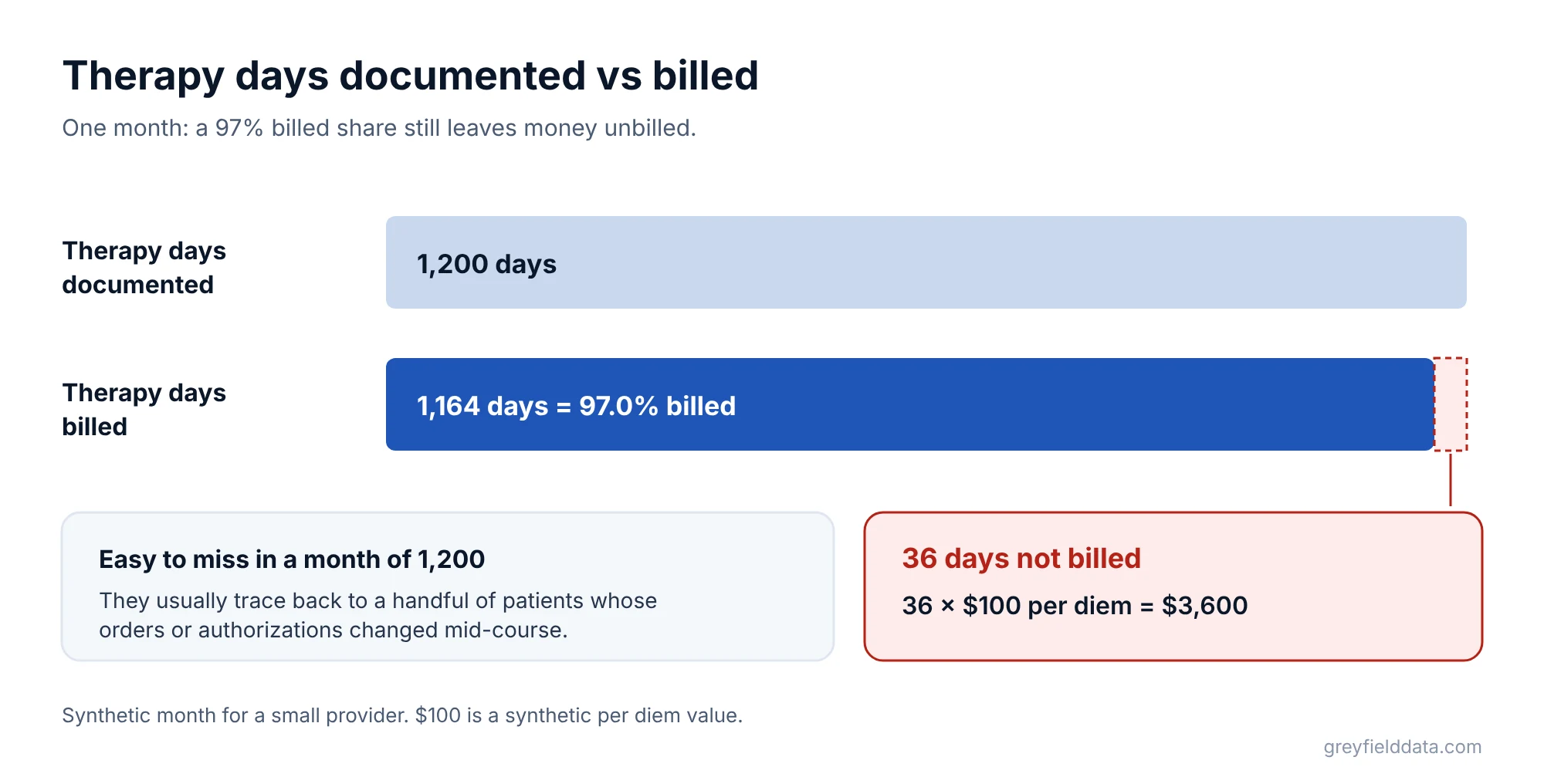
Here's one month for a small provider. All numbers are synthetic.
| Item | Value |
|---|---|
| Therapy days documented | 1,200 |
| Therapy days billed | 1,164 |
| Billed share | 1,164 ÷ 1,200 = 97.0% |
| Days not billed | 1,200 − 1,164 = 36 |
| Synthetic per diem value | $100 per day |
| Unbilled per diem | 36 × $100 = $3,600 |
Thirty-six days is easy to miss in a month with 1,200, and that is the point of the report. Most of those days usually trace back to a handful of patients whose orders or authorizations changed mid-course. The infusion revenue leakage calculator shows the same kind of gap at each step from scheduled visit to deposit.
Why is our home infusion denial rate so high?
Start by splitting denials by line type and reason, because home infusion claims deny for different reasons on different lines. The most useful first cut:
- Drug lines: often authorization, units, or coverage of the drug itself.
- Per diem lines: often days billed outside the authorized dates, or the wrong per diem code for the therapy.
- Nursing lines: often visits not covered, or more visits than authorized.
The reason codes on the remittance tell you which group a denial falls in (X12 claim adjustment reason codes). The infusion denial analysis guide shows how to group them and find where the problem starts. In the clinic denial work I've done, many denials traced back to intake and authorization rather than to billing itself, so check there first.
Where does the data usually live?
Home infusion data usually sits in more places than clinic data: the pharmacy system, the nursing scheduling tool, the billing system, remittance files, and the delivery or courier records. The reports above need at least three of them joined.
Start with referral to first dose and therapy days billed versus documented. Those two use the fewest systems and catch the most money. Then add nursing and denials. The referral to first treatment guide shows how to time each referral stage. If you're deciding when spreadsheets stop being enough, the Excel or BI tool guide can help. When several systems feed the same page, the infusion data warehouse white paper explains how one single source of truth keeps the numbers consistent.
What to do next
Count last month's therapy days documented and billed, and see if they match. That one number tells you whether billing is keeping up.
For a quick estimate of referrals lost before the first dose, try the referral leakage calculator. If you want to talk through which of these reports fit your operation, book a call with me. I'll be upfront about what I've built for clinics and what would be new for home infusion. The infusion analytics resource hub links every related guide.
Frequently asked questions
What analytics do home infusion providers need?
Start with referral to first dose, referrals not started, therapy days billed versus documented, nursing visits per nurse per day, and denials by line type. Add drug margin per therapy once those are steady.
Why is our home infusion denial rate so high?
Split denials by drug, per diem, and nursing lines, then by reason code. Home infusion denials often start with authorization dates or units, so check intake before blaming billing.
How is home infusion billing different from infusion center billing?
Clinics usually bill per visit. Home infusion often bills per therapy day, with separate lines for drug and nursing. Medicare's home infusion therapy services benefit pays professional services per infusion drug administration calendar day.
Can clinic infusion reports work for home infusion?
Most can, with changes. Count therapy days and nursing visits instead of chair visits, and add stages for hospital discharge and delivery to the open referrals report.
Part of the Infusion analytics guides, a reading path through related articles.
Linus Tse
Founder of Greyfield Data. Built 400+ dashboards. Certified in Sigma, Snowflake, Tableau, and Power BI.
About Linus