How do you calculate LTV:CAC by channel? The math, step by step
Divide each channel's spend by its new customers for CAC, multiply first-year revenue per customer by margin for LTV, then divide LTV by CAC.

Written by Linus Tse, founder of Greyfield Data
· 8 min read
On this page 10 sections
To calculate LTV:CAC for a channel, divide its ad spend by the new customers it brought to get CAC. Multiply first-year revenue per customer by your profit margin to get LTV. Then divide LTV by CAC. A result above 1.0 means that channel's customers paid for themselves within a year.
We build this ratio into the DTC data warehouses and dashboards we set up, with spend, customers and profit by channel on one agreed set of definitions. The math is simple. The work is in getting the inputs to mean the same thing every month.
Key takeaways
- CAC (customer acquisition cost) is a channel's ad spend divided by the new customers that channel brought in.
- LTV (lifetime value) here is profit per customer in their first 12 months: revenue per customer times profit margin after cost of goods, shipping and fees.
- LTV:CAC is LTV divided by CAC. Above 1.0 in year one means the channel's customers paid back what they cost within a year.
- Use realized LTV, what customers won 12 to 15 months ago actually spent in their first year, rather than a forecast.
- There is no universal "good" ratio. Set your own target from your margin and your cash needs.
How do you calculate LTV:CAC, step by step?
Four steps: spend ÷ customers = CAC; revenue per customer × margin = LTV; customers × revenue each = group revenue, as a check; LTV ÷ CAC = the ratio. Here is each one with a worked example.
The example uses synthetic numbers from a mockup: Google ads for a DTC subscription brand over the last 30 days. They show the method, not a benchmark.
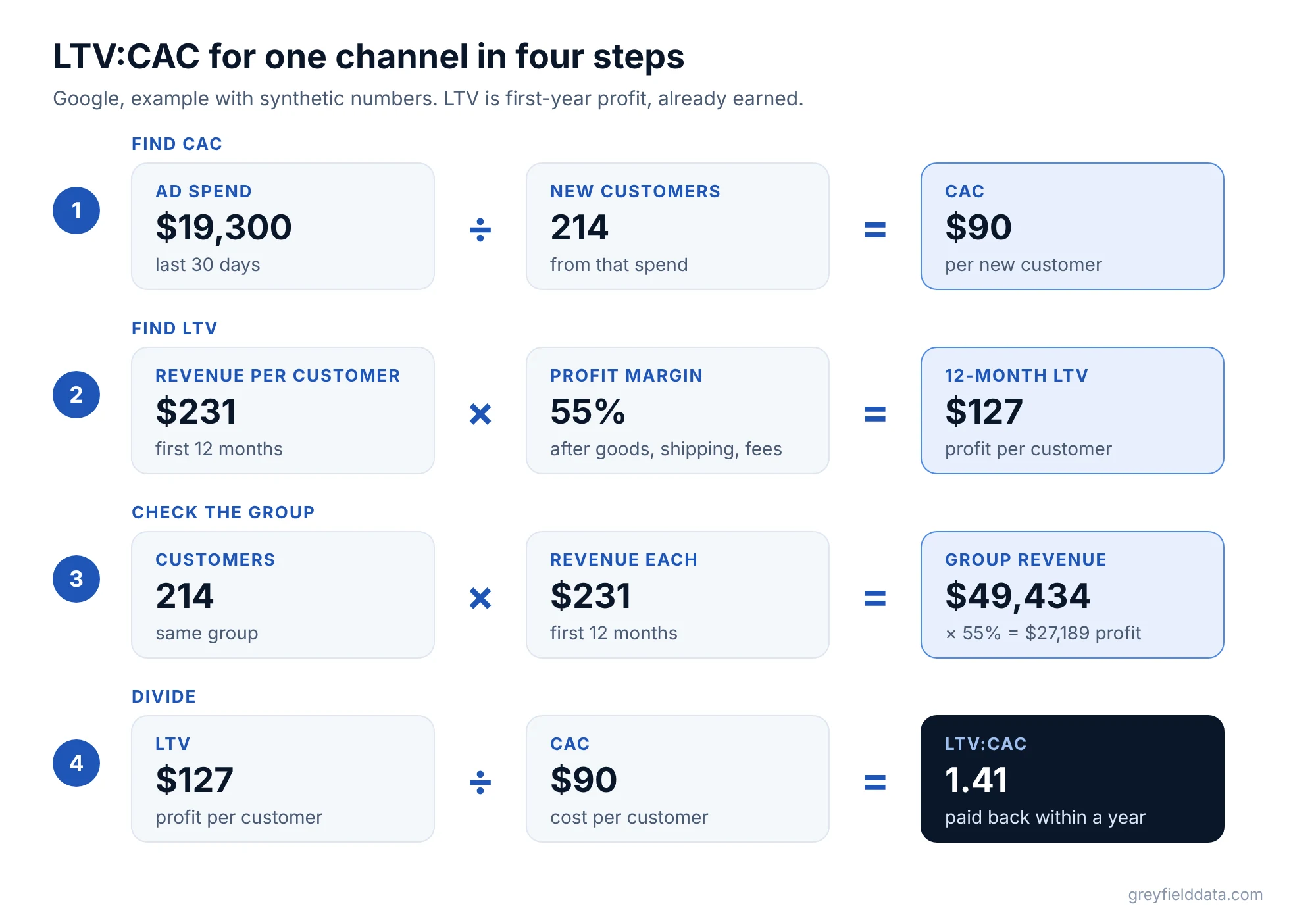
Step 1: spend ÷ new customers = CAC
$19,300 of Google ad spend ÷ 214 new customers = about $90 CAC.
Count only first-time customers, not every order the channel is credited with. A new customer means a first order ever, anywhere they buy, including Amazon. A repeat buyer on a new email address is not new. The guide to tracking customers across platforms covers how to match them.
Step 2: revenue per customer × margin = LTV
$231 of revenue per customer in their first 12 months × 55% profit margin = about $127 LTV.
The margin is after cost of goods, shipping and payment fees. It leaves out rent, salaries and software, because those don't rise when you add one more customer. The contribution margin metric page has the full definition.
Step 3: customers × revenue each = group revenue
214 customers × $231 each = $49,434 of first-year revenue from the group. At 55% margin, that is about $27,189 of profit against $19,300 of spend.
This step is a check. Totals are easier to reconcile against your books than per-customer averages. If the group's revenue doesn't tie out to what finance sees for those customers, fix that before trusting the ratio.
Step 4: LTV ÷ CAC = the ratio
$127 ÷ $90 = 1.41. The same answer comes from the totals: $27,189 ÷ $19,300 = 1.41.
Above 1.0 means that channel's customers paid for themselves within a year. Read 1.41 as "$1.41 of first-year profit back for every $1 of ad spend".
What does LTV:CAC look like across channels?
Run the same four steps for every channel, with the same definitions, and the channels become comparable. Here are three, still synthetic.
| Channel | CAC | 12-month LTV | LTV:CAC | Paid back within a year? |
|---|---|---|---|---|
| $90 | $127 | 1.41 | Yes | |
| Meta | $105 | $114 | 1.09 | Yes, just |
| TikTok | $118 | $101 | 0.86 | Not yet |
TikTok below 1.0 doesn't mean it loses money. Its customers haven't earned back their cost in the first year, but they may over the next two. Check its payback month before cutting.
These ratios are averages over all the spend in each channel. The next $10K in a channel can bring back much less, because channels saturate. The average vs marginal return on ad spend post covers that for budget decisions.
What is payback month?
Payback month is the month a channel's customers have, in total, earned back what they cost to acquire. Add up each month's profit from the group, starting with the first order, and mark the month the running total passes the spend. The DTC growth dashboard demo shows payback curves by channel on synthetic data.
It answers a cash question the ratio can't. Two channels can both end the year at 1.4, but one pays back in month 2 and the other in month 11. If cash is tight, the faster one matters more. A ratio of 1.41 tells you Google paid back somewhere inside the first 12 months; the payback month tells you where.
Why use profit, not revenue, for LTV?
Because revenue can't pay for ads. Only what is left after the product, shipping and fees can. A revenue-based LTV of $231 against a CAC of $90 looks like about 2.6, but $104 of that revenue went to cost of goods, shipping and fees.
Revenue LTV also ranks channels wrongly when margins differ. A channel whose customers buy discounted bundles can look great on revenue and poor on profit. Margin also changes over time; the underwriting CLTV vs GAAP CLTV post covers which cost to use after a cost of goods drop.
Realized or projected LTV: which should you use?
Use realized LTV as your main number. Realized means what customers won 12 to 15 months ago actually spent in their first year. It is a fact, not a forecast.
| Realized 12-month LTV | Projected LTV | |
|---|---|---|
| What it is | What a past group of customers actually spent in their first year, times margin | A forecast of what today's customers will spend |
| Strength | Nobody can argue with it | Covers customers acquired recently |
| Weakness | Lags: it describes customers won over a year ago | Depends on assumptions that are easy to stretch |
| Use it for | The headline ratio and targets | Early reads, clearly labelled as a forecast |
The lag is real. If you changed your offer six months ago, realized LTV can't show it yet. For early reads, watch early indicators of cohort quality, such as second-order rate, and label any projection as one.
To build realized LTV properly, group customers by first-order month and channel and track each group at the same age. The contribution margin LTV by acquisition channel post walks through that cohort method.
What is a good LTV to CAC ratio?
There is no single good number, and we won't invent one. A ratio of 1.0 in year one means a channel's customers paid back what they cost within a year. Whether you need more than that depends on your business.
Set your own target from three things:
- Margin. A lower margin leaves less room for error in the estimate.
- Cash. If you need ad spend back fast, set a higher year-one target or a payback-month limit.
- Repeat buying. If customers keep buying well past year one, a year-one ratio below 1.0 can still be acceptable.
Write the target down with the definitions behind it. A target of 1.2 on revenue LTV and 1.2 on profit LTV are very different goals.
Which channels need extra care?
TV and Amazon need extra care, because neither gives you a clean customer count.
TV has no clicks. TV new customers are estimated from post-purchase survey answers, TV discount codes and city tests, where you switch TV off in some cities for a few weeks and measure the drop. Label TV's CAC as an estimate. The TV spend and Amazon CAC post covers how to split shared TV cost.
Amazon shares no customer IDs. Amazon new customers come from its new-to-brand order counts, not from orders joined to a person. You can't follow a specific Amazon customer through their first year the way you can on your own site, so treat Amazon LTV as less precise.
Frequently asked questions
What is the LTV to CAC ratio formula?
LTV:CAC = LTV ÷ CAC. CAC is ad spend divided by new customers. LTV here is first-year revenue per customer times profit margin after cost of goods, shipping and fees.
What is a good LTV to CAC ratio for a DTC brand?
There is no universal benchmark. A ratio of 1.0 in year one means customers paid back their cost within a year. Set your own target from your margin, how fast you need cash back, and how much customers buy after year one.
Should LTV:CAC use revenue or profit?
Profit. Revenue includes cost of goods, shipping and fees that can't pay for ads. A revenue ratio can look far healthier than the business is, and it can rank channels in the wrong order when their margins differ.
Should I calculate LTV:CAC by channel or blended?
Both, for different jobs. Blended LTV:CAC checks the health of the whole business. Channel LTV:CAC shows where acquisition pays back, as long as each customer is credited to one channel under one agreed rule.
What is 12-month realized LTV?
It is the profit customers acquired 12 to 15 months ago actually produced in their first year. Because it uses real purchases rather than a forecast, it is the most defensible LTV for a headline ratio.
What to do next
Run the four steps for your top three channels with one set of definitions, and add a payback month for each. The customer lifetime value metric and customer acquisition cost metric pages have the full definitions to agree on first.
If spend, customers and margin don't yet live in one place, the DTC data warehouse service is how we set that up, or book a call to walk through your numbers.
Part of the Ecommerce reporting guides, a reading path through related articles.
Linus Tse
Founder of Greyfield Data. Built 400+ dashboards. Certified in Sigma, Snowflake, Tableau, and Power BI.
About Linus