How long does a Power BI or Tableau migration to Sigma take?
Build a realistic Sigma migration timeline around data readiness, shared models, conversion, validation, business review, and cutover dependencies.

Greyfield Data

In this article 8 sections
A Sigma migration timeline should follow its dependencies: source access and definitions, target data readiness, shared model work, a representative pilot, report waves, acceptance, and cutover. Calendar duration depends on both hands-on effort and the time needed for decisions, reviews, and access.
There is no reliable universal number of weeks per dashboard. This guide shows how to build a schedule with observable exit conditions instead of promising a date from a report count.
Define what the finish date actually means
Decide whether “done” means a draft exists, a workbook is published, users have accepted it, scheduled outputs are working, or the old reporting has been retired.
For a migration, I would track those as distinct milestones. A team can publish a replacement while still waiting on access tests or a monthly delivery cycle. Reporting the earliest milestone as full completion creates confusion.
Write the acceptance condition beside the planned date. For example: “January sales workflow accepted, restricted-user checks complete, and the agreed export received” is more useful than “Sigma dashboard complete.”
Start with a bounded workflow
This guide uses the Greyfield sample orders CSV: eight synthetic orders across January and February 2026. Each row is one order. Revenue is in generic currency units, with no tax, returns, or currency conversion. Dataset notes and calculated expected results are included. The arithmetic was checked independently with SQLite; it is a test specification, not a claim that a migration has passed in all three products.
The proposed workflow has Regional Sales, Product Mix, and Order Detail, with month and region selections. January totals 290; January East totals 190 across O100, O101, and O104.
A small fixture makes behavior review possible before production-scale tuning. It does not remove the need to test the real volume, infrastructure, or security setup later.
Record which source and target access is already available. Assign owners to missing dependencies so the project does not spend its first build week waiting for a connection or a definition.
Put data readiness ahead of dependent report work
The target needs usable data, including the transformations the source report relies on. Map source fields, preparation steps, target objects, types, refresh expectations, and access.
If the source exists only in an imported model or extract, data movement may be required before Sigma's migration workflow can use it. Sigma migration requirements
Some design work can happen while a pipeline is being prepared, but metric acceptance cannot be completed against data that has not arrived. Make that dependency visible in the schedule.
Build shared definitions before scheduling every report separately
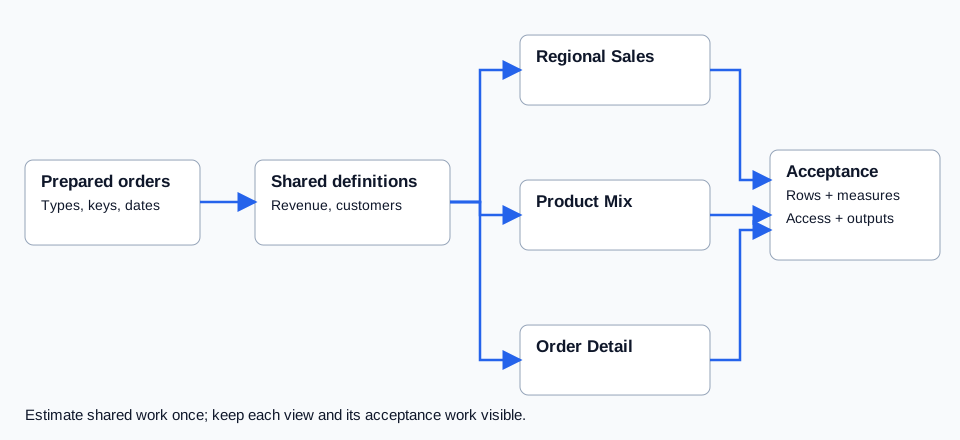
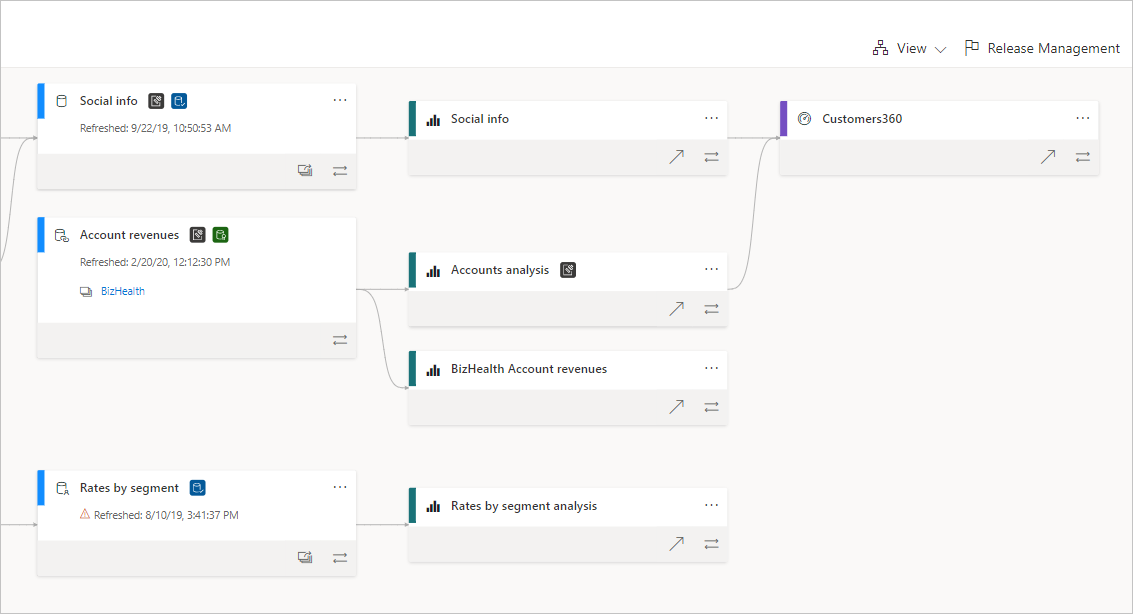
A shared semantic model can feed several reports. Schedule common work as its own dependency, then identify which report tasks can proceed once it is ready.
For the sample, the revenue and known-customer definitions should be agreed before all three views are reviewed. Otherwise, a late definition change can send each view back through testing.
Avoid assuming that visual similarity means common logic. Two reports labeled “sales” can use different dates, exclusions, or audience rules.
Give the pilot an explicit exit condition
The pilot should end with accepted behavior and a documented list of exceptions, not merely a successful conversion command.
Check the January baseline, the combined-period customer count, the O104 date boundary, the O105 grain case, region selection, and the intended export. Record actual work and review time.
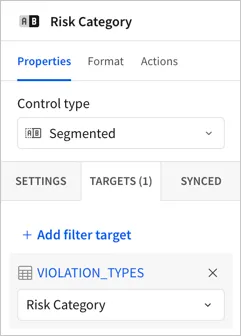
The Sigma control-target screenshot illustrates a configuration that can require inspection during the pilot. Verifying which elements respond to a selection is separate from creating the control.
If a critical case fails, revise the plan using what the pilot revealed. Do not preserve the original date by quietly dropping the failed behavior.
Use a conditional schedule rather than a benchmark
An illustrative four-week sequence might allocate week one to discovery and data readiness, week two to the pilot, week three to the first report wave, and week four to acceptance and cutover.
That is a planning example, not a claim that a migration generally takes four weeks. It assumes source access, a ready data platform, a small first wave, available reviewers, and no unresolved critical feature.
Attach a gate to each stage. Discovery exits when the inventory and definitions are agreed. The pilot exits when its cases pass or differences are approved. Cutover exits when the accepted version and required deliveries are ready.
If the data pipeline is delayed, show which downstream dates move. Do not compress the acceptance window by default.
Reserve review time and distinguish waiting from effort
A builder may finish a change in a day and wait a week for the business owner. Track both. The first affects delivery effort; the second affects elapsed duration.
Schedule review appointments early and provide a short task script with expected results. An owner can review January East's three orders more easily than an open-ended request to “check the dashboard.”
Set a process for unresolved definitions. Name the decision owner and record the affected reports. Repeatedly rebuilding around unapproved assumptions consumes both development and review time.
Include the operational observation window
Some outputs cannot be fully evaluated from an interactive workbook. A scheduled file needs an authorized delivery test; a month-end workflow may need a representative historical run or an agreed observation period.
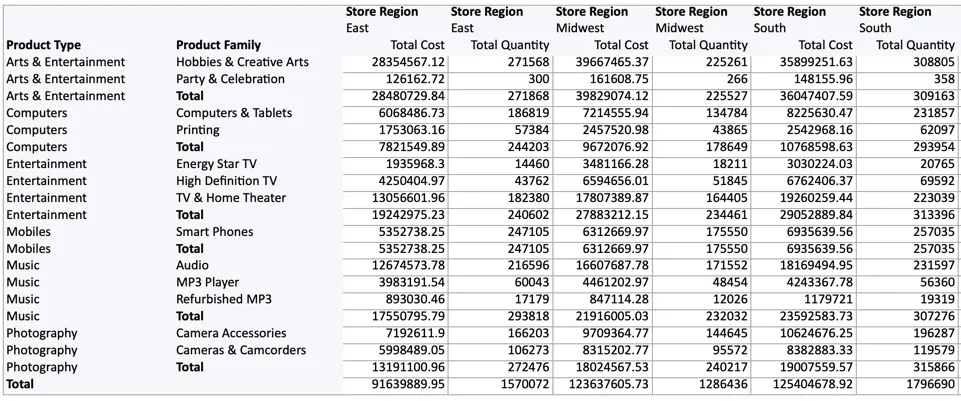
Inspect the received file's labels, period, rows, and destination. A schedule saved in the system is not the same milestone as a verified delivery.
Keep recovery and source retirement on the schedule. Confirm which old consumers have moved before disabling their reports or refresh processes.
The cost guide separates effort categories, and the cutover checklist defines the evidence needed for release. Together they make a timeline something the team can update from facts rather than defend as a guess.
Related
10 checks before approving a Sigma migration cutover
Review acceptance evidence, permissions, delivery, ownership, recovery, and retirement decisions before switching users from Tableau or Power BI to Sigma.
Calculation acceptance7 DAX measure tests to define before migrating Power BI to Sigma
Define expected behavior for Power BI measures before rebuilding them in Sigma, including totals, filters, distinct counts, dates, blanks, ratios, and relationships.
Tableau workflow review7 Tableau interactions to review before moving to Sigma
Document how people use Tableau before rebuilding their workflows in Sigma, from filter scope and parameters to actions, tooltips, navigation, and exports.