How do you measure Black Friday reactivation of lapsed customers?
Define a lapsed customer before the sale, track reactivation rate and reactivated customers by channel against last year, and pace new customers by stage.

Written by Linus Tse, founder of Greyfield Data
· 4 min read
On this page 7 sections
Measure Black Friday reactivation by defining a lapsed customer before the sale, then tracking reactivation rate and reactivated customers by channel against last year's same sale days. Pace new customer orders by stage too, because Cyber Weekend usually decides whether the goal is met.
We build this as the "Reactivation" tab of a BFCM dashboard. It's in the Black Friday dashboard demo, with made-up numbers for a made-up apparel brand, so every figure below is illustrative.
Key takeaways
- Write the lapsed definition down before the sale, for example "no order in the last 12 months," and keep it fixed until the sale ends.
- Reactivation rate is reactivated customers divided by all returning customers in the sale. Compare it with last year on the same sale days.
- Rank channels by growth in reactivated customers against last year. The channel that is short is where lapsed-customer retargeting isn't working.
- Pace new customer orders by stage of the sale, not by a straight line, and know how many the last stage has to bring in.
- A shrinking active base makes reactivation harder and more valuable. Say how big the base is next to the rate.
What counts as a reactivated customer?
A reactivated customer is someone whose last order before the sale was longer ago than your lapsed window, and who orders during the sale. Everyone else who orders is either a new customer (no prior order) or an active returning customer.
| Group | Definition | What it measures |
|---|---|---|
| New customer | First order ever is during the sale | Acquisition |
| Active returning customer | Ordered within the lapsed window before the sale | Loyalty |
| Reactivated customer | Last order before the sale is older than the lapsed window | Win-back |
Match customers across Shopify, subscriptions and email by one customer ID, or the same person can count as new and reactivated at once. How to track customers across platforms covers the joins.
How do you calculate the reactivation rate?
Reactivation rate = reactivated customers ÷ all returning customers who ordered in the sale. In the demo, it is 39.7% against a target of beating last year's 41.0%, on an active base of 250,000 that is 25% smaller than last year.
The base matters. With fewer active customers, each lapsed customer who comes back counts for more, and the rate can drop even when the campaigns are working. Put the base size next to the rate so nobody reads it in isolation.
Which channels are bringing lapsed customers back?
Rank channels by reactivated customers to date against last year on the same sale days. In the demo, paid search is up 5.4% and Meta is down 14.2%, about 210 reactivations short. Email is the other gap, down 7.7%.
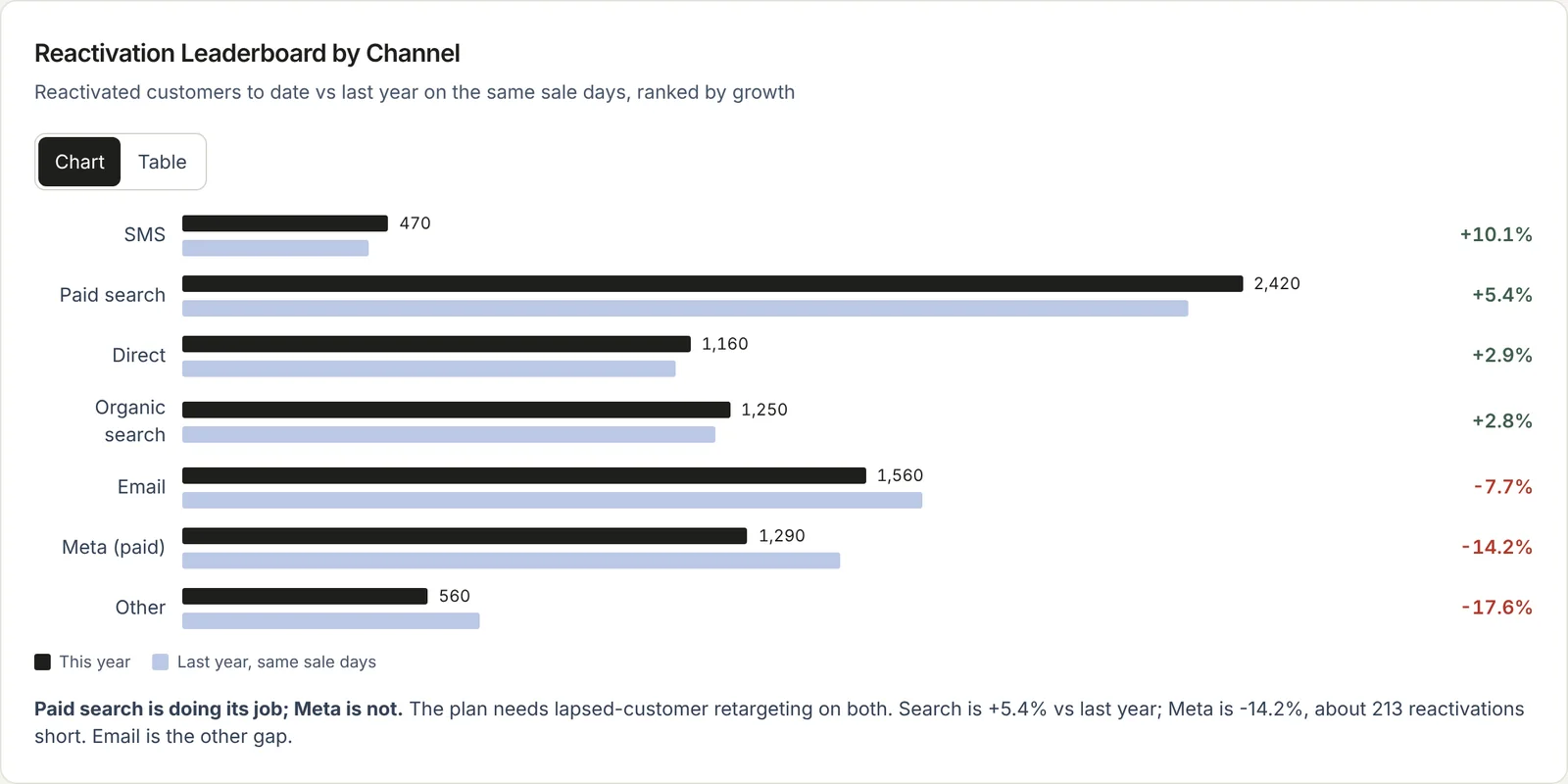
That points to one fix: the lapsed-customer audience on Meta. The plan needed retargeting on both paid search and Meta. One is doing its job, and one isn't.
How do you pace new customers through the sale?
Split the new customer goal into the sale's stages, following last year's phases. In the demo, 20,000 new customer orders split into four stages: Early, Pre-Thanksgiving, Thanksgiving to Black Friday, and Cyber Weekend.
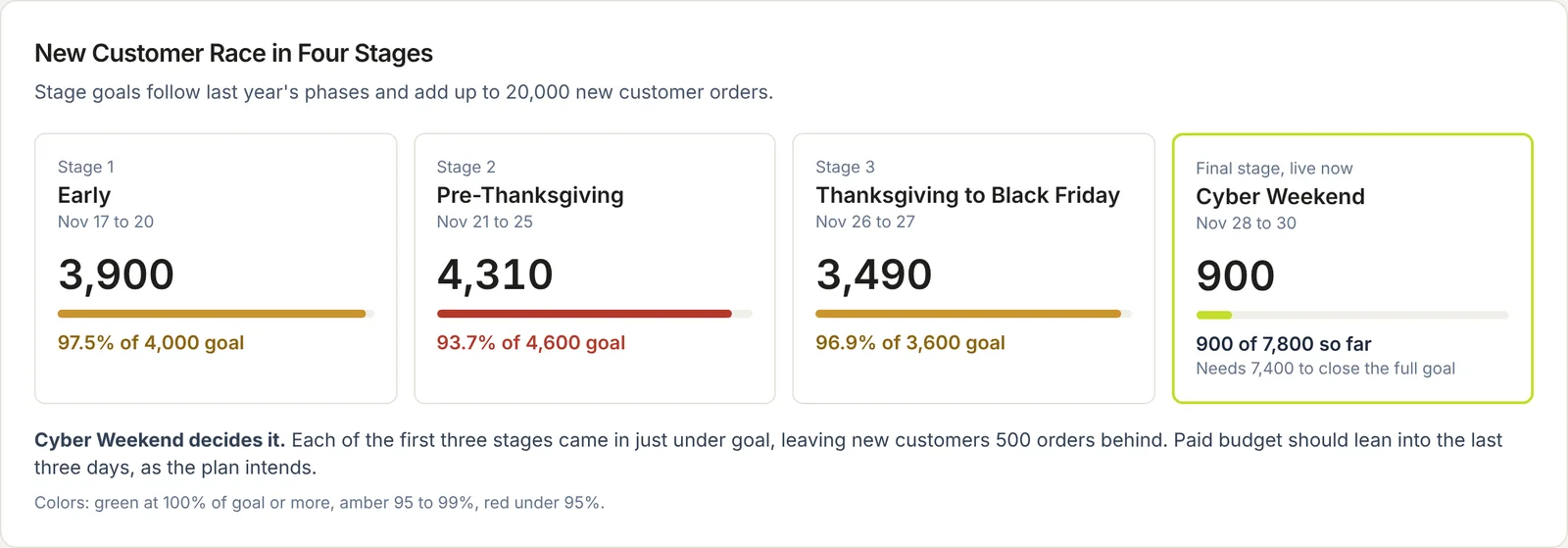
Each of the first three stages came in just under goal, leaving new customers 500 orders behind. Cyber Weekend now has to bring in 7,400 to close the full goal, so paid budget should lean into the last three days, as the plan intended. A straight-line pace would have hidden this until the sale was over.
Frequently asked questions
What is a lapsed customer?
A customer whose last order is older than a set window, often 12 months for apparel and shorter for consumables. Pick the window from how often your customers reorder, and keep it fixed through the sale.
What is a good reactivation rate for Black Friday?
There is no general benchmark worth trusting. Set your own baseline from last year's sale on the same days, and compare with that.
Should reactivated customers count as new customers?
No. Keep them separate. Counting them as new inflates acquisition and hides whether win-back campaigns worked.
Why compare channels to last year instead of to a plan?
Most brands plan reactivation as one total, not by channel. Last year's same sale days give each channel a fair comparison.
What to do next
Write down your lapsed window and stage goals before the sale, then open the Reactivation tab in the Black Friday dashboard demo. The retention value calculator shows what a better repeat rate is worth, and early indicators of cohort quality by channel covers what the new customers you win this weekend are likely to be worth. For the whole sale, start with how to track Black Friday sales against plan. To have this built on your own data, book a call.
Part of the Ecommerce reporting guides, a reading path through related articles.
Linus Tse
Founder of Greyfield Data. Built 400+ dashboards. Certified in Sigma, Snowflake, Tableau, and Power BI.
About Linus