9 questions to ask a Sigma migration consultant
Compare Sigma migration consultants by asking about scope, data readiness, calculation review, security, validation, ownership, and handover.

Greyfield Data

In this article 10 sections
Ask a Sigma migration consultant to show how they would inspect your source, preserve calculation behavior, and prove that users can complete their work. General familiarity with Sigma is useful, but it does not answer those migration questions.
These nine questions are designed for a working session with one source report available. Each includes the evidence I would expect to receive, using a small sales example to make the discussion concrete.
Bring one report and its dependencies
This guide uses the Greyfield sample orders CSV: eight synthetic orders across January and February 2026. Each row is one order. Revenue is in generic currency units, with no tax, returns, or currency conversion. Dataset notes and calculated expected results are included. The arithmetic was checked independently with SQLite; it is a test specification, not a claim that a migration has passed in all three products.
For the discussion, the report has Regional Sales, Product Mix, and Order Detail. January totals 290 across five orders. East contributes 190. The sample is deliberately small so a consultant can explain the method without hiding behind a large total.
Your real source should include the workbook or report, its model or data-source definition, and an owner who can explain the business rules. Remove confidential records from any evaluation material you are not authorized to share.
1. What do you inspect before estimating?
Ask them to separate reports from shared semantic models or data sources, then explain what else they inventory: transformations, calculations, filters, actions, permissions, and delivery.
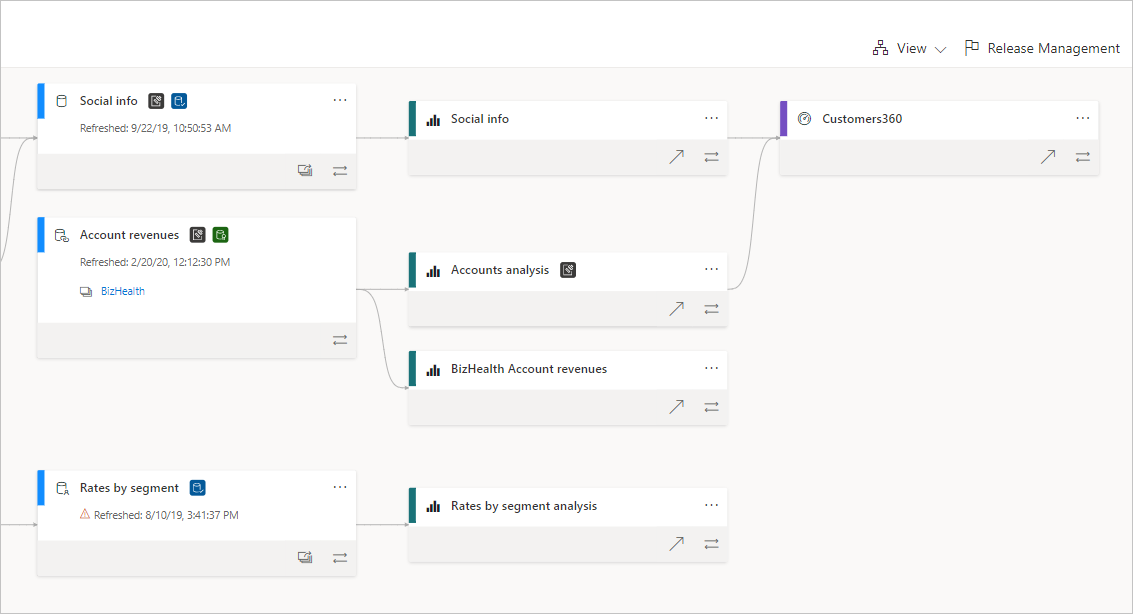
Power BI lineage can reveal shared dependencies. A proposal that treats every report as a separate model conversion may duplicate work; one that prices only the shared model may omit the user-facing rebuild and validation.
Request an example inventory structure. It should have owners and open issues, not merely object counts.
2. How do you identify data that is not ready for Sigma?
Ask where data preparation will run and who will own it. Discuss imported models, extracts, local files, and transformations embedded in the source.
A useful answer identifies target tables, required transformations, refresh expectations, and access dependencies. “The data is already in Snowflake” is incomplete if the report depends on prepared fields that are not there.
Ask which prerequisites are included in the estimate and which are assumed. Those assumptions should be written down.
3. How do you preserve a measure's meaning?
Give them the known-customer case. January has four, February two, and both months together five. Ask why adding the monthly values gives the wrong combined-period count.
Then discuss January East product A: 150 revenue divided by regional revenue of 190. Ask which filters the denominator keeps and ignores.
The expected response is a definition, test cases, and a proposed target approach. A confident claim of automatic formula equivalence without inspecting context is not sufficient evidence.
4. How do you handle source relationships and grain?
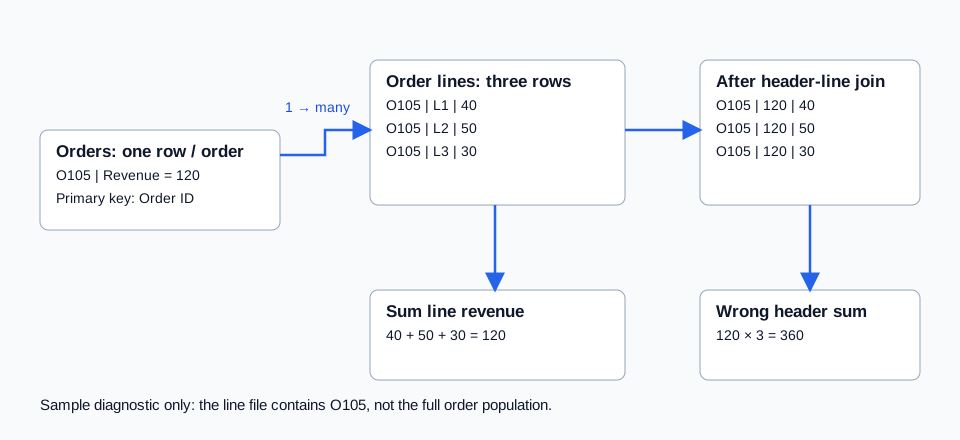
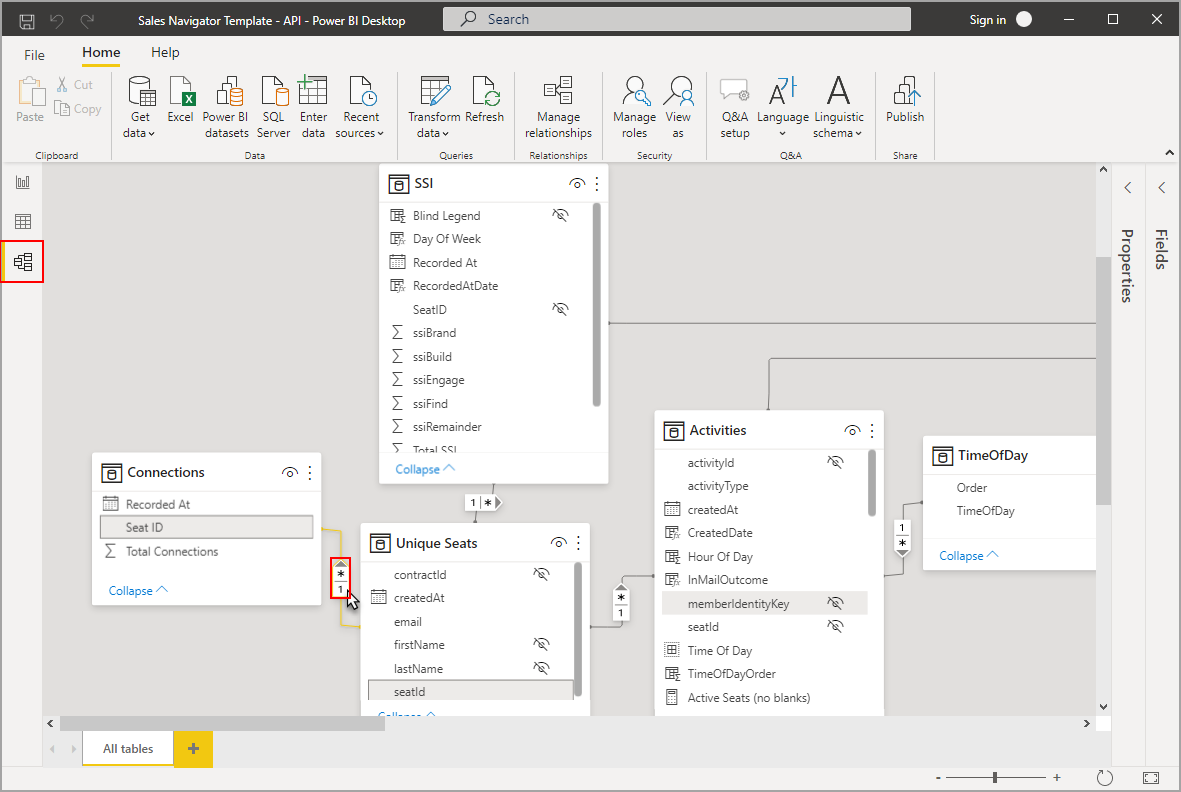
Ask them to inspect the source model's actual relationship columns and cardinality. In the sample, O105 has order revenue of 120 and three line records totaling 120. Joining the header to the lines and summing its repeated amount gives 360.
The consultant should explain where each measure belongs and how they will detect duplicated rows. Request a row-level reconciliation, not only a matching aggregate.
5. How do you preserve the user's workflow?
Ask for a demonstration plan covering month selection, region selection, opening detail, returning, clearing a filter, and exporting.
For January East, the detail should contain O100, O101, and O104. Clearing East should restore all five January orders while keeping the month selected.
Have the consultant distinguish an exact recreation from an approved redesign. Ask where those decisions will be recorded so a different developer or reviewer can understand them later.
6. What happens when automated conversion misses something?
Request an exception log with source object, problem, proposed treatment, owner, and status. Ask how tool versions and manual fixes are recorded.
Sigma publishes migration tooling, currently documented as beta. Its existence is a reason to evaluate automation, not proof that your specific workbook is complete. Sigma's migration workflow
An unresolved expression should remain visible. Replacing it with a simpler measure without agreement can produce a polished report that answers the wrong question.
7. How do you test permissions and exports?
Ask which restricted identities will be used and what evidence will show they cannot access another audience's records. Include the detail view and exported file.
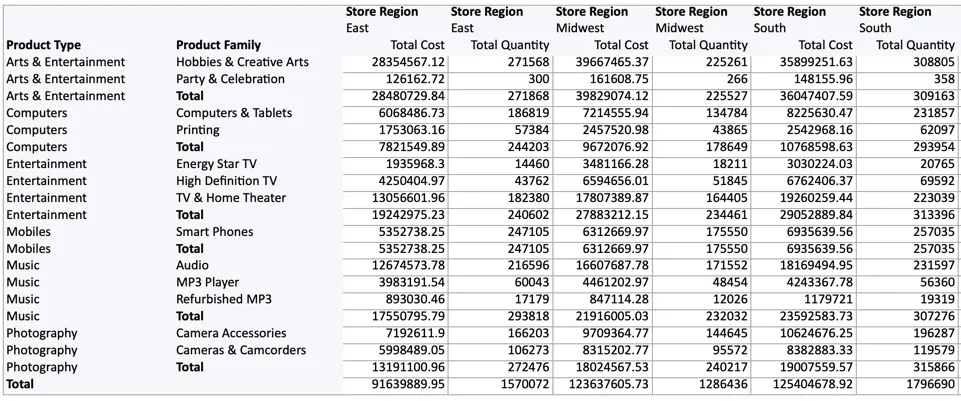
Ask to inspect a representative delivered attachment. The vendor screenshot illustrates output structure; your project needs its own test of fields, population, recipients, and timing.
Do not accept an administrator screenshot as the only access test or a manual download as the only proof of scheduled delivery.
8. What does the pilot tell us about cost and timing?
Request effort broken into preparation, modeling, report work, validation, fixes, and handover. Ask what remains outside the pilot.
A sales report does not prove embedded authentication, complex financial calendars, or performance at production volume. The consultant should describe those limits without treating every unknown as an unlimited contingency.
Ask how a failed pilot test changes the next estimate and which decisions require your team.
9. What exactly will we own at handover?
Ask for the source-to-target inventory, calculation definitions, data mappings, test evidence, exception log, delivery configuration, and operational owners.
Confirm how another builder can maintain the result and how users will find it. Agree when source reports can be retired and what restores service if a critical defect appears.
Those deliverables make a proposal reviewable. If you want to discuss this approach with Greyfield, use the Power BI-to-Sigma or Tableau-to-Sigma service page and bring one representative source report.
Related
10 checks before approving a Sigma migration cutover
Review acceptance evidence, permissions, delivery, ownership, recovery, and retirement decisions before switching users from Tableau or Power BI to Sigma.
Calculation acceptance7 DAX measure tests to define before migrating Power BI to Sigma
Define expected behavior for Power BI measures before rebuilding them in Sigma, including totals, filters, distinct counts, dates, blanks, ratios, and relationships.
Tableau workflow review7 Tableau interactions to review before moving to Sigma
Document how people use Tableau before rebuilding their workflows in Sigma, from filter scope and parameters to actions, tooltips, navigation, and exports.