Fivetran vs Airbyte vs Matillion vs Talend: Which ELT Tool Fits in 2026?
Fivetran is managed loading billed by monthly active rows, Airbyte is self-hosted or credits, Matillion is credit-based ELT, and Talend is now Qlik Talend Cloud.

Written by Linus Tse, founder of Greyfield Data
· Updated · 10 min read
On this page 11 sections
Pick Fivetran if you want connectors someone else maintains and you can live with usage billing. Pick Airbyte if you want source-available code you can run yourself or cheap metered cloud syncs. Pick Matillion if your team wants to build and orchestrate transformations visually inside Snowflake, Databricks or Redshift. Treat Talend as a Qlik Talend Cloud decision now, because the free Talend Open Studio was retired in January 2024.
We build and run these pipelines for clients on Snowflake, from the loader through the models and the reports. If you would rather hand that off, see our Snowflake consulting and dbt consulting work.
Disclosure. Greyfield Data is independent and is not a partner or reseller of any tool below. Every product claim links to the vendor page it came from. Pricing was checked on November 12, 2026.
Key takeaways
- Fivetran is a managed extract-and-load service billed on monthly active rows (MAR) per connection. Its Free plan covers 500,000 MAR a month.
- Airbyte Core is free to self-host under the Elastic License 2.0. Airbyte Cloud Standard starts at $20 a month, and Plus starts at $189 a month for 40 credits.
- Matillion sells annual packages of credits, consumed by pipeline task hours and extra developer users. It does not publish prices.
- Talend Open Studio, the free edition, was retired on January 31, 2024. Qlik Talend Cloud is the paid path, priced on capacity, with no published prices.
- Fivetran and dbt Labs completed their merger on June 1, 2026, so loading and dbt transformation now come from one company.
Quick answers
- Least maintenance: Fivetran. You pick a connector and it keeps the schema in sync.
- Lowest software cost: Airbyte Core, which is free to run on your own servers. You pay in engineering time instead.
- Best for visual, in-warehouse transformation: Matillion, which pushes the SQL it generates down to your warehouse.
- Best if you already run Qlik: Qlik Talend Cloud, which comes from the same vendor.
- Most predictable bill at high volume: Airbyte Pro, which is priced on capacity rather than rows.
How do Fivetran, Airbyte, Matillion and Talend compare?
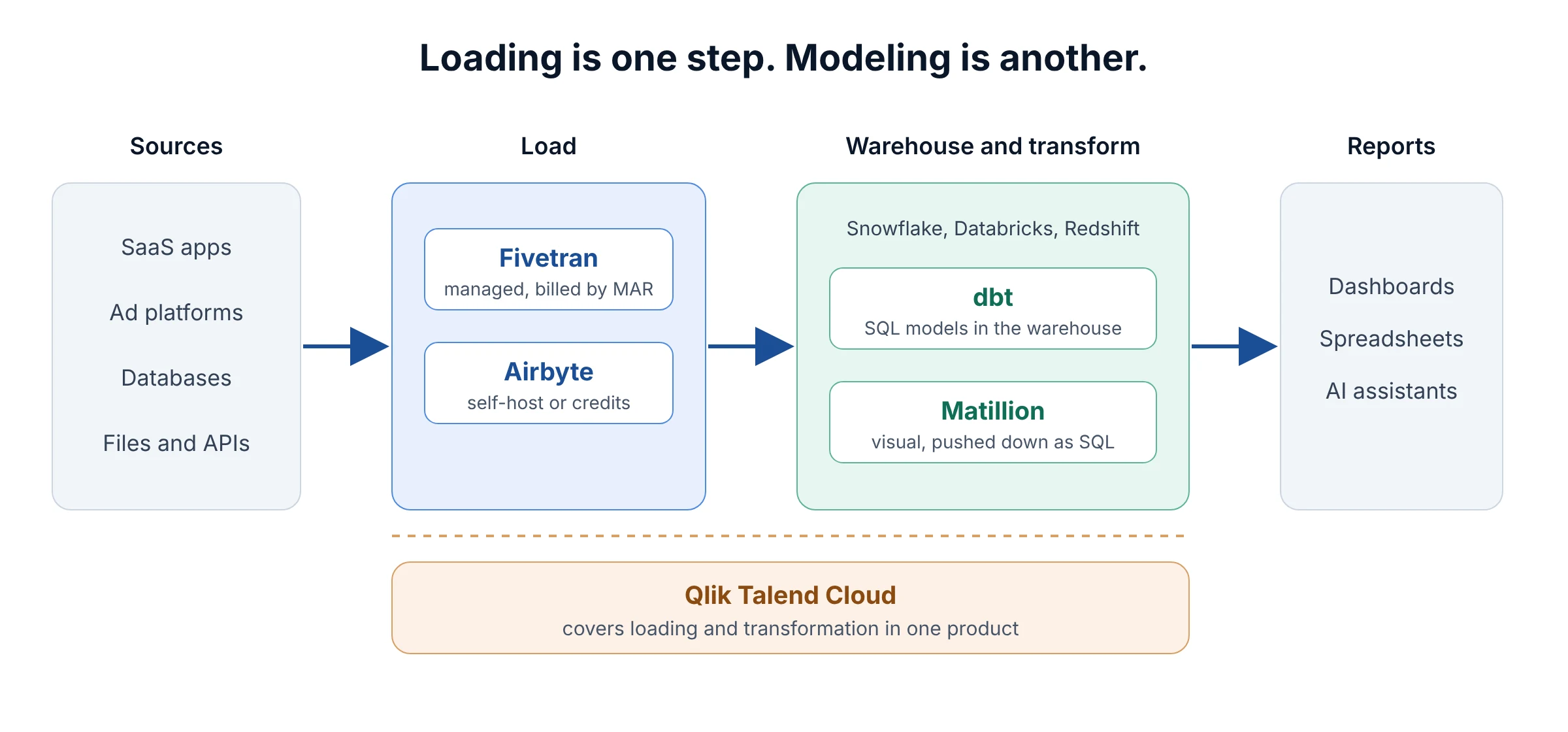
They overlap less than the search results suggest. Fivetran and Airbyte mainly move data into the warehouse. Matillion and Talend also build the transformations.
| Fivetran | Airbyte | Matillion | Talend (Qlik) | |
|---|---|---|---|---|
| Main job | Managed extract and load | Extract and load, self-hosted or cloud | Visual ELT and orchestration | Data integration, quality and governance |
| Transformations | dbt models, billed per model run | Handled in your warehouse with dbt or SQL | Built in, pushed down as warehouse SQL | Built in |
| Self-host option | No | Yes, Airbyte Core | No | Talend Data Fabric is client-managed |
| Free option | Free plan up to 500,000 MAR | Airbyte Core | Free trial | 14-day trial; Open Studio retired |
| Billing unit | Monthly active rows per connection | Credits (Standard, Plus) or capacity (Pro) | Credits for task hours and users | Capacity: data moved, job runs and run time |
| Published prices | Yes, with examples | Yes for Standard and Plus | No | No |
| Owner | Fivetran + dbt Labs | Airbyte | Matillion | Qlik |
How much do Fivetran, Airbyte, Matillion and Talend cost?
Only Fivetran and Airbyte publish prices you can plug numbers into. Matillion and Qlik Talend Cloud are quoted by sales.
| Tool | How you pay | Published numbers (November 12, 2026) |
|---|---|---|
| Fivetran | MAR per connection, plus model runs for dbt transformations | Free up to 500,000 MAR and 5,000 model runs a month. $5 base charge on Standard connections with 1 to 1M MAR. Model runs from $0.01 each above 5,000. (pricing) |
| Airbyte | Credits on Standard and Plus, Data Workers on Pro | Standard from $20 a month with 5 credits (about 1 GB). Plus from $189 a month for 40 credits, up to $4,999 for 2,000. Pro is a custom quote. (pricing) |
| Matillion | Annual credit packages | Not published. Credits are used by task hours when pipelines run and by developer users beyond those included (1 on Developer, 5 on Teams and Scale). (pricing) |
| Qlik Talend Cloud | Subscribed capacity per edition | Not published. Usage is measured on data volume moved, job executions and execution time. (pricing) |
Matillion cost vs Talend
Neither Matillion nor Qlik Talend Cloud publishes a price, so the honest comparison is on what each one meters. Matillion bills credits for the hours your pipeline tasks run and for developer seats beyond those included. Qlik Talend Cloud bills the capacity you commit to, measured on data moved, job runs and run time.
| Matillion | Qlik Talend Cloud | |
|---|---|---|
| What you buy | An annual package of credits | A subscription to an edition with set capacity |
| What uses it up | Task hours when pipelines run, plus extra developer users | Data volume moved, job executions and execution time |
| Users included | 1 on Developer, 5 on Teams and Scale | Set by edition and quote |
| Free option | Free trial | 14-day trial (Open Studio was retired in 2024) |
| What makes it expensive | Long or frequent pipeline runs, more builders | High data volume and many scheduled jobs |
In practice, Matillion is cheaper to reason about when a few analysts build a modest number of pipelines, because the bill follows run time and seats. Qlik Talend Cloud makes more sense when you also want its data quality and governance features, or already pay Qlik for analytics. Ask both vendors to quote the same workload: your sources, rows moved per month and how often each job runs.
A worked Fivetran example
Fivetran's own pricing page shows four connections for a company with 1 to 200 employees on the Standard plan. Facebook Ads (34,479 MAR) lists at $22.06, Google Analytics 4 (21,993 MAR) at $15.88, Google Ads (88,240 MAR) at $48.67, and Marketo (847,574 MAR) at $424.54.
That is $511.15 a month at list price for about 992,000 MAR. One busy source, Marketo, is 83% of the bill. That is the pattern to expect: MAR billing is cheap for quiet sources and expensive for sources where many rows change every month.
What drives the bill for each tool
- Fivetran: how many rows change each month in each connection, not how many rows you have. Inserts, updates and deletes count. Initial syncs and unchanged rows do not.
- Airbyte Cloud: how much data you sync on Standard and Plus. On Pro, the number of Data Workers, each of which runs about three syncs at once.
- Matillion: how long your pipelines run and how many developers build them.
- Qlik Talend Cloud: the capacity you commit to for your edition.
Our Snowflake cost calculator covers the other half of the bill, the warehouse compute these tools trigger.
When should you pick Fivetran?
Pick Fivetran when your team is small, your sources are standard SaaS apps, and you would rather pay than maintain connectors. It handles schema changes, retries and API changes for you.
Watch the connections where many rows change every month, such as marketing automation and event data. Price those first with your own row counts, because they dominate the bill. Since June 1, 2026 Fivetran and dbt Labs are one company, and the Standard plan includes integration for dbt Core, so loading and modeling can sit with one vendor.
When should you pick Airbyte?
Pick Airbyte when you want control over the code or the cost. Airbyte Core is free under the Elastic License 2.0, which lets you run and modify it but is not an OSI-approved open-source license.
Self-hosting needs an owner. Airbyte recommends 4 or more CPUs and at least 8 GB of memory, runs on Kubernetes, and installs locally with its abctl tool. If nobody on your team wants upgrades and monitoring, Airbyte Cloud Standard or Plus is the simpler start. For a narrow source, a small custom sync can also work: we published an open-source Klaviyo to Snowflake sync for that reason.
When should you pick Matillion?
Pick Matillion when the hard part is transformation and orchestration, not loading, and your team prefers a visual builder to writing dbt models. Matillion generates native SQL that runs inside Snowflake, Databricks or Redshift, so the heavy work stays in your warehouse.
Plan for a sales conversation. There are no published prices, and the bill depends on task hours, so long-running or frequent pipelines cost more. Matillion's newer branding calls the product Maia, so older docs and newer pages may use different names.
What happened to Talend Open Studio?
Qlik retired the free, open-source Talend Open Studio on January 31, 2024. Qlik's page says it is no longer hosted or updated and points users to the commercial Talend Studio and Qlik Talend Cloud.
If you still run Open Studio jobs, they get no security fixes. Your options are a Qlik Talend Cloud subscription, or moving the jobs to a loader such as Fivetran or Airbyte plus SQL or dbt models in the warehouse. Qlik Talend Cloud makes most sense when you already use Qlik, or need its data quality and governance features in the same product.
Which ELT tool is best for Snowflake?
All four load into Snowflake, so the choice comes down to who maintains what. For most small and mid-sized teams we see the best results from a managed loader for standard SaaS sources plus dbt models in Snowflake.
- No data engineer: Fivetran, with dbt for the models.
- A data engineer who wants control: Airbyte Core or Cloud, with dbt.
- Analysts who prefer visual tools: Matillion.
- An existing Qlik estate: Qlik Talend Cloud.
Loading is the easy half. The part that decides whether people trust the numbers is the modeling after it: staging, cleaning and joining sources into tables people can use. The bronze, silver and gold walkthrough shows that step on a real order table, and the setup guide for a new Snowflake account covers the roles and warehouses a loader needs.
For ecommerce sources specifically (Shopify, Amazon and ad platforms), read Fivetran vs Airbyte vs Daton and the Shopify to Snowflake integration page. For the wider picture, see the modern data stack, mapped and the data stack quiz.
What to do next
List your sources and estimate the rows that change each month in each one. Price Fivetran and Airbyte from their public pages with those numbers, and ask Matillion or Qlik for a quote only if you need their transformation or governance features. If you want a second opinion on the stack before you sign anything, book a call.
Frequently asked questions
What is the difference between Fivetran, Matillion and Airbyte?
Fivetran is a managed service that loads data into your warehouse, billed on monthly active rows. Airbyte does the same job but can also be self-hosted for free. Matillion focuses on building and orchestrating transformations visually inside the warehouse, billed in credits.
Is Talend Open Studio still free?
No. Qlik retired Talend Open Studio on January 31, 2024, and it is no longer hosted or updated. The paid options are Talend Studio in Talend Data Fabric and Qlik Talend Cloud.
Is Airbyte open source?
Airbyte Core is free to use and modify under the Elastic License 2.0. That license is not OSI-approved, so it is source-available rather than open source in the strict sense.
Is Fivetran cheaper than Airbyte?
It depends on how many rows change each month. Fivetran is free up to 500,000 MAR and then bills per connection, while Airbyte Cloud starts at $20 a month and self-hosted Airbyte Core has no license fee. Price both with your own volumes.
Is Matillion cheaper than Talend?
Neither publishes prices, so it depends on your workload. Matillion charges credits for pipeline task hours and extra developer users, while Qlik Talend Cloud charges for committed capacity based on data moved, job runs and run time. Get both quotes for the same sources, volumes and schedules.
Does Fivetran own dbt now?
Fivetran and dbt Labs completed an all-stock merger on June 1, 2026 and operate as Fivetran + dbt Labs. dbt Core remains open source under the Apache 2.0 license.
Part of the How to Use Snowflake, a reading path through related articles.
Linus Tse
Founder of Greyfield Data. Built 400+ dashboards. Certified in Sigma, Snowflake, Tableau, and Power BI.
About Linus