Why Amazon profit changes after a sale: estimated vs actual fees
Amazon fee events can arrive after the order. Build a margin report that replaces estimates by fee component, exposes missing costs, and explains later changes.

Greyfield Data
In this article 5 sections
Yesterday's Amazon margin can change because the sale and its costs don't become available at the same time. A report may start with estimated fees, then replace those estimates as actual events arrive. Refunds and later adjustments can change it again.
The reporting fix is to show what is estimated, what has posted, and what is still missing. Don't add actual fees on top of estimates for the same charge. Don't remove every estimate just because one actual fee arrived.
Amazon's listFinancialEvents reference explicitly warns that orders from the last 48 hours might not appear and that deferred events aren't returned until released. That is not a promise that all fees are final after 48 hours.
Amazon has deprecated listFinancialEvents, listFinancialEventsByGroupId and listFinancialEventsByOrderId. These v0 operations will be removed on August 27, 2027. Migrate to listTransactions in Finances API v2024-06-19 by that date.
Replace the matching component
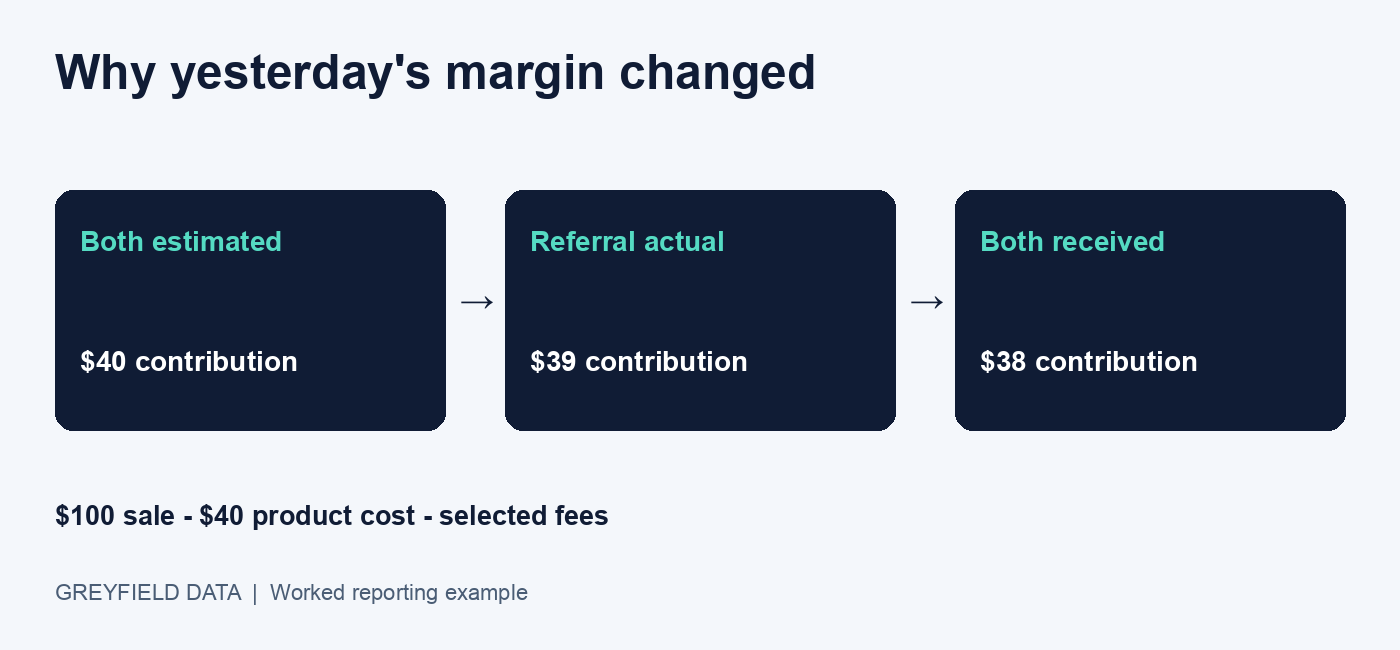
Consider an illustrative $100 merchandise sale with $40 product cost. For this example, the report initially estimates a $15 referral fee and a $5 fulfillment fee. It excludes advertising, storage, refunds and other expenses, so the result is a contribution measure for this stated scope, not total business profit.
| State | Referral fee used | Fulfillment fee used | Contribution |
|---|---|---|---|
| Both estimated | $15 estimated | $5 estimated | $40 |
| Referral event received | $16 actual | $5 estimated | $39 |
| Both components received | $16 actual | $6 actual | $38 |
The middle row matters. Replacing the whole $20 estimate with the first $16 actual charge would show $44, overstating contribution by the still-expected $5 fulfillment cost. Keeping the original $20 estimate and adding the $16 actual charge would show $24, understating it.
The intended rule is component by component: use the matched actual amount where available; otherwise use a valid estimate and label it. If neither is available, mark the cost unknown.
Keep a fee ledger, not one fee column
Preserve the source event or transaction identifier, account, currency, posting time, event type, fee component, amount and available order or item references. Keep the original sign and document any transformation to a positive expense amount.
Some costs won't have a clean order-level reference. Keep them at their native level until you have a stated allocation policy. An allocation is a reporting choice, not a source-provided order fee. Show allocated costs separately when readers need to understand the difference.
Estimate records need their own version and effective date. Otherwise, changing today's fee assumptions can silently rewrite yesterday's reported estimate. If you need to explain what a reader saw last week, retain snapshots or enough versioned inputs to reproduce that view.
The API and report selection is a separate problem. Our Amazon seller fee source guide covers financial events, settlements and fee-related reports. This article is about what to do with those records once they reach reporting.
Actual doesn't mean complete
An actual fee record proves that a particular event was received. It doesn't prove that every expected component has arrived, that no adjustment will follow, or that your ingestion captured every page.
Define completeness against the fee types your report promises to include. Track expected components, matched actual components, unresolved events and source freshness. A label such as “2 of 2 modeled components received” is more precise than “final profit.” It also makes the report's limited cost scope visible.
For the v0 financial-events endpoint, Amazon notes that responses can contain empty pages and instructs callers to continue until the pagination token is null. Stopping on the first empty page can leave a report incomplete even though the request succeeded. Check your connector's behavior against the API version it uses.
Reprocess late data without charging it twice
Choose a lookback and reconciliation schedule based on observed delays and the sources you're using. Recent orders need repeated checks, and older periods need a way to receive later adjustments. Don't hard-code a universal two-day close from an API availability warning.
Store source events with a stable identity and handle updates deliberately. A repeated extraction should not add the same expense again. A distinct adjustment should not disappear just because it references an order you've already loaded.
Before trusting the pipeline, replay a small batch. The same source events should leave the same total on a second load. Add a new adjustment and verify that only its intended effect appears. Review unmatched fees rather than forcing them onto a convenient order.
Explain the change on the dashboard
A useful margin view includes contribution, estimated fee value still in use, actual fee value, unknown-cost orders, the as-of timestamp and a bridge from the previous refresh. The bridge should separate new sales, actual-fee replacements, refunds and other adjustments.
Use Sigma metrics to reuse the agreed calculations across workbooks. Keep the detailed fee records available for investigation. Sigma can present the modeled states, but it doesn't determine whether a missing fee is zero or whether an estimate is valid.
Your daily channel scorecard can show an early operational view while a separate reconciliation tracks how that view matures. Label the coverage so someone comparing channels doesn't mistake better fee availability for worse business performance.
When a number changes, the report should explain the events behind the change. That's what makes an early margin estimate useful without pretending it is a completed account of every cost.
Related
How to avoid double-counting Shopify, Amazon and TikTok orders
Separate the sales channel from the fulfillment provider, link mirrored orders, and reconcile revenue before combining Shopify, Amazon and TikTok Shop reports.
GuideMap SKUs across Shopify, Amazon and TikTok without breaking margin
Build a product crosswalk with source IDs, dated mappings and explicit bundle quantities. Catch duplicate joins and missing costs before calculating product margin.
GuideShopify refund date vs order date: why monthly sales differ
A refund processed this month can belong to last month's order. Learn how event-date and order-cohort reporting differ and reconcile both without double counting.