Breaking into data? Join a consulting firm first (8 I'd look at)
Why a consulting firm is one of the best first jobs in data, the trade-offs versus an internal analyst role, and 8 data consultancies I'd look at joining.

Written by Linus Tse, founder of Greyfield Data
· 6 min read
On this page 8 sections
If you're trying to break into data, one of the best things you can do early in your career is join a consulting firm. These companies are almost always hiring and looking for new talent.
This advice comes from my own years in consulting. I now run Greyfield Data, an independent consultancy. If you're on the other side, a team looking for help rather than a job, here is what we do.
Key takeaways
- Consulting speeds up your learning through the sheer volume of reps. At my high point, I was building 50 to 60 dashboards in a year. I knew internal analysts who might work on two.
- You learn quickly, and just as importantly, you fail quickly, on new projects with new clients every few months.
- The trade-off: consultants don't always go as deep or live with the long-term consequences of what they build. Internal analysts often understand one business far better.
- If I were starting out, these are 8 firms I'd look at: InterWorks, Massive Insights, phData, Aimpoint Digital, Boston Data Company, Slalom, Squadron Data, and CapTech.
- The Big Four have data and analytics practices too, but if I got to choose, I'd lean toward a specialized data consultancy, where data is the core business.
Why is consulting a good way to break into data?
Because you get far more reps than almost anywhere else, and reps are how you get good.
At my high point, I was building 50 to 60 dashboards in a year. I knew internal analysts who might work on two. It wasn't because they were less capable. Their job gave them depth in one company.
In consulting, you get the chance to not only learn quickly, but just as importantly, fail quickly.
What did consulting actually teach me?
- Range. Every few months, I would get the chance to tackle new projects with new clients and learn all about their businesses.
- What works in the real world. I got to see what tools, software, and architectural decisions actually worked, and what separated the good data teams from the best.
- Responsibility early. I got the opportunity to lead initiatives that were worth hundreds of thousands of dollars and get access to executives I wouldn't otherwise have gotten.
- Getting up to speed fast. I learned how to step into new situations and deliver value quickly.
What are the trade-offs of starting in consulting?
The trade-off is that consultants don't always get to go as deep or live with the long-term consequences of what they build. Internal analysts often understand one business far better.
But if you're early in your career, I don't think there are many places where you can learn that much, that quickly.
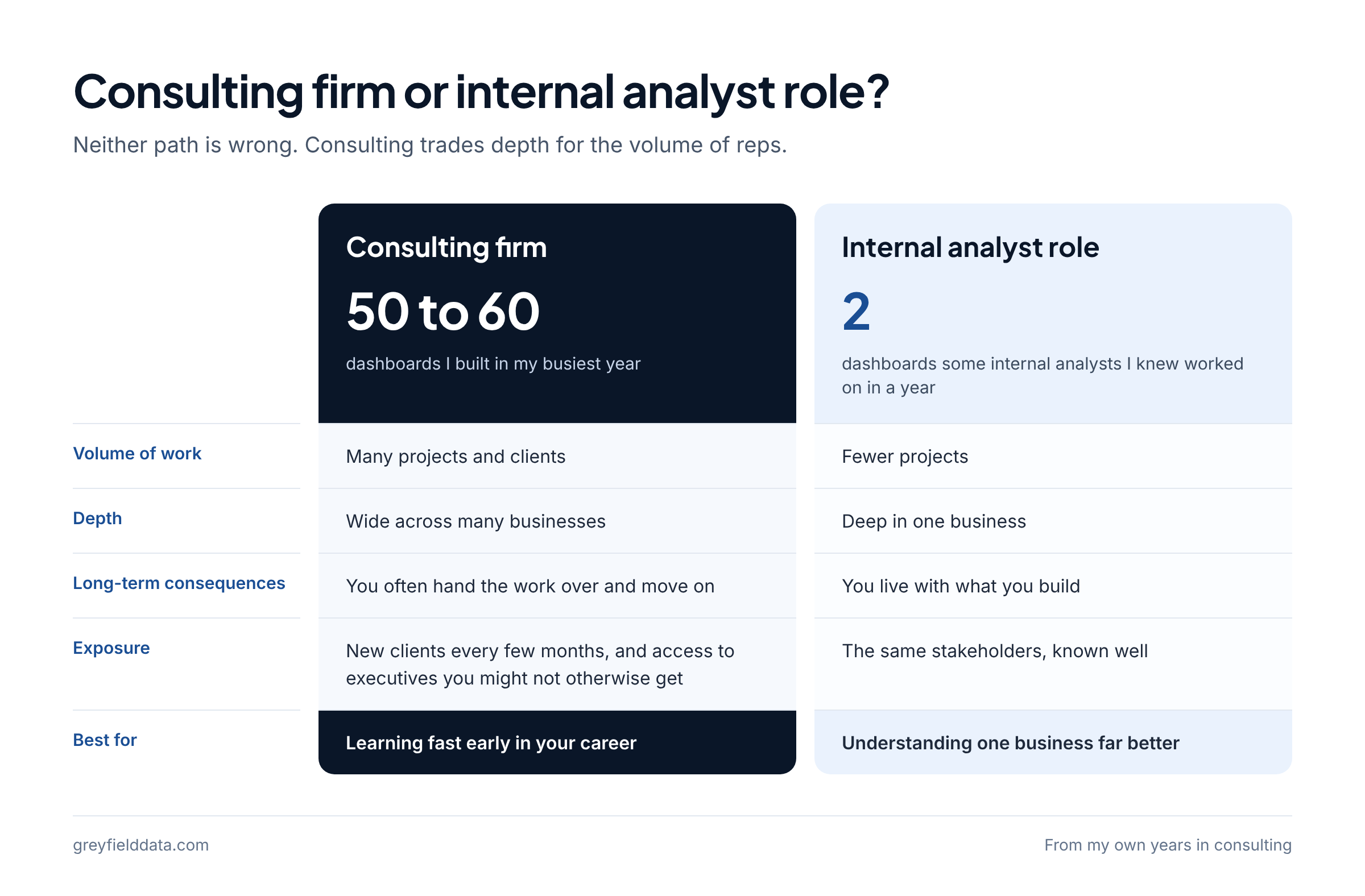
Here is how the two paths compare side by side.
| Consulting firm | Internal analyst role | |
|---|---|---|
| Volume of work | Many projects and clients; I built 50 to 60 dashboards in my busiest year | Fewer projects; some analysts I knew worked on two in a year |
| Depth | Wide across many businesses | Deep in one business |
| Long-term consequences | You often hand the work over and move on | You live with what you build |
| Exposure | New clients every few months, and access to executives you might not otherwise get | The same stakeholders, known well |
| Best for | Learning fast early in your career | Understanding one business far better |
Neither path is wrong. I think more people trying to break into data need to know this one exists.
Which consulting firms would I look at joining?
If I were starting my career in data analytics or engineering, these are 8 consulting firms I'd look at. Each line below comes from the firm's own site, checked in November 2026, and links to its careers or about page.
| # | Firm | What its own site says | Where to look |
|---|---|---|---|
| 1 | InterWorks | Founded in 1996 in Stillwater, Oklahoma; offers AI, data and analytics, and IT and infrastructure services. | InterWorks careers |
| 2 | Massive Insights | Helps companies "unlock the full potential" of their data through embedded experts, managed outcomes, or tailored solutions. | massiveinsights.com |
| 3 | phData | Calls itself a remote-first company, with a professional development allowance and certification bonuses. | phData careers |
| 4 | Aimpoint Digital | An analytics, data engineering, operations research, and AI advisory and solution engineering firm, with remote, hybrid, or office work. | Aimpoint Digital careers |
| 5 | Boston Data Company | A data consulting firm covering data architecture, reporting, and analytics. | bostondata.co |
| 6 | Slalom | Describes itself as "fiercely human consulting", with services across strategy, data, AI, and cloud. | Slalom careers |
| 7 | Squadron Data | Headquartered in Kansas City with an office in Toronto, and "always looking for top Snowflake talent." | Squadron Data careers |
| 8 | CapTech | Services include AI, data and analytics, management consulting, and systems integration. | CapTech careers |
Several of these firms also show up on my lists for buyers. If you want to see how they position their Snowflake and Sigma work, read the best Snowflake consulting firms and the best Sigma consulting firms.
What about the Big Four?
The Big Four also have data and analytics practices: Deloitte, PwC, EY, and KPMG.
But if I got to choose, I'd personally lean toward a specialized data consultancy, where data is the core business.
How do you pick between these firms?
Pick the one whose work you'd want to be doing every day for the next few years. A few ways to find out:
- Read the careers page and the service pages together. The careers page tells you how they hire. The service pages tell you what you'd actually build.
- Look at the tools they partner with. If you want to work in Snowflake, Sigma, or Tableau, pick a firm that does a lot of that work.
- Ask about the reps. In an interview, ask how many projects a new analyst works on in their first year, and how often they switch clients.
- Ask who you'd learn from. The volume of reps matters most when someone senior reviews your work.
What to do next
If you're breaking into data, pick two or three firms from the list and read their service pages this week. Then apply where the work looks like what you want to learn.
If you're a team hiring help rather than a job seeker, here is what we do: Snowflake consulting and Sigma consulting. You can also book a call with me.
Frequently asked questions
Is consulting a good first job in data?
I think it's one of the best. You get the volume of reps that speeds up learning, new clients every few months, and early responsibility. The trade-off is less depth in any one business.
Are data consulting firms hiring entry-level people?
Consulting firms are almost always hiring and looking for new talent. Check each firm's careers page for current openings.
Is it better to join a Big Four firm or a specialized data consultancy?
The Big Four have data and analytics practices, and they're a real option. If I got to choose, I'd lean toward a specialized data consultancy, where data is the core business.
What do internal analysts learn that consultants don't?
Depth. Internal analysts often understand one business far better, and they live with the long-term consequences of what they build.
Linus Tse
Founder of Greyfield Data. Built 400+ dashboards. Certified in Sigma, Snowflake, Tableau, and Power BI.
About Linus